
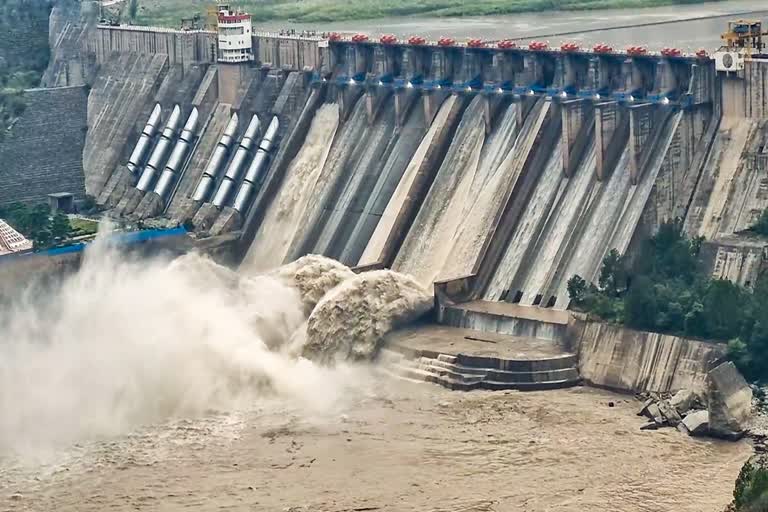
There is an attractive simplicity to Jammu and Kashmir’s latest energy ambition: build more dams, generate more electricity and buy less power from outside.
By December 2035, the administration wants to raise installed hydropower capacity from 3,540.15 MW to 10,969.65 MW – more than tripling what it has today. The plan is bold, long-term and, on paper, transformative.
But a decade-long hydropower programme should not be judged only by the number of megawatts on a government presentation. The harder question is whether Jammu and Kashmir can turn its enormous rivers into reliable economic power without allowing delays, cost overruns and environmental pressures to undermine the promise.
The stakes are unusually high.
J&K has identified 14,635 MW of hydropower potential, yet only about 24.21 percent has been harnessed. The Chenab basin alone accounts for 11,283 MW of identified potential, compared with 3,084 MW in the Jhelum basin and 500 MW in the Ravi basin.
The arithmetic makes hydropower look like an obvious answer to the region’s electricity needs.
The reality is more complicated.
Hydropower projects are not ordinary infrastructure. They require years of excavation, tunnelling, construction and testing, often in some of the most difficult terrain in the country. They demand enormous capital and coordination among government departments, power corporations, central agencies and local administrations.
The government knows this. At a meeting on Friday chaired by Chief Secretary Atal Dulloo, officials reviewed construction schedules, financial progress and bottlenecks across major projects. The emphasis was on coordination and regular monitoring.
That emphasis is justified because J&K’s hydropower story has long been less about the absence of potential than about the difficulty of converting potential into electricity.
Consider the roadmap.
The first major additions are expected from Pakal Dul, Kiru and Karnah, together adding 1636 MW and taking installed capacity to 5176.15 MW. Parnai would push the total to 5213.65 MW by the end of 2027.
In 2028, the planned commissioning of Kwar and Ratle would add another 1390 MW, taking cumulative capacity to 6630.65 MW. Dulhasti Stage-II and Uri-I Stage-II are expected to contribute another 500 MW by the end of 2029.
Then comes the largest leap: Kirthai-II, Kirthai-I and Sawalkote are projected to take the total to nearly 11,000 MW by 2035.
These are impressive numbers. They are also a reminder that the government’s greatest challenge is now execution.
Some projects are already substantially advanced. Pakal Dul is reported to be 85 percent physically complete, with units 3 and 4 scheduled for testing and commissioning in March 2027, followed by units 1 and 2 in May and June. Kiru has reached 88.75 percent physical progress and is similarly targeted for commissioning in March 2027.
Karnah is 93 percent complete. Parnai has reached 72.5 percent physical progress, with most of its head-race tunnel excavation completed.
But other projects demonstrate how long the road can be. Kwar has recorded 37.82 percent physical progress, while Ratle stands at 31.53 percent. Ratle’s underground powerhouse excavation has been completed, with full commissioning targeted for November 2028.
The lesson is obvious: announcing capacity is easy; delivering electrons to the grid is not.
There is also a danger in treating hydropower as synonymous with energy self-reliance.
Electricity demand does not stand still. Industry, tourism, households, transport, digital infrastructure and new commercial activity will all consume more power as the economy expands. A larger generation fleet can reduce dependence on external supplies, but it will not eliminate the need for a robust transmission network, storage, grid management and other sources of electricity.
Hydropower itself is also not simply a number on a balance sheet. Rivers are ecological systems, and large infrastructure projects can alter landscapes and affect communities. In a region where mountains, valleys and river systems are central to both livelihoods and tourism, the costs and benefits of each project need to be evaluated honestly.
That means the debate should move beyond a simplistic choice between development and environmental protection.
The better question is whether J&K can build the infrastructure it needs while demanding the highest standards of environmental assessment, rehabilitation and local benefit.
If the government succeeds, the payoff could extend well beyond electricity generation.
Cheap and reliable power can make factories more competitive, reduce operating costs for businesses, support tourism infrastructure and improve the economics of digital and industrial investment. It can also provide the foundation for new forms of economic activity that are difficult to sustain when electricity is expensive or uncertain.
But there is a second dividend that may matter just as much: confidence.
For an economy trying to attract investment, the ability to say that electricity supply is becoming more secure is itself an asset.
That is why the 2035 target deserves serious attention. It is ambitious enough to change the region’s economic trajectory.
Yet ambition needs discipline.
Every delayed tunnel, unresolved land issue, procurement problem or cost escalation pushes the promise further into the future. A megawatt that exists only in a project report cannot power a hotel, a factory or a home.
The administration’s proposed answer – tighter coordination, regular monitoring and faster resolution of bottlenecks – is therefore less glamorous than the 10,969.65 MW headline, but ultimately more important.
Jammu and Kashmir has the rivers.
It has the identified potential.
It now needs something harder to manufacture: the institutional capacity to deliver.
By 2035, the real measure of success will not be how impressive the target looked when it was announced. It will be how much electricity was actually generated, how reliably it reached consumers, how much the projects cost, and whether the communities and landscapes that carried the burden of development shared in its rewards.
The mountain rivers can provide the power.
The government must prove it can provide the execution.
About the Author
Syed Sameer Ahmad Nazki is a filmmaker skilled in editing and videography, with an interest in visual storytelling and sports.