
Kashmir Impulse Desk
Srinagar, Sep 03
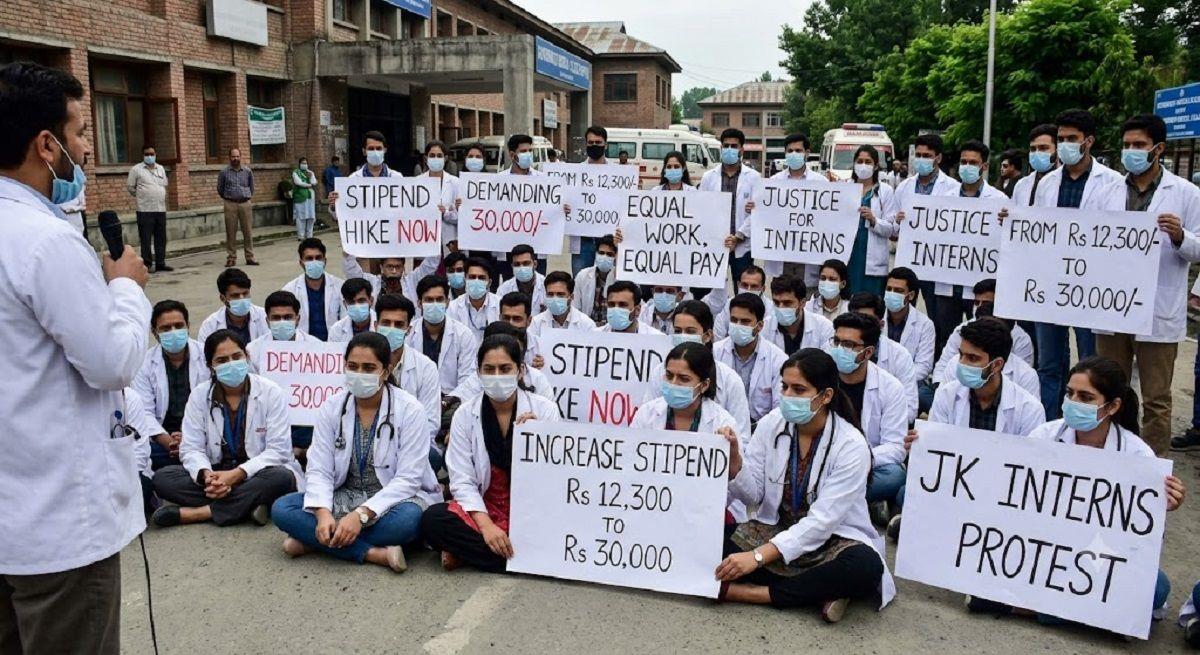
Medical interns across Jammu and Kashmir entered the fifth day of a strike on Thursday over a long-pending demand for higher stipends, leaving hospitals dependent on resident doctors and senior faculty to fill gaps in emergency and ward services.
MBBS and BDS interns stopped reporting for duty on August 31, according to officials and representatives of the protesting interns.
Interns are part of the frontline workforce in government medical institutions, including emergency departments, wards and outpatient services, and their absence has placed additional pressure on resident doctors and senior medical staff, hospital officials said.
The strike has affected services at Government Medical College Srinagar, GMC Jammu, SKIMS Bemina, GMC Anantnag, GMC Baramulla, GMC Handwara, and other institutions, the officials said.
There is no consolidated official figure for the number of MBBS and BDS interns currently undergoing the mandatory one-year Compulsory Rotating Medical Internship in Jammu and Kashmir.
The scale of the workforce can be gauged from the 1100 MBBS seats available in J&K in the 2020-21 session, along with BDS graduates undergoing internship.
Interns say they receive Rs 12,300 a month, based on a daily rate of around Rs 400, and that the amount has remained unchanged for several years.
They have compared the stipend with payments in other states, citing monthly stipends of Rs 44,319 in Odisha, Rs 43,099 in West Bengal, and Rs 35,000 in Assam.
A committee constituted in J&K in 2023 recommended increasing the stipend to about Rs 25,000.
The figure was subsequently referred to as Rs 26,300 during discussions in the J&K Assembly in 2026.
Interns say no final government order has followed the recommendation and that the proposal remains under consideration.
Health Minister Sakina Itoo has described the interns’ demand as justified while urging them not to strike, saying the withdrawal of services could affect patient care.
The National Medical Commission told the Union Health Ministry in February that its Compulsory Rotating Medical Internship Regulations, 2021, provide for payment of a stipend to interns.
The amount of the stipend, however, is determined by the respective state or union territory authorities, taking into account their financial capacity and budgetary provisions, the commission said.
In June, the NMC told the Supreme Court that non-payment of stipends persisted at seven of 756 medical colleges across the country.
The Supreme Court has separately considered petitions relating to intern stipends. In one order, it directed that interns at the Army College of Medical Sciences be paid Rs 25,000 a month with effect from October 2023.
In October 2025, the court criticised the NMC over the delay in resolving the stipend issue, which had remained before it for an extended period.
The matter remains before the court, with a nodal counsel appointed in June 2026 to compile a state-wise compliance chart.
Under the 2021 CRMI regulations, interns work under supervision during their internship and are not permitted to practise independently.
They assist in outpatient departments, wards, emergency units and other hospital services.
Interns say their duties can include extended shifts, including overnight and 24-hour postings, as well as compulsory rural assignments.
The J&K government has said the proposal to revise the stipend is under process.
The continuing strike has brought renewed attention to the gap between the workload assigned to interns and the stipend paid to them in Jammu and Kashmir.