
Kashmir Impulse Desk
Srinagar, Sep 03
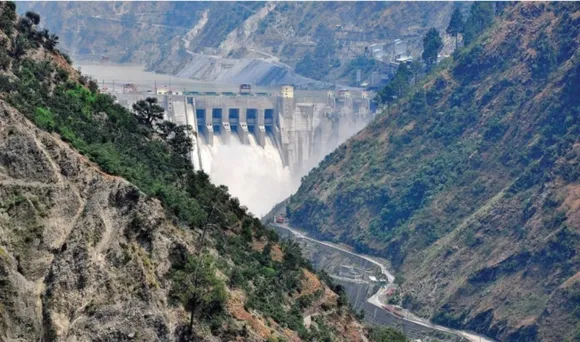
A 450-megawatt stage of Jammu and Kashmir’s 900-MW Baglihar hydropower project has remained out of service for 18 days after a desilting operation led to heavy silt accumulation around its gates, officials familiar with the matter said.
The shutdown has cut the project’s available generation capacity by half, leaving its second 450-MW stage operational.
Desilting and silt-flushing operations at Baglihar, built on the Chenab River in Ramban district, began on August 18.
Stage-II was restored on August 22, but Stage-I has not resumed generation because of the accumulated silt, the officials said.
The prolonged outage has added to power supply pressures in Jammu and Kashmir, where peak summer demand is around 2500 MW, prompting the administration to arrange additional electricity from outside J&K.
Officials involved in power management said about 450 MW of additional power was being purchased externally to offset the loss from Baglihar.
The outage has also contributed to unscheduled power curtailments in parts of J&K, they said.
Officials familiar with the restoration work said difficulties arose during the silt-flushing operation after a gate was opened and large quantities of silt accumulated around the gates and adjoining parts of the system.
One official, speaking on condition of anonymity, attributed the prolonged outage to shortcomings in the handling of the desilting operation.
“If desilting had to be undertaken, it should have been done in a proper and planned manner,” the official said.
A senior official associated with the restoration work said the quantity of accumulated silt had made the operation technically difficult and potentially hazardous.
“Our gates are five metres high, but the silt is around eight metres high,” the official said.
The official said the silt had accumulated to about three metres above the height of the gates, making removal more difficult.
He said engineers were proceeding cautiously because of the risks involved and because water levels in the Chenab remained high.
“It is a very risky job. We have to take precautions,” he said.
The official said the problem was not confined to a single gate and had affected a wider portion of the flushing system.
“Work is going on, but I think it will take more than 15 days,” he said, without giving a firm date for restoration.
Baglihar has an installed capacity of 900 MW divided equally between Stage-I and Stage-II. Each stage consists of three 150-MW Francis turbine generating units.
Stage-I was commissioned in 2008-09 and Stage-II in 2015-16.
The loss of 450 MW from Baglihar, combined with outages at other hydropower projects during the desilting period, has increased the gap between electricity demand and available supply, officials said.
The power department has consequently had to make additional purchases to manage demand, increasing the cost of meeting the shortfall.
Separately, sources have raised questions about the quality and shelf life of paint reportedly used in the spiral casing of a Stage-II generating unit.
The spiral casing surrounds the turbine and distributes water around the turbine runner. Protective coatings are used on the component to guard against corrosion and deterioration.
Sources said the reported use of allegedly expired or unsuitable material warranted technical examination.