
Kashmir’s honey industry is expanding rapidly, but behind the growing production figures lies a challenge for consumers and beekeepers alike: establishing whether honey sold under the region’s name is genuine and whether its claimed origin can be verified.
Jammu and Kashmir produced 3895 metric tonnes of honey in 2025-26, up from 1460 metric tonnes in the previous financial year, according to figures provided for the region. The reported increase of about 167 percent needs clarification, as a separate claim circulated alongside the figures put the rise at 77 percent.
The growth points to the potential of an industry built around Kashmir’s floral diversity. But concerns about adulteration, traceability and quality testing threaten to undermine confidence in a product whose market value depends partly on its reputation.
A key complication is that honey sold in Kashmir is not necessarily produced there, while honey made by a Kashmiri beekeeper may not come entirely from the Valley’s flowers.
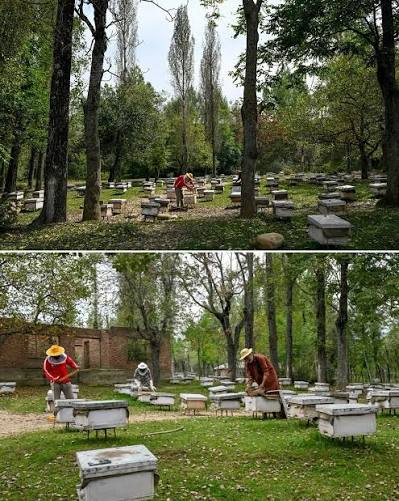
Nearly 90 percent of Kashmir’s registered beekeepers are reported to move their colonies to warmer parts of India during winter, following flowering cycles and seeking better nectar supplies. The practice can significantly improve yields. One study found migratory beekeeping could produce an additional 50 to 60 kg of honey per colony annually compared with stationary beekeeping.
But moving colonies across regions complicates claims about floral and geographical origin. Honey’s taste, aroma and other characteristics depend partly on the plants from which bees collect nectar.
Neither migratory production nor processing outside Kashmir automatically makes honey inferior or adulterated. The problem arises when labels claim a particular floral source or geographical origin that cannot be substantiated.
For consumers, packaging is often the only immediate guide. Without credible information about the apiary, harvest period, floral source and processing, distinguishing a premium product from one relying mainly on the Kashmir name can be difficult.
Beekeepers say erratic rainfall and temperature fluctuations have affected acacia flowering in Kashmir. Some have reported losses of up to 90 percent, although these accounts do not establish the extent of damage across the industry.
Poor flowering can reduce supplies of sought-after varieties just as demand remains strong, creating an incentive for misleading claims about origin or composition. A shortage, however, is not evidence of adulteration by itself.
The uncertainty adds pressure on genuine producers, who must contend with unpredictable yields while competing in a market where consumers may struggle to distinguish documented products from those making unsupported claims.
Historical estimates from the Jammu and Kashmir Entrepreneurship Development Institute put the regional honey market at about 770 tonnes, with around 75 tonnes processed locally at the time of the study. The figures offer an indication of earlier processing capacity but cannot establish the market’s current size.
Production, local consumption, imports and shipments to other regions measure different things. Updated data tracking these flows would help establish how much honey is sold locally and how much reaches consumers under Kashmir-specific labels.
Parliamentary figures from the Union Agriculture Ministry list 2,097 registered beekeeping entities in Jammu and Kashmir and more than 217,268 bee colonies recorded on the government’s Madhu Kranti portal.
These figures indicate a substantial base of registered activity, but they do not reveal how much honey each beekeeper produces, where colonies are located during flowering seasons or whether retail labels accurately reflect the product’s source.
Authorities have taken steps to expand honey-testing and processing infrastructure. Facilities have been established in Pulwama, Bandipora and Jammu, while Sher-e-Kashmir University of Agricultural Sciences and Technology of Kashmir has received a grant of Rs 4 crore for three additional testing laboratories in Pulwama, Kupwara and Bandipora.
The expansion could help producers establish authenticity and give regulators greater capacity to investigate suspicious products. Its effectiveness, however, will depend on laboratory equipment, testing methods, inspection frequency and enforcement.
Earlier this year, authorities seized honey made from sugar syrup at multiple locations in Srinagar. The seizures highlighted the risk of products being sold as honey despite not meeting the basic expectation that the jar contains genuine honey.
They do not establish how widespread adulteration is across Kashmir. In the absence of a comprehensive regional market survey, consumers have evidence that adulterated products exist but no reliable estimate of their prevalence.
The challenge extends beyond Kashmir. A national honey survey published in 2020 found that 10 of the 13 brands examined failed all the purity tests used in the investigation. It also reported that samples deliberately spiked with up to 50 percent syrup could pass Indian tests.
The findings should not be treated as proof that most honey sold across India or Kashmir is adulterated. The limited sample does not establish prevalence across the wider market. But the results raised questions about whether conventional testing can detect increasingly sophisticated adulteration.
Honey has a complex natural composition, and some adulteration methods can imitate measurable characteristics of genuine honey. Depending on the syrup and technique used, routine tests may miss problems that specialised analytical methods could identify.
A quality certificate is therefore only as reliable as the methods employed, the sample tested and the integrity of the testing process. A result for one batch cannot automatically establish the authenticity of every batch sold under the same brand.
Testing must be supported by representative sampling, trained personnel and regular inspections across brands, shops and distribution channels. Authorities also need to publish results and act against violations.
Traceability is equally important. Records linking beekeepers and colony movements to harvest locations, processing facilities and packaging could help establish the history of a product. They would also allow regulators to investigate misleading labels and trace suspect batches.
A regional market survey could provide a baseline for measuring the scale of adulteration and assessing whether enforcement measures are working. It should distinguish between products with adulterated composition and those making inaccurate claims about floral or geographical origin.
That distinction would help prevent the actions of individual sellers from casting suspicion over the entire industry.
The stakes extend beyond consumer confidence. Honey supports beekeepers and related businesses, while premium prices partly depend on the credibility of Kashmir’s name. Producers who invest in careful harvesting and processing may struggle to compete if buyers cannot distinguish their products from cheaper imitations.
Jammu and Kashmir’s expanding production and testing infrastructure offer an opportunity to strengthen the industry. But rising output and new laboratories alone cannot guarantee authenticity without reliable records, independent testing and consistent oversight.
As autumn brings honey back into the spotlight, the central question is not simply how much the region produces, but how confidently consumers can trust what they buy.
Until the contents of the jar can be matched to verifiable claims about composition and origin, Kashmir’s honey will carry both a premium and a question mark.