
In Jammu and Kashmir, history is rarely confined to museums. It sits along roads and riverbanks, rises from the ruins of ancient settlements and survives in temples, mosques, forts and palaces that have endured centuries of political change, natural decay and, at times, neglect.
Now, figures placed before Parliament offer a measure of what it costs to keep that past standing.
The Archaeological Survey of India spent Rs 26.59 crore on conservation, preservation and environmental development of centrally protected monuments in Jammu and Kashmir over the five years from 2021-22 through 2025-26, according to data provided by the Ministry of Culture in the Rajya Sabha.
The spending did not follow a straight line. It began at Rs 2.55 crore in 2021-22, climbed sharply in subsequent years and reached a high of Rs 7.17 crore in 2023-24, before settling at Rs 5.95 crore in 2025-26.
The numbers are modest when set against the scale of the landscape they are intended to protect. Yet they illuminate a larger question confronting the Himalayan region: how much does a government spend to preserve structures whose value is measured not only in rupees, but in memory, identity and the stories they allow successive generations to inherit?
The parliamentary disclosure came in response to a question concerning the conservation and promotion of historical forts. The ministry said that conservation and maintenance work at centrally protected monuments is undertaken according to the condition and requirements of individual sites and is subject to the availability of resources.
That formulation captures an essential reality of archaeological conservation. A monument does not deteriorate according to a government budget cycle. Stone absorbs moisture whether funds have been released or not. Timber weakens. Plaster peels. Vegetation finds cracks in masonry. Rain and snow work slowly on roofs and foundations. A site that appears stable to a visitor can require years of specialised intervention.
For the ASI, therefore, conservation is described as a “continuous process,” with priorities determined by the condition and requirements of protected sites.
The government said that no centrally protected monument under ASI protection has been identified as endangered. It also said that all centrally protected monuments are in a good state of preservation.
The claim is significant in a region where monuments are exposed to an unusually demanding combination of weather, terrain and historical pressures. Jammu and Kashmir contains traces of several civilisations and religious traditions, and its built heritage reflects the movement of dynasties, faiths, craftsmen and political power across the mountains.
The monuments are not merely remnants of a distant past. Some remain part of living cultural landscapes.
The Shankaracharya Temple in Srinagar, for example, stands on a hill above the city, its physical presence inseparable from the modern image of the Kashmir Valley. The Ministry of Culture has separately approved a Rs 1.21 crore project under the National Culture Fund for 2026-27 to develop amenities at the temple.
Such projects suggest that the preservation of heritage is increasingly being considered alongside the practical question of how people encounter it. A monument can survive physically and still remain inaccessible, poorly interpreted or disconnected from the public.
That is where environmental development and visitor amenities enter the conservation equation.
Across Jammu and Kashmir, the ASI’s five-year expenditure accounted for about 1.5 percent of its national conservation spending. The comparison puts the regional figure into perspective.
Nationally, the ASI spent Rs 1,794.74 crore on conservation, preservation and environmental development between 2021-22 and 2025-26. Annual spending increased from Rs 269.57 crore in 2021-22 to Rs 376.67 crore in 2025-26. The national peak, like the Jammu and Kashmir peak, came in 2023-24, when expenditure reached Rs 443.53 crore.
The ASI currently has responsibility for 3688 centrally protected monuments and sites across India.
Against that national canvas, Jammu and Kashmir’s Rs 26.59 crore may look like a small allocation. But percentages can obscure geography.
Conservation in the Himalayan region is not simply a matter of allocating money to a structure. It often involves access, climate, specialised materials, engineering constraints and the challenge of protecting a site without erasing the evidence of its age.
The distinction between restoration and preservation is important. A monument is not ordinarily being rebuilt into something new. The objective is to slow deterioration, stabilise what remains and retain as much of the historic fabric as possible.
That can make conservation an almost invisible form of public expenditure.
A newly built road announces its cost. A restored wall often does not.
The work may consist of repairing masonry, addressing drainage, removing vegetation, stabilising structural elements, protecting architectural details or improving the immediate environment. To the visitor, the result can appear uneventful: a building that simply continues to exist.
But continuity is precisely the point.
Jammu and Kashmir’s heritage is particularly revealing in this regard because the region’s historical narrative cannot easily be reduced to a single period or tradition. Its archaeological and architectural record encompasses ancient religious sites, medieval structures and monuments associated with later political and cultural transformations.
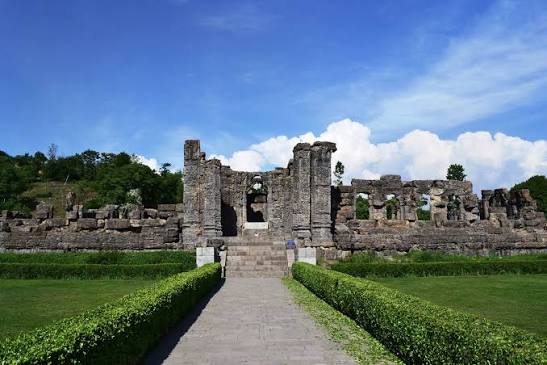
The remains of the ancient Awantipora temples, for instance, offer a window into Kashmir’s early medieval architectural tradition. Their weathered stone blocks, open courtyards, and surviving sculptural elements are fragments of a political and cultural world that disappeared centuries ago.
Other protected sites carry different histories.
Forts and defensive structures recall periods when control over routes, towns and strategic locations was central to political power. Religious monuments preserve traditions that have outlived the rulers who built or patronised them. Palaces and civic structures record more recent layers of Kashmir’s history.
Together, they form something larger than an inventory of buildings.
They constitute a physical archive. And archives require maintenance.
The parliamentary data also provides an intriguing comparison with Ladakh, which is now listed separately from Jammu and Kashmir in the ASI expenditure statement.
Ladakh received Rs 12.70 crore for conservation-related works over the same five-year period. Its annual expenditure rose dramatically, from Rs 43 lakh in 2021-22 to Rs 4.65 crore in 2025-26.
Taken together, ASI conservation-related expenditure in Jammu and Kashmir and Ladakh amounted to Rs 39.29 crore during the five years.
The contrasting spending patterns reflect, at least in part, the different conservation landscapes of the two Himalayan regions.
In Ladakh, monasteries, palaces, fortifications and other historic structures face an arid but severe environment marked by extreme temperatures, intense sunlight, freeze-thaw cycles and limited local resources. In Kashmir, heavy precipitation, humidity, snowfall and vegetation create a different set of problems.
The figures, however, do not by themselves reveal how much was spent on each monument or what specific work was carried out at individual sites. Nor do they establish whether expenditure in one year represents a sustained conservation programme or a concentrated intervention at particular monuments.
That distinction matters.
A five-year aggregate can show the broad scale of government spending. It cannot tell the full story of a monument.
The ASI’s own explanation reflects this site-specific approach: conservation, maintenance and development works are undertaken according to individual requirements and available resources.
For visitors, the most visible sign of conservation may be the absence of obvious change.
A monument remains where it has always stood.
That apparent stillness is deceptive. Behind it is a system of surveys, engineering assessments, archaeological judgment, procurement, skilled labour and repeated maintenance. The goal is not to make history look new, but to prevent it from disappearing.
There is also a growing economic dimension to the preservation debate.
Historic monuments can serve as destinations for domestic and international visitors, contribute to local economies and create opportunities for guides, artisans, transport operators and small businesses. But tourism can itself become a pressure on fragile sites if visitor numbers rise without adequate management.
The challenge is therefore double-sided: protect monuments from neglect while protecting them from the consequences of their popularity.
For Jammu and Kashmir, where tourism remains an important part of the region’s economy and public image, the balance is particularly consequential.
The government’s declaration that all centrally protected monuments are in a good state of preservation offers reassurance. But preservation is not a final condition. It is a continuing obligation.
The Rs 26.59 crore spent over five years represents one measure of that obligation.
The more revealing measure may be what happens next.
A monument that has survived a thousand years does not necessarily need a spectacular intervention. It needs the kind of patient attention that can appear ordinary in a government ledger but prove extraordinary over generations.
In Kashmir, where political histories have repeatedly changed, and landscapes have absorbed successive cultures, the physical remains of the past have a way of becoming witnesses.
They do not speak. But they remain.
And the money spent to keep them standing is, in the end, an investment not simply in old buildings but in the possibility that future generations will still be able to see, touch, and question the history that came before them.
About the Author
Amir Yaseen is a Srinagar-based journalist interested in Kashmir, policy, progress, and the human stories shaping everyday life.