
The Jammu and Kashmir government has been given three weeks to explain why it failed for almost a year to respond to a central government directive on conservation plans for three wetland reserves, in a judicial intervention that has brought fresh scrutiny to the management of some of the region’s most important aquatic ecosystems.
A division bench of the High Court of Jammu and Kashmir and Ladakh, comprising Acting Chief Justice Sanjeev Kumar and Justice Muhammad Yousuf Wani, also questioned why other Ramsar Sites in the Union territory were left out of the management-planning exercise.
The questions came during the hearing of a Public Interest Litigation concerning environmental protection, placing the administration’s handling of wetland conservation under direct judicial examination.
At the heart of the matter are Integrated Management Plans submitted by the Jammu and Kashmir government under the Centre’s National Plan for Conservation of Aquatic Ecosystems, or NPCA, a Centrally Sponsored Scheme intended to support the protection and restoration of wetlands and other aquatic ecosystems.
According to the Ministry of Environment, Forest and Climate Change, the government submitted the plans on Aug. 25, 2025, covering the five years from 2025-26 through 2029-30. The proposals sought consideration and administrative approval for three wetland reserves.
But the ministry found that the submissions did not meet the requirements of the NPCA scheme.
On September 10, 2025, it wrote to the Jammu and Kashmir government asking it to prepare and submit separate Integrated Management Plans for each wetland in accordance with the NPCA Guidelines, 2024.
The ministry told the High Court that no response had been received from the administration to that communication.
That silence became the central concern of the court.
The bench directed the government to file an affidavit explaining why it had not responded to the ministry’s September 2025 letter and why the three management plans had not been resubmitted in the format required under the central guidelines.
The court went further, asking the government to explain why other Ramsar Sites in Jammu and Kashmir had not been included in the Integrated Management Plans.
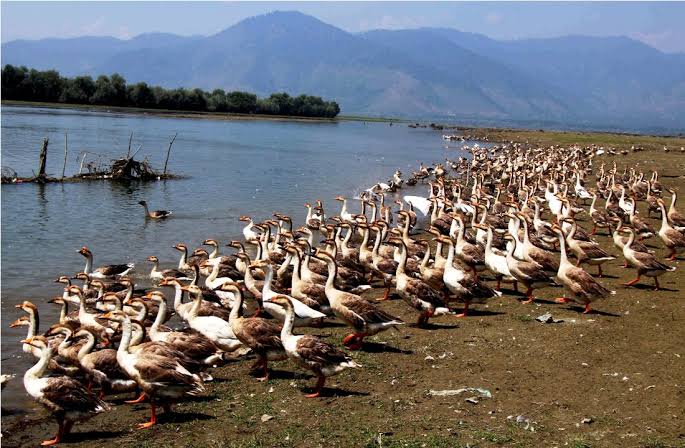
The question is significant in a region where wetlands are not simply patches of water and marshland but part of a larger ecological system involving migratory birds, freshwater resources, agriculture and communities whose lives are intertwined with aquatic landscapes.
Ramsar designation carries international recognition of wetlands considered to be of importance under the Ramsar Convention, an intergovernmental treaty devoted to their conservation and wise use. Jammu and Kashmir has several such sites, including wetlands that serve as important habitats for migratory birds and other wildlife.
The court’s intervention therefore touches on a broader issue than an exchange of official letters: whether conservation planning is keeping pace with the ecological importance of the sites under protection.
The proceedings also come as the future of the NPCA scheme itself remains uncertain.
The Environment Ministry informed the court that the programme, which was initially valid until March 31, 2026, has received an interim extension until Sept. 30, 2026.
A proposal to continue the programme for the 2026-31 financial cycle is currently before the competent authority, the ministry said.
That timetable gives the dispute an added urgency. With the existing extension due to expire in weeks, delays in preparing and approving management plans could affect the ability of wetland authorities to secure support under the scheme, even as the broader programme awaits a decision on its continuation.
For the Jammu and Kashmir administration, the court’s order now places the burden of explanation squarely before it.
The government must account for the nearly yearlong gap between the ministry’s request and the next formal step, while also addressing why separate plans for the three wetlands were not submitted as required.
It must additionally explain the apparent omission of other Ramsar Sites from the planning exercise.
The court has allowed three weeks for the affidavit.
The proceedings illustrate a recurring challenge in environmental governance: the distance between recognising an ecosystem as worthy of protection and putting in place the detailed administrative machinery needed to protect it.
A management plan is more than a formal document. It is intended to establish the priorities, interventions and institutional responsibilities through which a protected ecosystem is managed. When such plans are delayed, rejected as non-compliant or left incomplete, conservation efforts can become dependent on administrative follow-through that is often less visible than the ecological crises it is meant to address.
In Jammu and Kashmir, that administrative responsibility carries particular weight.
The region’s wetlands occupy an important place in its natural landscape and are exposed to pressures that can arise from development, encroachment, pollution, changing land use and other environmental stresses. Their health also has implications beyond their boundaries, affecting biodiversity and the wider ecological balance.
The High Court has not, in the present proceedings, determined whether the government’s conservation efforts have failed or whether the exclusion of other Ramsar Sites amounts to a violation of any particular obligation.
Instead, it has demanded an account of the decision-making process – why a central communication went unanswered, why revised plans were not submitted, and why other internationally recognised wetlands were not included.
Those questions now await the government’s response.
For the court, the three-week deadline turns what had been an administrative delay into a matter requiring a formal explanation under oath.
And for Jammu and Kashmir’s wetlands, the significance of the proceedings may ultimately extend beyond the paperwork. The case has put the machinery of conservation itself under scrutiny, at a moment when the future of the central programme that supports it is also being decided.
About the Author
Bilquees Punjabi holds a Master’s in Computer Applications and explores the evolving relationship between technology, digital media, audiences, and journalism.