
For hundreds of young players, hockey is no longer just a school sport but a chance to imagine bigger futures on newly built turfs across Jammu and Kashmir. Syed Samir Ahmad Nazki reports.
The match had ended, but few of the players wanted to leave.
Under the summer sun at Srinagar’s historic Polo Ground, groups of schoolchildren lingered around the synthetic turf long after the final whistle of the ALFA Hockey Inter-School Tournament 2026. Some posed for photographs with teammates. Others replayed moments from the match in animated conversation. A few simply stood quietly on the sidelines, staring at the field.
For many of them, this was more than a school tournament. It was a glimpse of possibility.
Somewhere among the dozens of teams and hundreds of young participants, coaches were searching for talent. Administrators were assessing potential. Officials were imagining futures. And young players were daring to believe that hockey could become more than an extracurricular activity.
It could become a career. It could become a calling. It could become a pathway beyond the boundaries of their hometowns.
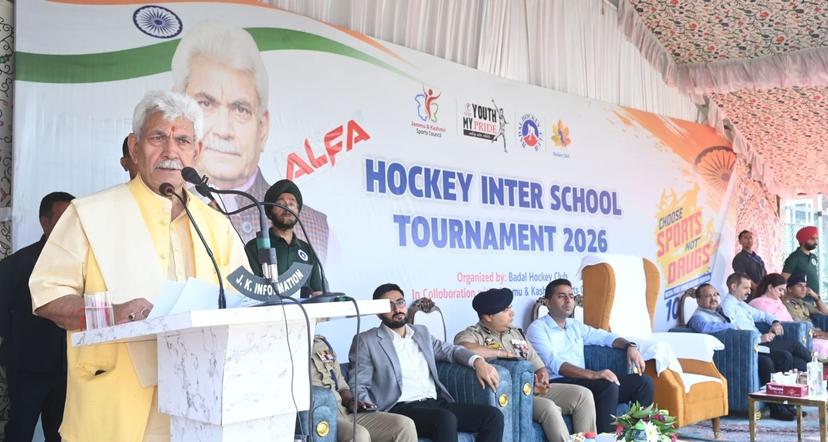
Standing before players, coaches and spectators at the tournament’s closing ceremony, Lieutenant Governor Manoj Sinha outlined an ambition that extends far beyond a single competition. Jammu and Kashmir, he said, is working to create a complete hockey ecosystem – one capable of identifying talent, nurturing athletes and ultimately producing players who can compete on the national stage.
The statement reflected something larger happening in sports across the region.
For years, discussions about athletic development in Jammu and Kashmir focused primarily on cricket. Cricket dominated conversations, television screens and youthful aspirations. Hockey, despite being India’s national sport and one of the country’s proudest international success stories, often existed in the background. That is beginning to change.
At first glance, hockey may appear an unlikely candidate for resurgence in Kashmir.
Unlike cricket, which can be played in almost any open space, modern hockey increasingly depends on specialised infrastructure. Synthetic surfaces, coaching facilities, equipment and organised competitions are critical to player development.
Talent alone is rarely enough. The game demands systems. That reality has shaped the administration’s approach.
Over recent years, authorities have invested in creating infrastructure designed specifically for hockey. Synthetic turfs now exist at Srinagar’s Polo Ground, Pulwama and Poonch. Additional facilities are under development at Bandhu Rakh and K.K. Hakku Stadium in Jammu.
To casual observers, these projects may appear to be routine construction work. In hockey development, however, synthetic turf changes everything.
Modern hockey is played almost exclusively on artificial surfaces. The speed of the game, movement of the ball and tactical demands differ dramatically from traditional grass fields. Players hoping to compete at higher levels must learn the sport in conditions that mirror national and international competition.
Without turf, talent can stagnate. With turf, possibilities expand.
The importance of infrastructure has been demonstrated repeatedly throughout hockey’s global history. Regions that consistently produce elite players rarely rely on chance. They rely on systems. Facilities. Competitions. Coaching. Scouting. Repetition.
Jammu and Kashmir’s emerging hockey framework appears to be moving in that direction.
The ALFA Hockey Inter-School Tournament itself offers an example of how that process works. The competition brought together students from thirty-two schools across several districts of Kashmir. On the surface, it was an inter-school event. Beneath that, it functioned as a talent identification exercise.
Some players arrived with coaching experience. Others came with raw ability and limited exposure.
The challenge for organisers was to identify those whose potential might otherwise remain unnoticed. That challenge is particularly relevant in Jammu and Kashmir, where geography often shapes opportunity.
A gifted athlete in a major city may have access to coaches, competitions and facilities. A similarly talented player in a remote village may not. The difference between success and obscurity can sometimes be measured not by ability but by access.
This is one reason why grassroots competitions matter. Every great athlete begins somewhere.
India’s hockey history is filled with stories of players emerging from modest backgrounds, carrying little more than determination and skill. Some practised on uneven fields. Others learned with borrowed equipment. What connected them was not privilege but opportunity.
The tournament at Polo Ground was built around that principle.
Speaking at the event, LG Sinha specifically highlighted the importance of identifying talented players from disadvantaged backgrounds. Talent exists everywhere, he suggested. Opportunity does not.
Closing that gap remains one of the central challenges of sports development. It is also where Jammu and Kashmir’s hockey ambitions intersect with broader social goals. For policymakers, sports represent more than competition. They represent engagement. Discipline. Community. Aspiration.
The language of sports development frequently overlaps with the language of youth empowerment because both address the same question: how do young people imagine their future?
The answer increasingly involves organised athletics.
Across Jammu and Kashmir, participation in sports has expanded considerably over the past decade. Football leagues have proliferated. Winter sports have gained attention. Cricket continues to thrive. Athletics programmes have expanded. Hockey is now attempting to join that movement. The sport carries a unique significance.
For much of the twentieth century, hockey was synonymous with Indian sporting excellence. Olympic gold medals transformed players into national icons. Names like Dhyan Chand became part of the country’s collective memory.
Reconnecting younger generations to that legacy remains part of hockey’s challenge nationwide. In Jammu and Kashmir, the challenge is accompanied by opportunity.
The region possesses one of India’s youngest populations. Schools provide a large talent base. Growing infrastructure offers new possibilities. What remains is the creation of a sustained pathway from school competition to elite performance.
That pathway is precisely what administrators say they are trying to build. A player enters a school tournament. Coaches identify potential. The player moves into structured training. Regional competitions follow. State representation becomes possible. National selection becomes conceivable. The journey is long. But for the first time, the route appears increasingly defined.
Of course, infrastructure alone does not create champions. The most successful sporting cultures possess something less tangible. Belief. Young athletes must believe that advancement is possible. Parents must believe that sports can create opportunities. Schools must believe that athletic development deserves investment. Communities must believe that excellence can emerge from their own neighbourhoods.
That cultural shift may prove as important as any synthetic turf. At Polo Ground, evidence of that shift was visible everywhere.
Students spoke about professional hockey with enthusiasm. Coaches discussed development programmes. Organisers talked about future tournaments. Administrators described expansion plans. The language was no longer about participation alone. It was about progression. The distinction matters.
Participation introduces children to sport. Progression creates athletes. As the ceremony concluded, medals were distributed and photographs taken. The formal proceedings ended. The players began drifting toward the exits. Yet some remained. A few lingered near the turf, hockey sticks still in hand. Perhaps they were reluctant to leave.
Or perhaps they were imagining themselves returning someday – not as schoolchildren competing in a local tournament, but as players representing Jammu and Kashmir on larger stages. That vision remains distant. It will require years of coaching, competition and perseverance. Not every young player will reach that destination. Most will not.
But every sporting success story begins with the creation of possibility. For decades, hockey in Jammu and Kashmir existed largely on the margins of the region’s sporting landscape.
Now, amid new infrastructure, grassroots competitions and expanding opportunities, the sport is attempting something more ambitious. It is trying to build a future.
And somewhere on a synthetic turf in Srinagar, Pulwama, Poonch or Jammu, the next chapter may already be learning how to hold a hockey stick.
About the Author
Syed Sameer Ahmad Nazki is filmmaker with command over film editing. With a parallel interest in videography, Nazki gravitates toward stories that live at the intersection of image and emotion. Away from the edit table, he remains an engaged observer of sport.