
On Kashmir’s lakes, the first signs of a crowded summer are often visible before they are measurable. A shikara glides across Dal Lake, its wooden hull cutting through water that has carried tourists, traders, and generations of residents. Along the banks, traffic thickens. Hotels fill. Roads become impatient. Plastic bottles find their way into drains and streams. The mountains, which have long served as the Valley’s most persuasive advertisement, remain still – though the pressure on them is anything but.
For decades, tourism in Kashmir has been sold as an encounter with nature: snow beneath one’s feet, willows reflected in quiet water, pine forests rising into mist, meadows opening beneath enormous skies. The promise has always been simple. Come here, and you will find beauty.
The question confronting Kashmir now is less simple: What happens when too many people come to see that beauty – and when the infrastructure built to accommodate them begins to threaten it?
At an Ethical Tourism Conclave organised by the Tourist Trade Interest Guild, Lieutenant Governor Manoj Sinha called for a fundamental shift in the way the region thinks about tourism. Eco-friendly tourism, he said, should become a mass movement, not a slogan confined to conferences or policy documents. The tourism industry, he argued, must balance economic expansion with environmental protection and ensure that the people who live in the Valley – and whose labour sustains its tourism economy – share in its rewards.
“Tourism in Jammu and Kashmir must be seen as a celebration of this heritage, and ethical tourism must be the guiding principle for its future,” Sinha said.
In Kashmir, the phrase ethical tourism carries a practical urgency.
The region’s tourism economy depends on a landscape that is magnificent and fragile. Its lakes are vulnerable to pollution and encroachment. Its rivers and streams carry the consequences of poor waste management downstream. Its forests face the cumulative pressures of construction, traffic and changing land use. Its mountain destinations, once reached by adventurous travellers willing to endure long journeys, are now increasingly accessible to mass tourism.
The success of tourism has therefore created a paradox. The more attractive Kashmir becomes as a destination, the greater the risk that its popularity could undermine the very qualities that made it attractive.
Sinha acknowledged the extraordinary expansion of the sector. Tourist arrivals, he said, had reached record levels. Confidence among domestic and international travellers had returned, investment had increased and employment opportunities had expanded.
For thousands of families, the return of visitors means the return of an income. A hotel room occupied is a wage earned. A shikara ride is a household expense paid. A pony hired is a livelihood sustained. A carpet purchased, a meal served, a homestay booked – each transaction passes through a network of people whose lives are connected to the visitor economy.
Yet Sinha offered a caution against measuring tourism’s success by numbers alone.
The question, increasingly, is not simply how many tourists Kashmir can attract. It is how many it can accommodate without losing its ecological balance – and whether the prosperity generated by their presence is distributed widely enough to justify the environmental costs.
Tourism statistics are easy to count. The degradation of a wetland is harder to quantify. The loss of a forest edge may not appear in an annual arrival figure. The slow disappearance of a traditional craft, the economic insecurity of a boatman, or the exhaustion of a young worker in an overcrowded destination rarely makes it into a tourism dashboard.
The industry, Sinha said, must recognise people working in traditional and local sectors as equal stakeholders. Dal Lake boatmen, pony owners, artisans and homestay operators are not decorative elements in the tourist experience. They are part of the economic architecture of Kashmir’s hospitality.
“Profits should not remain confined to large enterprises. Tourism must provide dignified incomes, training, and opportunities to all stakeholders,” he said.
It is a proposition that places sustainability somewhere beyond recycling bins and solar panels. A genuinely sustainable tourism economy must also ask who owns the hotel, who cleans the rooms, who transports the tourists, who makes the handicrafts, who serves the food and who ultimately receives the greatest share of the money generated by the visitor.
The Valley’s tourism image is built upon a culture that predates modern tourism by centuries. Its handicrafts, cuisine, architecture, music and hospitality are living traditions. But traditions can become commodities when tourism grows faster than communities can adapt.
The challenge, then, is to make tourism an economic opportunity without turning local culture into a performance staged exclusively for outsiders.
Sinha’s call for greater livelihood opportunities for young people and women speaks directly to that challenge. A greener tourism model could broaden the field: environmental guides, cultural interpreters, conservation workers, nature educators, local food entrepreneurs, digital travel curators and skilled hospitality professionals.
Women, too, could play a far greater role through homestays, traditional crafts, food enterprises and community-based tourism initiatives. But participation requires more than encouragement. It requires training, access to finance, digital connectivity, safe working environments and markets that reward quality rather than merely low prices.
Sinha proposed training programmes that could prepare young people to become environmental and cultural custodians. A young Kashmiri who understands the ecology of a wetland, the history of a shrine, the architecture of an old neighbourhood or the cultural meaning of a traditional craft is not simply a potential tourism employee. He or she can become an intermediary between visitors and the place they have come to experience.
That role may become increasingly necessary as Kashmir’s tourism map expands.
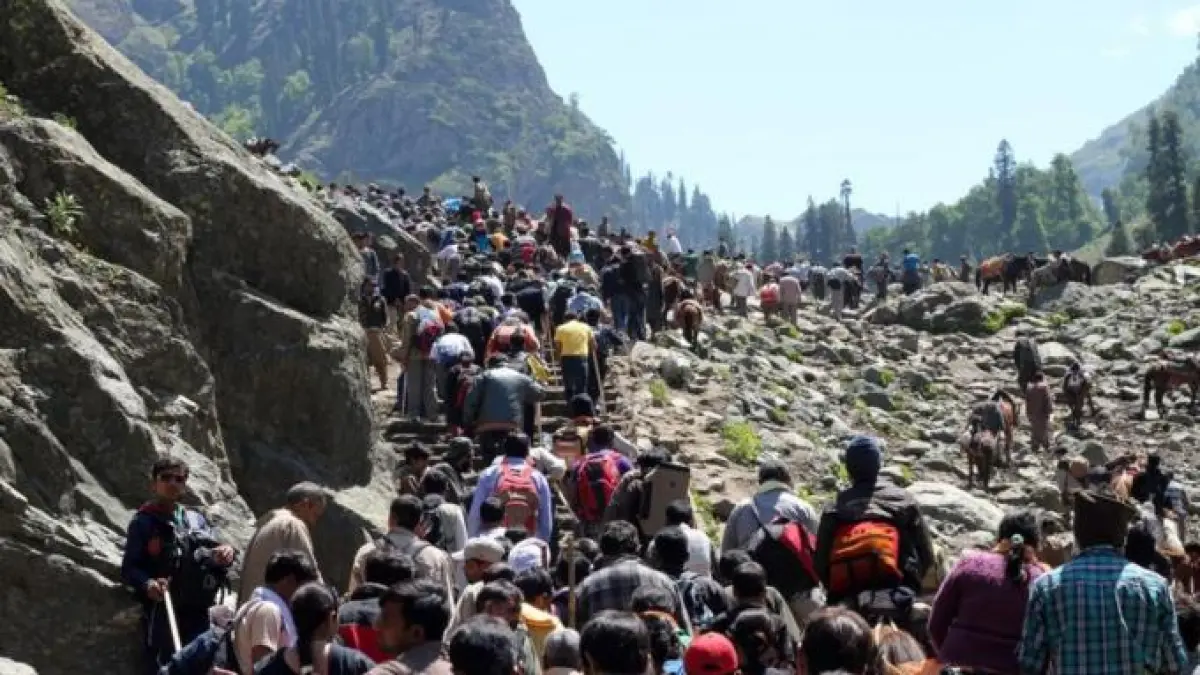
The Valley’s best-known destinations already carry the burden of popularity. Gulmarg, Pahalgam, Sonamarg and Dal Lake have become synonymous with the Kashmiri holiday. But concentrating visitors in a handful of destinations creates its own distortions. Roads clog. Waste accumulates. Water demand rises. Construction accelerates. Local residents find themselves competing with visitors for basic resources.
A greener model would distribute tourism more intelligently, encouraging travellers to discover lesser-known places while ensuring that those places are not subjected to another wave of uncontrolled development.
The solution is not to keep visitors away. It is to change the terms of their arrival.
That may begin with something as mundane as infrastructure.
Roads, hotels and tourism facilities are symbols of progress, but they are also physical interventions in fragile landscapes. The question is not whether Kashmir needs infrastructure – it plainly does – but what kind it chooses to build.
Sinha urged authorities and businesses to develop roads, hotels and other tourism facilities with minimal ecological impact. Taken seriously, that principle would require attention to carrying capacity, water availability, sewage treatment, waste disposal and the cumulative impact of construction.
A hotel is not sustainable merely because it has a sign announcing that it is “eco-friendly.”
Nor is a destination green because its visitors are asked to carry reusable bottles.
Sustainability is a system. It begins with planning and ends with accountability.
The visitor, too, has a role.
Sinha urged tourists to avoid single-use plastics, manage waste responsibly, conserve water and energy and respect wildlife. These may sound like modest requests, but their cumulative effect in a high-volume tourism economy can be significant.
A traveller who leaves a plastic bottle behind may regard it as an insignificant act. Multiply that by thousands of visitors, and the Valley’s landscape becomes the waste-management system.
The deeper question is whether tourists can be persuaded to see themselves not as consumers passing through Kashmir but as temporary participants in a living ecosystem.
The traditional Kashmiri welcome has always carried an implicit promise: the guest is honoured. But hospitality cannot mean that the host must absorb every cost. A visitor who expects unlimited water in a water-stressed destination, unrestricted access to fragile landscapes or disposable conveniences at every turn is effectively asking the local environment to subsidise the holiday.
Ethical tourism reverses that equation. The visitor becomes responsible for the place as well.
This is where proposed certification standards for environmentally friendly homestays and hotels could become significant. If properly designed and independently monitored, such standards could encourage businesses to reduce waste, conserve water and energy, improve sewage treatment and use environmentally responsible materials.
But certification will matter only if it is credible.
The label “green” has become commercially valuable around the world. Kashmir must avoid allowing sustainability to become another marketing category detached from measurable action. Clear benchmarks, transparent monitoring and meaningful penalties for violations would be essential.
Sinha’s proposal for digital platforms connecting tourists directly with local communities could also shorten the distance between visitor and host, allowing travellers to book local homestays, guides, artisans and experiences while keeping more tourism revenue within communities.
But technology alone cannot make tourism equitable. A digital platform is useful only when the people it is designed to serve have access to it and the skills to use it.
The most compelling idea emerging from the conclave, therefore, may be the simplest: tourism must become a shared enterprise.
Kashmir’s future as a destination cannot be secured by the government alone, nor by the tourism industry, nor by environmental groups, nor by visitors. It depends on an alignment of interests that has often been difficult to achieve. The hotelier wants more guests. The conservationist wants fewer pressures on the landscape. The local resident wants employment without losing access to land and resources. The tourist wants an authentic experience. The government wants economic growth.
Green tourism asks whether these interests can coexist.
The answer will determine more than the future of Kashmir’s tourism industry. It will shape the future of the places that industry depends upon.
At the conclave, Sinha called on tourism stakeholders to turn recommendations into concrete action plans with measurable targets and timelines. That may be the most important part of the challenge. Kashmir has never lacked for declarations about the environment. What it has often lacked is sustained implementation.
The Valley does not need another abstract promise to protect its lakes, forests and rivers. It needs targets that can be measured, institutions that can enforce them and businesses willing to accept that conservation is not an obstacle to profit but its long-term precondition.
The logic is ultimately unavoidable. If Dal Lake becomes more polluted, if forests recede, if rivers become dumping grounds, if mountain destinations lose their character under unchecked construction, tourism will eventually pay the price.
Nature is not an infinite asset. Nor is culture.
For Kashmir, the next phase of tourism may therefore require a different imagination. The old model asked how many visitors could be brought in. The new one must ask what kind of visitors the Valley wants, how they travel, where they stay, what they consume and what they leave behind.
It must ask whether the young person in a remote village can earn a dignified living without leaving home. Whether the artisan can receive a fair price. Whether the boatman can continue his trade on a healthy lake. Whether a woman running a homestay can become an entrepreneur rather than merely an unpaid extension of household labour. Whether a tourist can leave Kashmir having contributed something more lasting than a hotel bill.
“If local communities and youth combine innovation with sensitivity, link technology with culture, and development with environmental conservation,” Sinha said, “then I am confident that Jammu Kashmir can emerge as a model of sustainable tourism for the entire nation.”
It is an ambitious vision. But perhaps Kashmir has little choice.
The Valley’s greatest tourism asset has never been its hotels, its roads or its promotional campaigns. It has been the landscape itself – the lakes, forests, rivers, mountains and human communities that give the place its singular character.
To protect that asset is not to resist tourism. It is to understand what tourism is for.
The most successful destination, in the end, may not be the one that welcomes the largest number of people. It may be the one that can welcome generations of visitors without asking its rivers to carry their waste, its forests to absorb their expansion or its people to surrender their share of the prosperity.
Kashmir’s tourism story is entering that more complicated chapter now.
The world is arriving.
The real test is whether the Valley can remain itself when they do.
About the Author
Amir Yaseen is a Srinagar-based journalist interested in Kashmir, policy, progress, and the human stories shaping everyday life.