
Kashmir Impulse Desk
Srinagar, Aug 16
Chief Secretary Atal Dulloo on Sunday ordered departments to accelerate the formulation and execution of projects under a Rs 1579.09 crore disaster recovery package, while directing agencies to ensure rebuilt infrastructure is designed to withstand future disasters.
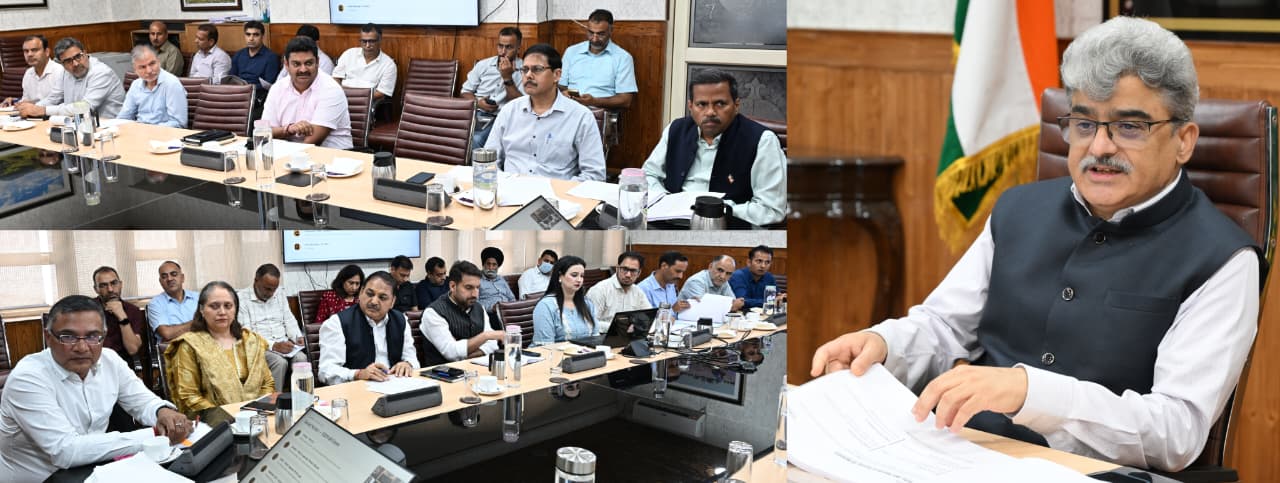
Dulloo reviewed implementation of the Recovery and Reconstruction Plan-2025 and utilisation of assistance approved by the Centre for damage caused by floods, cloudbursts, landslides and other disasters.
The package, approved by the National Disaster Management Authority under the National Disaster Response Fund and State Disaster Response Fund recovery and reconstruction funding window and sanctioned through the Ministry of Home Affairs, includes Rs 1534.58 crore under the Post-Disaster Needs Assessment for disaster-related damage.
A further Rs 44.52 crore has been earmarked for a dedicated recovery plan for Ramban district following the April 2025 cloudburst and flash floods.
Departments have so far prepared costed action plans worth Rs 1,225.78 crore, leaving Rs 353.31 crore to be operationalised by the Jal Shakti and Agriculture departments.
Dulloo said disaster recovery should go beyond simply restoring damaged infrastructure to its pre-disaster condition. He directed implementing agencies to follow a “Build Back Better” approach, aimed at making reconstructed assets more resilient.
He also ordered strict cross-verification of beneficiary lists and project proposals against major ongoing schemes, including PMAY-G, Jal Jeevan Mission, AMRUT, SASCI, NABARD, PMGSY and Samagra Shiksha, to prevent duplication and ensure efficient use of public funds.
Reconstructed infrastructure must incorporate disaster-resilient features where appropriate, including compliance with Seismic Zone IV and V requirements, elevated plinths and slope-stabilisation measures, the Chief Secretary directed.
Departments were also asked to use both norm-based and flexible assistance under the approved recovery framework to cover additional resilience requirements.
All projects are to be geo-tagged and uploaded on the BEAMS digital platform to establish a unified digital record of physical progress, expenditure and project outcomes.
Principal Secretary, Department of Disaster Management, Relief, Rehabilitation and Reconstruction, Chandraker Bharti told the meeting that progress had been recorded across several components.
In the social sector, departments had prepared plans worth Rs 262.11 crore against an approved allocation of Rs 289.40 crore.
The housing component had achieved 100% commitment against its Rs 193.19 crore allocation, covering 9,083 households, including 5,227 fully damaged and 3,856 severely damaged houses.
Roads and bridges was among the strongest-performing infrastructure sectors, with the entire Rs 461.64 crore allocation planned for restoration of about 1,230.7 km of roads and 4,494.5 metres of bridges.
The power sector had planned utilisation of Rs 70.08 crore against Rs 72.97 crore, targeting restoration of more than 21,000 poles, 1,100 circuit kilometres of conductors and 800 transformers, benefiting about 1.45 lakh consumers.
The drinking water and sanitation sector had formulated plans worth Rs 59.02 crore against Rs 139.65 crore, while Irrigation and Flood Control had planned Rs 93.01 crore against an allocation of Rs 199.79 crore. Both sectors were working towards utilising their full allocations.
In the productive sectors, Agriculture had prepared plans worth Rs 168.36 crore against Rs 223.67 crore, covering 45 packages involving crop inputs, land reclamation and restoration of research infrastructure at SKUAST-Jammu.
Animal husbandry and livestock had planned Rs 8.86 crore against Rs 10.28 crore, while Horticulture had fully utilised its Rs 3.87 crore allocation to support 3,493 farmers.
The review also covered the dedicated Rs 44.52 crore Ramban recovery plan drawn up after the April 19-20, 2025 cloudburst and flash floods.
The plan includes Rs 23.24 crore for roads and bridges, Rs 3.34 crore for irrigation and flood control, Rs 1.78 crore for education and Rs 1.48 crore for animal husbandry and livestock. Approved and proposed allocations in these components have been fully reconciled.
Dulloo directed that household relief under the recovery programme be released through a 30:40:30 progress-linked direct benefit transfer mechanism, ensuring that payments correspond with actual reconstruction progress.
Block, sub-divisional and district-level nodal officers were ordered to resolve E-Samadhan and CPGRAMS grievances within 15 days, making grievance redressal part of the recovery-monitoring process.
The chief secretary said the programme should deliver more than timely restoration of damaged assets, with the ultimate objective of creating a more resilient and disaster-ready Jammu and Kashmir and ensuring that every rupee sanctioned translates into durable public infrastructure and tangible relief for affected communities.
The meeting was attended by senior officials including the Additional Chief Secretaries of Finance and Public Works, the Principal Secretary of DMRR&R, the Director of Civil Defence and SDRF, administrative secretaries and divisional commissioners of Kashmir and Jammu.
Deputy Commissioners from all 20 districts participated virtually.