
On International Museum Day, rare manuscripts, coins, and artefacts at the S P S Museum offered visitors a quiet journey through Kashmir’s layered civilisational memory. Aasif Bashir reports.
On a quiet Monday morning in Srinagar, before the city had fully awakened into its usual rhythm of traffic, shop shutters and hurried movement, people began climbing the old stone steps of the S P S Museum.
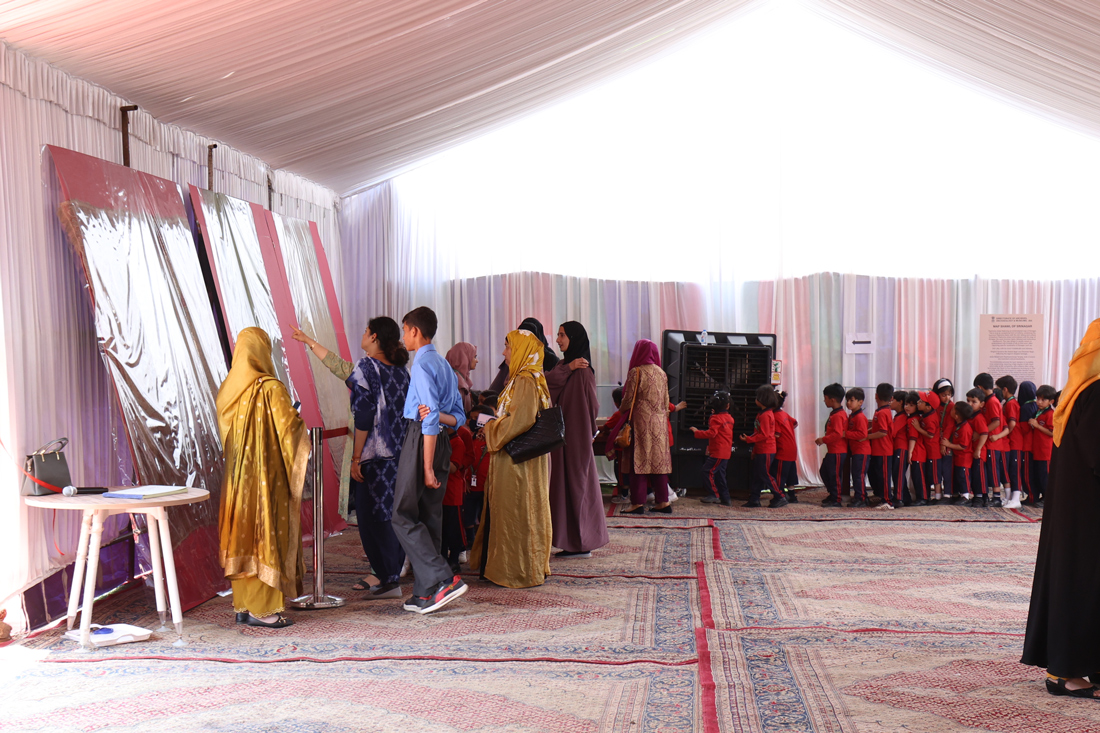
Some arrived out of curiosity, others out of habit. Students came carrying notebooks. Elderly men entered slowly, hands folded behind their backs like visitors returning to an old memory. Young parents guided children through corridors where centuries waited silently inside glass cases.
Outside, the Chinars had begun turning greener under the late spring light. Inside the museum, time moved differently.
International Museum Day is not usually the sort of event that draws crowds with the urgency of political rallies or cricket matches. Museums belong to quieter emotions. They ask for patience. They ask people to pause before objects that cannot speak but somehow still manage to tell stories.
This year’s theme – ‘Museums Uniting a Divided World: Connecting Cultures, Bridging Communities, Building Peace’ – felt especially poignant in Kashmir, a region where history is rarely distant and memory often lives close to the skin.
And nowhere was that history more visible than inside the SPS Museum on Sunday, where manuscripts, coins, shawls, paintings and artefacts from centuries of Kashmiri civilisation lay displayed beneath soft gallery lights.
There was something deeply moving about watching people stand before the Gilgit Manuscript.
The manuscript, considered among the oldest surviving Buddhist manuscripts in the world, rested quietly inside its protective case while visitors leaned forward reverently, almost instinctively lowering their voices near it. Schoolchildren stared at it with the uncertain fascination reserved for objects too old to fully comprehend. Their teachers tried explaining that these fragile pages had survived empires, invasions, migrations and weather itself.
Nearby stood an astrolabe – a reminder of the centuries when astronomy, mathematics and philosophy moved fluidly across Persian, Central Asian and Kashmiri intellectual traditions. A few feet away lay Persian translations of the Mahabharata, as if the museum itself was quietly arguing against every modern attempt to reduce identity into narrow categories.
Museums often reveal what politics forgets.
In Kashmir especially, where public discourse is frequently dominated by conflict, security, and uncertainty, museums preserve another narrative – one of exchange, coexistence and layered civilisation.
The S P S Museum does not merely display objects. It displays continuities.
A visitor moving through its galleries encounters Buddhist influences beside Persian manuscripts, Afghan-period shawls beside Dogra-era textiles, Sanskrit traditions beside Islamic calligraphy. The story unfolding inside the museum is not linear but braided – much like Kashmir itself.
In one corner, visitors gathered around the famous woven map of Srinagar. Elderly residents smiled as they pointed toward neighbourhoods they recognised. Younger visitors photographed it on their phones. The map seemed to collapse time, placing old Srinagar and contemporary Srinagar briefly within the same frame.
A young university student stood staring at the Shahnama-e-Firdousi manuscript for several minutes before quietly taking notes. Across the room, two schoolgirls giggled while trying to pronounce unfamiliar Persian names written on exhibit cards. Nearby, an elderly woman adjusted her glasses to examine intricate shawl patterns from the Afghan and Sikh periods.
Museums are often imagined as solemn spaces, but they are also deeply human ones.
Children become restless. Visitors whisper interpretations to each other. Some glance casually and move on; others stop unexpectedly before an object that seems to stir something personal inside them. A museum is not only about preservation. It is also about recognition – the sudden realisation that people centuries ago worried, created, worshipped and dreamed in ways not entirely different from our own.
At the Dogra Art Museum in Jammu, another set of histories unfolded simultaneously.
There, visitors encountered rare palm-leaf manuscripts of the Skand Puran, delicate birch-bark writings, Basohli paintings glowing with their distinctive colours, terracotta heads from Ambaran Akhnoor and collections of old currency notes and stamps that once passed through countless forgotten hands.
The exhibitions in Jammu and Srinagar felt geographically separated yet spiritually connected – two museums holding fragments of a shared civilisational memory.
An official from the Department of Archives, Archaeology and Museums described museums as “living spaces that preserve our collective memory and identity.” The phrase lingered in the mind while walking through the S P S galleries.
Living spaces.
Because the objects displayed here are not dead relics. They continue shaping cultural imagination long after the people who created them disappeared.
A manuscript survives a kingdom. A shawl outlives an empire. A coin remembers a ruler nobody else recalls.
There is something humbling about that endurance.
In Kashmir, where political transitions have repeatedly altered public life, museums quietly resist erasure. They hold evidence that the region has always been larger than any single period of history. Larger than conflict. Larger than borders. Larger even than memory itself.
The crowds at the museum were not enormous, but they were steady throughout the day. That mattered.
A teenage boy photographed Kushan gold coins with remarkable seriousness. A father explained ancient scripts to his daughter. Tourists moved carefully through exhibits while local visitors occasionally corrected details for each other with affectionate authority.
The atmosphere carried less the feeling of a formal exhibition and more that of a reunion between people and their own past.
And perhaps that is why museums matter most now.
Modern life is increasingly hostile to slowness. Attention spans fracture under screens, notifications and endless information. History itself is often consumed through short videos and simplified narratives stripped of nuance. Museums demand another kind of engagement – quieter, slower and more contemplative.
You cannot rush through an ancient manuscript.
You must stand before it long enough to feel the distance between your own brief life and the centuries it has survived.
At one point during the afternoon, sunlight filtered faintly through high windows onto a row of artefacts, illuminating dust particles drifting softly through the gallery air. For a brief moment, the museum felt almost sacred.
Not sacred in the ritualistic sense, but in the way places become sacred when they hold collective memory carefully.
Outside the museum gates, Srinagar continued normally. Auto-rickshaws rattled past. Shopkeepers arranged merchandise. Young boys played cricket in narrow lanes. Yet inside the museum, another rhythm persisted — one measured not in hours but in centuries.
There is a tendency in modern societies to treat museums as spaces primarily concerned with the past. But the best museums are equally concerned with the future.
They ask what kind of inheritance a society chooses to preserve.
The exhibitions on International Museum Day were ultimately less about nostalgia than continuity. They reminded visitors that heritage is not only inherited; it is also protected deliberately, generation after generation.
The young students wandering through the galleries on Sunday may someday forget specific dates or dynasties. But perhaps they will remember the feeling of standing before objects older than imagination itself. Perhaps they will remember that Kashmir’s history cannot be reduced to headlines alone.
Because inside museums, history breathes differently.
Not loudly. Not politically. But patiently.
And in that patience lies something increasingly rare in the modern world: the possibility of seeing humanity not through division, but through the long continuity of shared memory.
About the Author
Aasif Bashir is a visual journalist with a postgraduate degree in convergent journalism. He works at the intersection of imagery and narrative.