
A viral video circulating on social media has brought renewed attention to the story of a Japanese mayor who spent decades building flood defences that many considered excessive, only for those defences to prove their worth when a devastating tsunami struck years after he had left office.
The story of Kotaku Wamura, the long-serving mayor of Fudai village in Japan’s Iwate Prefecture, has become a parable about foresight.
It also raises an uncomfortable question for Kashmir.
What does a government do in the years between one catastrophic flood and the next?
The viral video says Wamura was mocked for insisting on a 51-foot seawall and a similarly enormous floodgate despite criticism over the cost.
The broad story is authentic, although some details in the narration are simplified or embellished.
Wamura served as mayor of Fudai from 1947 to 1987.
Having witnessed the devastation caused by earlier tsunamis, he pushed for major coastal defences.
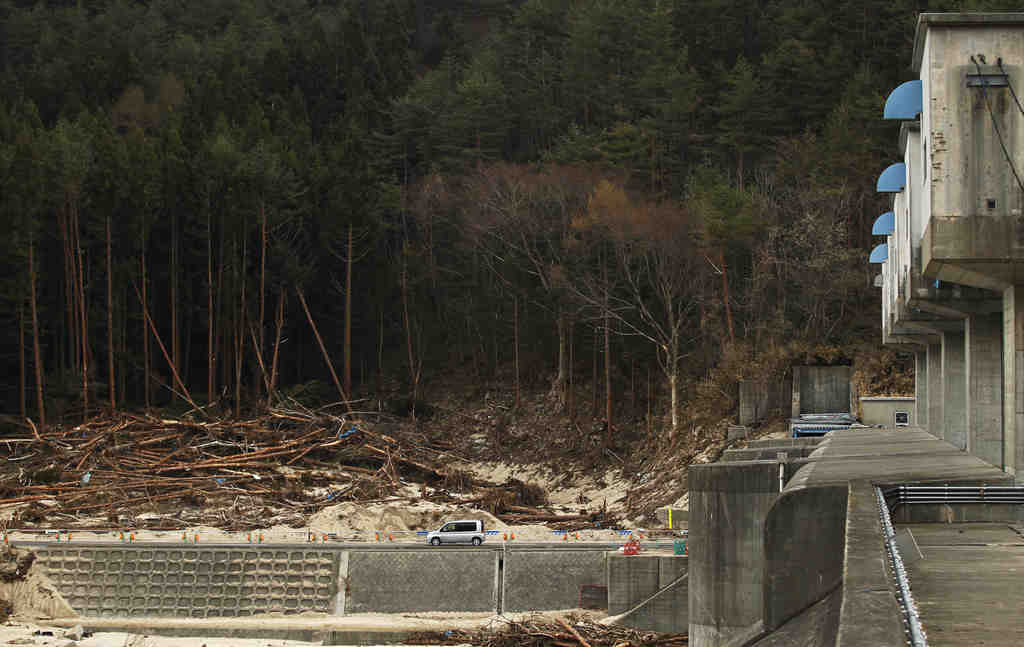
The Fudai floodgate, about 15.5 metres high, was completed in 1984 at a reported cost of around 3.56 billion yen.
Wamura died in 1997.
Fourteen years later, on March 11, 2011, a magnitude 9 earthquake struck off northeastern Japan, generating a tsunami that devastated communities along the Sanriku coast.
Fudai was hit too.
But the floodgate and the village’s coastal defences helped significantly reduce the tsunami’s destructive impact.
The village suffered far less devastation than many neighbouring communities.
The structure had been built for a disaster that its architect would never live to see.
That is the part of the viral story that matters most.
Wamura did not build because a tsunami was imminent.
He built because one had happened before.
Kashmir has had its own warning.
It came not in the distant past, but in September 2014.
The floods that year were among the worst disasters in Jammu and Kashmir’s recent history.
The Jhelum breached its banks, large parts of Srinagar and south Kashmir were inundated, homes and businesses disappeared beneath the water, and critical public infrastructure was severely damaged.
Around 300 people died, according to World Bank assessments, while the disaster affected more than a million families and caused billions of dollars in losses across sectors.
The flood was a natural disaster.
But its scale was also a warning about human vulnerability.
The Jhelum is the central artery of Kashmir’s flood system.
Its tributaries, flood channels, wetlands, lakes, drainage networks, and floodplains are all part of the same hydrological equation.
When one part of that system is weakened, the consequences can spread across the basin.
The 2014 floods exposed weaknesses that had accumulated over years like inadequate drainage, pressure on wetlands and natural flood-storage areas, encroachment, limited carrying capacity in critical stretches of the river system, and gaps in disaster preparedness.
The disaster triggered a major reconstruction effort.
In January 2016, the Government of India and the World Bank signed a USD 250 million Jhelum and Tawi Flood Recovery Project. The programme was designed to rebuild infrastructure damaged by the floods while improving resilience to future disasters.
The project covered 20 flood-affected districts and included reconstruction of roads, bridges, and public infrastructure as well as measures intended to strengthen disaster preparedness and resilience.
It was a significant financial commitment.
But reconstruction is not the same as resilience.
Reconstruction restores what the flood destroyed.
Resilience changes what happens when the next flood comes.
That distinction has remained at the heart of Kashmir’s unfinished flood story.
The Comptroller and Auditor General’s performance audit of disaster management in Jammu and Kashmir, which examined preparedness, response and post-flood arrangements, identified shortcomings in the state’s disaster-management framework.
The audit’s broader message was clear: disaster management cannot begin when the disaster arrives.
Preparedness must exist before the water rises.
Since 2014, successive governments and administrations have undertaken a range of measures.
Work has been carried out on embankments and flood channels.
Efforts have been made to improve the carrying capacity of the Jhelum and remove obstructions.
Dredging and desilting have periodically been proposed or undertaken.
Disaster-management institutions have been strengthened, while early-warning and emergency-response mechanisms have received greater attention.
The World Bank-backed recovery programme provided substantial resources for reconstruction and resilience.
These are important steps.
It would therefore be inaccurate to say that successive governments have done nothing since 2014.
The more difficult question is whether the measures taken have added up to a comprehensive, long-term flood-resilience strategy for the entire Kashmir basin.
The evidence suggests that the answer remains uncertain.
The problem is that Kashmir’s flood risk cannot be solved by a single project.
Nor can it be solved simply by dredging the Jhelum.
A resilient flood-management system would have to connect river management with urban planning, wetland protection, drainage, land-use regulation, floodplain management, real-time hydrological monitoring, early warning, evacuation planning and the protection of critical infrastructure.
The natural landscape itself is part of the flood-defence system.
Kashmir’s wetlands and water bodies act as natural buffers, absorbing and storing excess water.
But many of these have been degraded, encroached upon or reduced in size.
Government data cited in recent reporting has pointed to a significant decline in the number and size of natural lakes and water bodies in Jammu and Kashmir over decades.
The loss of these natural flood-storage areas adds pressure to an already vulnerable river system.
A flood channel can be widened.
An embankment can be strengthened.
A river can be dredged.
But once a natural wetland that once absorbed excess water has been filled or built over, restoring its original function becomes far more difficult.
That is why the debate over Kashmir’s flood resilience must extend beyond engineering.
It must include the question of what kind of development is permitted in areas that nature itself has designed to hold water.
The record since 2014 also raises a question of accountability.
How much money has been allocated? How much has actually been spent? Which projects announced after the 2014 floods have been completed? Which remain incomplete? Which recommendations made after the disaster are still pending? And, most importantly, have the investments changed the valley’s ability to withstand another extreme flood?
There is no single authoritative figure that captures every rupee spent by successive governments, central agencies and departments on flood recovery, mitigation, drainage, river management and disaster preparedness since 2014.
The USD 250 million World Bank-backed recovery project is one major programme, but adding it to other schemes without reconciling their scope and accounting periods would risk presenting an inaccurate total.
The absence of a single consolidated public account of all post-2014 flood-resilience spending is itself an argument for greater transparency.
The public should be able to see a clear ledger of the region’s flood-resilience effort: what was promised, what was funded, what was built and what remains unfinished.
The need for such scrutiny became apparent again this month.
In July 2026, widespread and persistent rainfall pushed the Jhelum and its tributaries sharply higher.
Authorities issued warnings as water levels approached critical thresholds.
Flood alerts and advisories were issued in parts of Kashmir, while people living near vulnerable water bodies and riverbanks were urged to remain cautious.
The waters eventually receded without a repeat of the 2014 catastrophe.
But the episode offered another reminder of how quickly the situation can change.
Kashmir did not experience another 2014.
That does not mean the valley is safe from another 2014.
The two events were different in their rainfall patterns, duration and hydrological circumstances.
The July 2026 rains did not produce the same basin-wide catastrophe.
But that is precisely why the episode should be viewed as a warning rather than reassurance.
A flood-resilient region is not one that escapes every flood.
It is one that can absorb an extreme event without suffering catastrophic loss.
That is where the story of Fudai becomes relevant.
The viral video’s portrayal of Wamura as a stubborn mayor who was mocked for 44 years and proved everyone wrong in a single morning makes for compelling storytelling. But the historical lesson is more nuanced.
Wamura was not simply a visionary who acted alone while everyone else opposed him. He was a long-serving elected mayor who had experienced the consequences of earlier disasters and pursued infrastructure based on that memory.
The important lesson is not the size of the wall.
It is the length of the vision.
Wamura built for a disaster that might not happen for decades.
Kashmir’s authorities have something Wamura did not have.
They have already seen the disaster. They have seen the Jhelum overwhelm the valley. They have seen Srinagar submerged. They have seen hospitals and homes inundated. They have seen roads disappear and bridges become unusable. They have seen the economic and human cost.
The 2014 flood should therefore have been Kashmir’s Fudai moment — the point at which a catastrophe was converted into a permanent blueprint for resilience.
Twelve years later, that transformation remains incomplete.
The comparison between Fudai and Kashmir is not exact.
Fudai is a small Japanese coastal village. Kashmir is a densely populated Himalayan basin with a complex hydrological system extending across a much larger area.
A Japanese floodgate cannot simply be transplanted to the Jhelum.
Kashmir does not need one giant wall.
It needs a system.
That system would include a healthy and unobstructed river, functional flood channels, protected wetlands, resilient urban drainage, stronger embankments where scientifically justified, strict enforcement against construction in vulnerable floodplains, accurate weather and hydrological forecasting, modern monitoring systems and credible evacuation plans.
It would also require something less tangible but equally important: continuity.
Flood resilience cannot be rebuilt every time a new administration takes office.
It requires a policy that survives changes of government.
That may be the greatest lesson from Fudai.
Wamura served for 40 years.
The floodgate he championed outlived him.
The government that builds resilience must think beyond the five-year political cycle, beyond the next budget and beyond the next election.
The infrastructure that protects a city from a once-in-a-century flood may spend decades looking like an unnecessary expense.
Until the day it is needed.
For Kashmir, the next major flood could come next year, a decade from now or much later.
It could be caused by prolonged monsoon rainfall, an extreme rainfall event or a combination of weather and hydrological conditions that exceed current assumptions.
No one can predict precisely when it will happen.
But after 2014, no one can honestly say the possibility is unimaginable.
The viral video about Fudai has brought an old Japanese story back into public view.
Its relevance to Kashmir lies not in the tale of a mayor who was supposedly right and everyone else wrong.
It lies in a more uncomfortable question.
What does a government do when it knows exactly what the worst-case scenario looks like?
In Fudai, the disaster came decades after the decision to prepare for it.
In Kashmir, the disaster came first.
The valley has already been given its warning.
The test of governance now is whether the years between floods are being used to build a system capable of surviving the next one.
Waiting for another catastrophe to prove the need for resilience would be the most expensive form of planning.
About the Author
Amir Yaseen is a Srinagar-based journalist interested in Kashmir, policy, progress, and the human stories shaping everyday life.