
At five in the morning, when Srinagar is still mostly blue with sleep, the lights are already on in some of the city’s gyms.
Some men arrive with the solemnity of office-goers. Some young women come in groups, exchanging the day’s first jokes before stepping onto treadmills. There are college students lifting weights they could barely have imagined touching a few years ago, middle-aged professionals trying to reverse the consequences of desk-bound lives, and older residents discovering that a little breathlessness, properly managed, can be a form of freedom.
The machines hum. Shoes squeak against rubber flooring. The mirrors do their quiet work.
Outside, the city is beginning another day.
Inside, Kashmir is changing its relationship with the body.
For decades, the Valley’s idea of physical activity was inseparable from ordinary life: walking to school, working in the fields, climbing steep lanes, playing cricket in open spaces, skiing in winter, or simply living in a landscape that demanded movement. The contemporary gym represents something different. It is deliberate, scheduled, and paid for. It is exercise stripped of necessity and turned into a choice.
And that choice is becoming increasingly popular.
Srinagar now has a visibly expanding ecosystem of gyms, fitness centres and health clubs, ranging from large commercial facilities to neighbourhood establishments. Directories and local listings show a broad spread of fitness businesses across the city, from Sonwar and Rajbagh to Soura, Bemina, Hyderpora, Karan Nagar, Baghat and Hazratbal. Among the establishments currently visible in local listings are THE MUSCLE STUDIO, Gold Standard Fitness Club, TEAMFIT GYM, A&M Health Club, ABC Fitness Hub, Refuel Unisex Fitness Club and The Fitness Nation. One local directory alone lists dozens of fitness centres in Srinagar, suggesting a market that has moved well beyond the handful of traditional bodybuilding gyms that once defined the city’s fitness scene.
Perhaps the most revealing change is taking place among women.
The rise of women-only gyms and female-focused fitness spaces is a quiet but significant development in Kashmir’s urban culture. In places such as La femme – Women Fitness Hub and Health Fitness Gym – Exclusive For Ladies, the very idea of a gym is being recalibrated around women’s comfort, privacy and participation. The growth of such spaces reflects something larger than the business of fitness: a growing willingness among Kashmiri women to claim physical activity as part of everyday life rather than treating it as an occasional indulgence.
The change can also be seen in the language of the industry.
The old gym vocabulary – biceps, bodybuilding, bulk – has acquired new companions: wellness, mobility, cardio, functional training, weight management, endurance, mental health.
The gym is no longer necessarily the place where a young man goes to become enormous.
It is where a woman goes because she wants to feel stronger, where a businessman goes because his blood pressure has become a conversation, where a student goes because sitting for 12 hours with a laptop has made the body feel older than the mind, where someone recovering from years of inactivity discovers that the first goal is not a six-pack but being able to climb stairs without stopping.
This is perhaps why the growing fitness culture in Kashmir feels less like a fashion than a social adjustment.
The Valley has entered an era in which sedentary living is increasingly normal. Work has moved indoors. Screens have replaced streets. Food is available at all hours. The body, once an instrument of daily survival, has become something that must be consciously maintained.
The result is a new kind of awareness.
People are talking about calories. They are counting steps. They are comparing protein sources. They are discussing trainers and running shoes. They are sharing workout videos and before-and-after photographs. The fitness vocabulary that once belonged mostly to professional athletes and bodybuilders has entered ordinary conversation.
And then there is the example set by public figures.
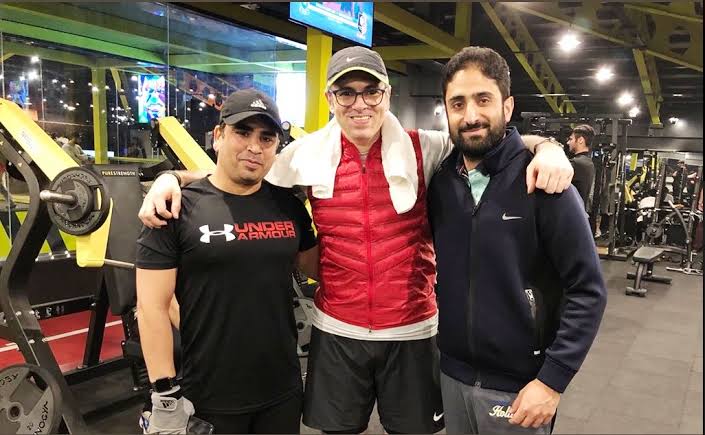
Chief Minister Omar Abdullah has increasingly made running a visible part of his public life. In October 2024, during the inaugural Kashmir Marathon, he ran the 21-km half-marathon and spoke of his hope that marathons would become a regular feature in Kashmir and help place Jammu and Kashmir on the international marathon map. In March 2026, he again put himself at the centre of a major fitness event, completing the 2-km half-marathon at the first Jammu Marathon in under 2 hours, while urging people to adopt an active and healthy lifestyle.
There is something politically interesting about a Chief Minister running a half-marathon.
Politics is usually performed from stages, podiums and motorcades. Running is different. It is a public display of effort rather than authority. The runner cannot delegate the final kilometre. There is no shortcut around fatigue.
When Chief Minister Omar Abdullah runs, he is not simply appearing at a sporting event. He is also presenting an image of leadership that is physical and participatory: the politician among the runners, moving at the same pace, at least for a while, as everyone else.
The symbolism has not been lost on his colleagues.
Among the National Conference’s younger political generation, fitness and personal discipline have become increasingly visible parts of public life. Tanvir Sadiq, one of the party’s prominent younger faces, is among those whose public persona increasingly intersects with the broader culture of exercise and physical activity. Whether this represents a direct imitation of the Chief Minister’s routine or simply a generational shift within the political class, the optics are unmistakable: the days when politicians were expected to be seen only in offices, public meetings and election rallies are fading.
The new political photograph may just as easily be taken in running shoes.
But the more important story is happening away from politics.
It is happening in the women’s gym in Karan Nagar. It is happening in the fitness studio near Sonwar. It is happening in the neighbourhood gym where a young man who once spent his evenings scrolling on his phone now spends an hour lifting weights. It is happening in the parks where runners appear before sunrise. It is happening on the Boulevard, where walking has long been part of Srinagar’s rhythm but running is increasingly becoming one too.
The first Kashmir Marathon in 2024 was an important marker of this transition. Thousands of participants, including international runners, gathered in Srinagar for full and half-marathon races. The event was not merely a sporting spectacle. It offered a glimpse of a different Kashmir – one in which the body, movement and public space could become part of the story the Valley tells about itself.
The phenomenon is particularly striking among women.
For many women, the gym is not simply about losing weight. It can be a rare space in which the body is considered in terms other than appearance. Strength becomes a goal. Stamina becomes measurable. Exercise becomes an hour that belongs entirely to oneself.
The existence of dedicated women’s facilities is important for precisely this reason. Comfort and privacy can determine whether someone walks through a gym door at all. Once inside, the experience can be transformative – not necessarily in the cinematic sense of dramatic physical change, but in the quieter sense of acquiring a routine.
A woman who begins by walking for 15 minutes may, six months later, be lifting weights. A man who joins to lose 10 kg may discover that he enjoys running.
A teenager who arrives because of social media may stay because exercise makes him sleep better.
The motivations vary. The habit remains.
In Kashmir, this culture is still young enough to be visible in its contradictions.
There is an enthusiasm for fitness, but also an industry eager to sell an idealised body. There is a growing interest in health, but also the temptation to confuse thinness with wellness. There are expensive memberships and personal trainers, but also people who cannot afford either. There is an expanding interest in marathons, but not always enough safe, accessible public infrastructure for everyday running and cycling.
The fitness revolution, in other words, is uneven.
Yet it is real.
Walk into a Srinagar gym today and the most interesting thing may not be the equipment. It may be the clientele.
The bodybuilder is still there, of course. So is the young man chasing a particular physique. But alongside him are office workers, women, students, mothers, professionals and people in their forties and fifties who have decided that health cannot be postponed indefinitely.
The gym has become a kind of social cross-section.
Everyone arrives with a different reason. Everyone eventually confronts the same fact: the body keeps its own account.
Perhaps that is why the sight of a Chief Minister running a half-marathon resonates beyond politics. The message is elementary, almost stubbornly so. Health is not an abstract policy objective. It is something lived, one breath at a time.
For Kashmir, where the public conversation has for years been dominated by questions of politics, conflict, economy and uncertainty, the rise of fitness introduces a different vocabulary.
Endurance. Discipline. Recovery. Strength.
These words belong to sport, but they also belong to life.
And somewhere, before sunrise, while the city is still quiet and the mountains are only beginning to separate themselves from the darkness, another gym door opens.
The lights come on. The treadmill starts. Someone begins to run.
About the Author
Amir Yaseen is a Srinagar-based journalist with an eye for the telling detail and an ear attuned to the cadences of Kashmir. He approaches news as narrative, locating the human story within the language of policy and progress and the quiet recalibration of everyday life.