
Kashmir Impulse Desk
New Delhi, April 13
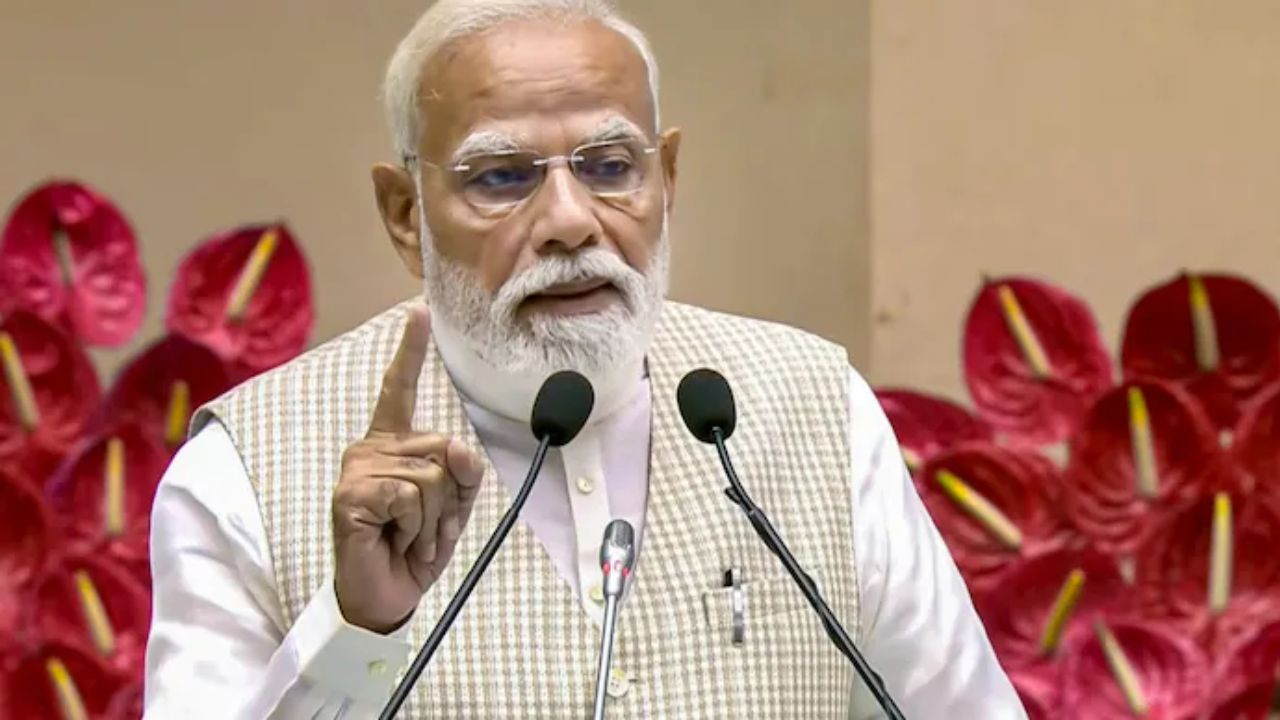
Prime Minister Narendra Modi said on Monday that women would play a decisive role in shaping India’s future, as he called for the timely implementation of a landmark law aimed at boosting their representation in legislatures.
Speaking at a ‘Nari Shakti Vandan’ programme at Vigyan Bhawan, PM Modi said India was on the cusp of taking “one of the biggest decisions of the 21st century” dedicated to women’s empowerment.
The event coincided with the Baisakhi festival and came ahead of regional New Year celebrations.
The PM paid tribute to victims of the Jallianwala Bagh massacre and described the current moment as “historic”, saying Parliament was close to creating a new chapter that would fulfil past aspirations and future goals.
He reiterated the government’s commitment to social justice, saying India envisioned an egalitarian society where it formed an integral part of governance rather than a slogan.
“The wait of decades, from state assemblies to the nation’s Parliament, is coming to an end,” PM Modi said.
Referring to the Nari Shakti Vandan Act passed in 2023, he said that political parties had backed its implementation by 2029.
The PM said a special sitting during Parliament’s Budget Session beginning April 16 would take up the issue, stressing the need for dialogue and cooperation to preserve the dignity of the institution.
Highlighting growing public interest, he said women across the country were expressing aspirations to enter state assemblies and the Lok Sabha, and urged them to remain actively engaged and share their views with elected representatives.
PM Modi also underscored women’s contributions from the independence movement to the Constituent Assembly, and said those given leadership roles had delivered strong outcomes for the country.
Citing local governance as an example, he said more than 1.4 million women were serving in Panchayati Raj Institutions, with participation nearing 50 percent in 21 states.
Studies showed that greater female participation in decision-making improved focus on issues such as water, education, health and nutrition, the PM said, pointing to the Jal Jeevan Mission as an example of effective grassroots involvement.
He said women in local bodies had gained experience over the years and were ready for larger roles, adding that the reservation law would ease their transition “from panchayat to Parliament”.
Outlining government initiatives since 2014, PM Modi said programmes across health, education and financial inclusion had sought to support women throughout their lives, including schemes to promote girls’ education, maternal health, sanitation and access to clean fuel and drinking water.
He highlighted efforts to boost economic empowerment, including prioritising women as beneficiaries under housing schemes and expanding access to banking through the Jan Dhan programme.
The PM said women accounted for over 60 percent of loans under the Mudra scheme and played a growing role in startups.
He cited increased maternity leave, skills training and the expansion of self-help groups, saying nearly 100 million women had joined such networks, with millions achieving higher income levels.
PM Modi said women were making inroads into sectors traditionally dominated by men, including aviation and the armed forces, and noted rising participation in higher education and research.
On safety, he said legal reforms and fast-track courts had been introduced to strengthen protections, adding that new criminal laws included provisions to simplify complaint procedures and improve victim support.
The PM urged women to spread awareness about the reservation initiative across communities, saying broader participation in decision-making would be key to India’s future.
“Ensuring women’s rightful place in governance is the strongest guarantee of a bright future,” he said.