
Kashmir Impulse Desk
Srinagar, Aug 26
Lieutenant Governor Manoj Sinha on Wednesday called for advanced healthcare to become accessible to all citizens, saying quaternary care should be treated as a right rather than a privilege.
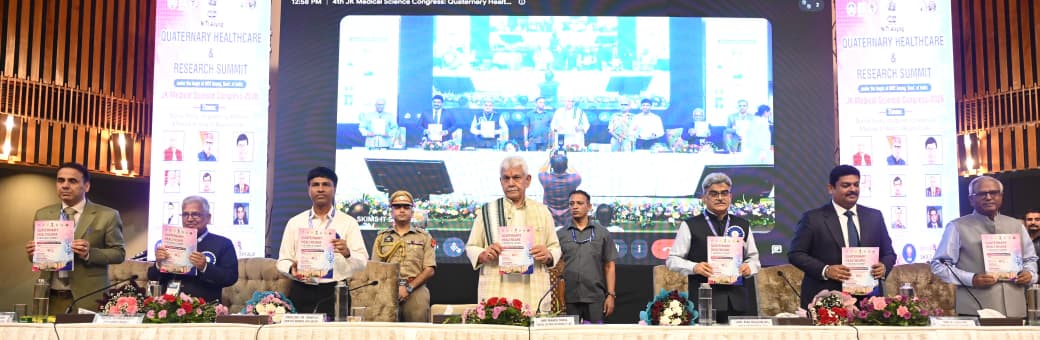
Addressing a healthcare and research summit in Srinagar, Sinha said Jammu and Kashmir needed to move beyond tertiary care and develop facilities capable of providing highly specialised treatment and research.
He recalled a 2020 visit to Akhnoor during the Back to Village programme, when doctors raised concerns about diagnosing rare diseases and access to modern equipment.
Sinha said the interaction highlighted a gap between healthcare available at district hospitals and the treatment patients require.
He cited India’s expansion of healthcare infrastructure, including 23 AIIMS and 2,045 medical colleges, and said Jammu and Kashmir had two AIIMS, 10 medical colleges, two State Cancer Institutes, a Bone and Joint Hospital, a Paediatric Hospital, 52 nursing colleges, 23 paramedical colleges and five pharmacy colleges.
But he said tertiary hospitals should now be developed into quaternary-care centres.
“Quaternary care should not be a privilege reserved for the economically rich section of society. It must become a right of citizenship,” Sinha said.
He called on hospitals to develop capabilities in organ transplantation, robotic and precision surgery, genomics, cellular therapies and artificial-intelligence-assisted diagnostics.
Sinha also urged hospitals to set aside annual funds for specialised infrastructure, including advanced operating theatres and proton-beam therapy.
He proposed stronger links between district hospitals, tertiary centres and quaternary institutions to speed up diagnostics, imaging and specialist consultations.
Telemedicine and AI-based diagnostic tools should become part of standard healthcare infrastructure, he said.
The LG also called for expanded training and fellowships in transplantation, oncology, genomics and critical care.
“Advanced care is impossible without advanced specialists,” he said.
He proposed a joint initiative involving Himalayan states, universities, hospitals, private institutions and innovators to advance biomedical research and address funding challenges.
“We must develop new inventions ourselves instead of importing innovation from abroad,” Sinha said.
He also said hospitals should be treated as strategic national assets alongside highways and ports.
Sinha released a summit souvenir and several publications at the event.