
Wetlands are often treated as landscapes that happen to contain water. That is perhaps the first mistake we make about them.
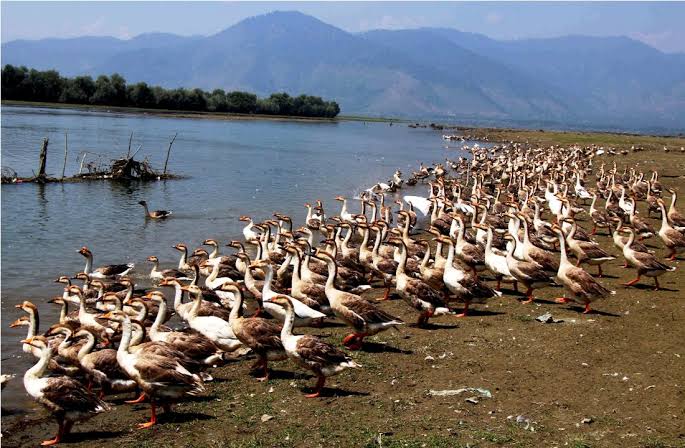
A lake is not merely a lake. A wetland is not simply an expanse of reeds, marsh or open water waiting to be beautified, developed, or fenced. These ecosystems are living infrastructure. They absorb excess water, sustain biodiversity, support livelihoods, moderate local environments and, in places like Jammu and Kashmir, form part of the region’s ecological identity.
Yet the health of these water bodies cannot be secured by government departments alone.
That is why the call by Jammu and Kashmir’s Environment Committee to bring scientific evidence and community participation into conservation deserves to be taken seriously. Chaired by Muhammad Yousuf Tarigami, the committee reviewed major water bodies including Hokersar, Mansabal, Wular, Nigeen, Mansar and Surinsar, as well as wetlands across the region.
Tarigami described wetlands as critical to ecology, biodiversity and flood mitigation, while warning about pollution and increasing human interference.
The obvious question is: who should be responsible for reversing that damage?
The answer cannot simply be “the government”.
Government agencies must enforce environmental rules, control encroachment, regulate pollution, restore degraded habitats, fund scientific studies, and ensure conservation plans are implemented. But people living around wetlands see things official maps cannot always capture.
They know when water levels change, which drains carry waste into a lake, where illegal dumping occurs, when migratory birds arrive and when they stop coming. They know which areas have become polluted or choked with weeds. That local knowledge should not be treated as anecdotal. It should become part of the conservation system.
The committee’s emphasis on community involvement points toward a more durable model of environmental governance: conservation done with communities rather than simply for them.
Jammu and Kashmir’s wetlands are not isolated from human life. They exist within settlements, agricultural landscapes, tourism economies and transport networks. Their degradation is often the cumulative result of thousands of small actions rather than one dramatic event.
A household discharging waste into a water channel may appear insignificant. A construction project near a wetland may seem manageable. A blocked drainage channel may look like a local inconvenience. But ecosystems accumulate these pressures.
The result is polluted water, shrinking habitats, declining biodiversity and increasing ecological vulnerability.
Conservation, consequently, must also become local.
People living around wetlands should have meaningful opportunities to participate in monitoring and restoration. Local institutions, schools, community organisations, fishermen, farmers, tourism operators and civil society groups can all become partners in protecting water bodies.
Such participation does not mean transferring the state’s responsibility to citizens. It means creating a partnership in which communities have both a voice and a stake.
The government’s emerging use of technology could make that partnership considerably stronger.
Officials told the committee that a comprehensive exercise is underway to identify wetlands through high-resolution satellite imagery. The mapping began with wetlands larger than 2.25 hectares, moved to those between 2.25 and one hectare, and has now been extended to wetlands smaller than one hectare.
Around 1700 wetlands have so far been identified across J&K, officials said.
The number itself should change how we think about conservation.
The region does not have a handful of important water bodies. It has a vast and interconnected ecological network, much of which may be too small or remote to attract sustained public attention.
Satellite imagery can reveal where these wetlands are. Scientific assessments can establish their condition. Geographic information systems can track changes over time.
But a satellite cannot tell a community why a particular wetland matters.
That is where public participation becomes essential.
The proposed state-level environmental portal could become a bridge between science and society. Officials are developing a platform that will include layers showing forest boundaries and the Wildlife Department’s protected-area network. Tarigami has called for it to be public-friendly and accessible not only to lawmakers and government departments but to ordinary citizens.
That is the right instinct.
Environmental information should not be locked inside government files.
If people can see the location of wetlands, understand their ecological status, and follow changes in water bodies, forests, and rivers, conservation becomes more transparent. Citizens can ask better questions. Researchers can use better data. Legislators can scrutinise government action more effectively.
And communities can become watchdogs.
Imagine a resident reporting an encroachment on a wetland through a public platform and tracking what happened to the complaint. Imagine students comparing satellite images of a nearby lake over several years, or communities documenting bird populations, water quality and waste hotspots for official monitoring.
That is what meaningful public participation could look like.
It would also help address one of environmental policy’s most persistent weaknesses: the gap between announcement and implementation.
The committee reviewed observations from the Comptroller and Auditor General and directed departments to submit time-bound Action Taken Reports on conservation measures for the six major lakes and other wetlands.
Such accountability is necessary. Conservation plans mean little if deadlines disappear into files.
But accountability should not stop at government offices.
Citizens should be able to see what was promised, what was completed, what remains pending and why.
Transparency can transform conservation from a bureaucratic exercise into a public conversation.
There is also an economic argument for involving communities.
Healthy wetlands can support tourism, fisheries, agriculture, recreation and education. Degraded wetlands, by contrast, impose costs through pollution, flood vulnerability, declining biodiversity and loss of scenic and cultural value.
Protecting them is therefore not simply an environmental expense. It is an investment in the region’s future.
But community participation will work only if communities believe conservation serves them too.
People cannot be asked to protect wetlands while their concerns about livelihoods, access or basic infrastructure are ignored. Conservation policy must listen before it instructs.
The challenge is to build a social contract around water.
That contract would recognise that lakes and wetlands belong to an ecological system larger than any one department – and that their protection is ultimately a shared responsibility.
Jammu and Kashmir has the scientific tools to map its wetlands. It has government institutions capable of regulating and restoring them. It now needs to build the public institutions and habits that allow ordinary people to become participants in their protection.
The most important conservation worker may not always be wearing a government uniform.
Sometimes it may be the fisherman who notices a change in the water, the student who records disappearing birds, the farmer who protects a drainage channel, or the resident who reports an encroachment.
The future of J&K’s wetlands will be determined not only by how accurately we map them, but by how deeply people feel connected to them.
If the lakes belong to everyone, their conservation must belong to everyone too.
About the Author
Wajahat Iqbal Kashtwari is a filmmaker and multimedia professional with a keen interest in the environment, ecology, and climate change.