
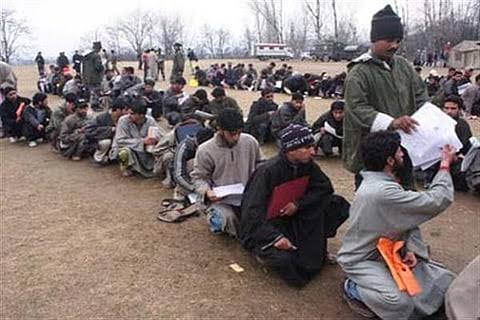
For thousands of young people in Jammu and Kashmir, the government job remains a coveted destination – a promise of stability in an economy where secure employment can be difficult to find.
The latest recruitment figures from the Jammu and Kashmir Public Service Commission offer a striking measure of that demand.
During 2025-26, the Commission received 94,546 applications for 960 advertised posts. On a simple application-to-post calculation, that works out to about 98.5 applications for every post, or nearly 99 applications chasing each vacancy.
The number is not a measure of unemployment by itself. One person can apply for more than one recruitment process, and applicants may already be employed or seeking a change in jobs. Nor do the 960 posts represent all government employment opportunities available across J&K.
But the figures capture something unmistakable: the extraordinary competition surrounding the government vacancies that do reach the JKPSC.
The scale becomes more apparent when viewed over time.
In the five financial years from 2021-22 through 2025-26, the commission received a combined 3,11,031 applications. The annual figures were 41,932 in 2021-22, 37,880 in 2022-23, 74,465 in 2023-24, 62,208 in 2024-25 and 94,546 in 2025-26.
The latest figure was the highest in the five years. It was also 32,338 applications higher than the previous year, an increase of about 52 percent. Compared with the earlier peak of 74,465 applications in 2023-24, the increase was 20,081.
Nearly three out of every 10 applications received by the Commission over the five years came in the latest financial year alone.
Behind those numbers is a familiar feature of the employment landscape: the government remains a particularly attractive employer for candidates seeking predictable careers, job security and the social standing traditionally associated with public service.
That appeal translates into crowded examination halls and large pools of candidates whenever vacancies are announced.
Most of the applications received by the Commission during 2025-26 were for recruitment processes involving both a written examination and an interview. That category accounted for 88,185 applications. Another 6361 applications were received for recruitment based exclusively on written examination.
The volume of candidates has consequences beyond the applicants themselves. It adds considerably to the administrative burden of the recruiting agency, which must conduct examinations, scrutinise applications, evaluate candidates and carry out interviews before recommendations can be made.
During 2025-26, JKPSC interviewed 1,847 candidates, compared with 1128 the previous year – an increase of nearly 64 percent.
The commission also recommended 1152 candidates for appointment, up from 721 in 2024-25.
Of those recommendations, 529 came through recruitment involving written examination and interview, while 623 were made through recruitment based exclusively on written examination.
The number of recommendations has fluctuated over the past few years. There were 763 in 2022-23 and 958 in 2023-24, before the figure fell to 721 in 2024-25. It then climbed sharply to 1152 in 2025-26.
The figures underline another distinction that is easily lost when looking at the application numbers: applications, vacancies and appointments are three different measures.
The commission advertised 960 posts across various departments during 2025-26. At the same time, it received eight requisitions involving 889 posts from different departments.
A requisition is the beginning of a recruitment process, while an advertised post represents a vacancy formally opened to applicants. Recommendations, meanwhile, reflect the candidates the commission has selected for appointment after completing the relevant recruitment process. That makes the headline ratio – 94,546 applications for 960 advertised posts – striking, but also something that needs to be read carefully.
It does not mean that 99 unemployed people were competing for every government vacancy. Some candidates may have applied for several posts. Others may have been employed in the private sector, in government or elsewhere. And the total number of vacancies in Jammu and Kashmir extends well beyond the posts advertised by JKPSC.
Still, the ratio conveys the pressure placed on every recruitment opportunity.
For a young graduate preparing for a competitive examination, the numbers are more than an annual statistic. They describe the size of the field against which an individual candidate is competing.
A single advertisement can draw tens of thousands of applications. A relatively small number of vacancies can therefore become the focus of an enormous pool of hopeful candidates.
The five-year figures suggest that this pressure is not confined to a single recruitment cycle. More than three lakh applications were received by JKPSC between 2021-22 and 2025-26, with the latest year accounting for the largest share.
The increase in applications in 2025-26 also coincided with a larger recruitment workload. More candidates were interviewed, and more recommendations were made than in the previous year.
That may offer one measure of the Commission’s increased activity. But for those on the other side of the recruitment process, the central equation remains unchanged: a limited number of government posts and a very large number of people hoping to secure them.
The figures therefore tell two stories at once.
The first is about the reach of competitive recruitment in Jammu and Kashmir, where tens of thousands of candidates are prepared to enter the race for a government position.
The second is about the limits of what the numbers can reveal. Applications are not people, advertised vacancies are not all available jobs, and recommendations are not necessarily the same as final appointments.
Even with those qualifications, however, the direction of the numbers is difficult to ignore.
In 2025-26, 94,546 applications converged on 960 advertised posts.
For the candidates who filled out those forms, paid the application fee, studied for the examinations, and waited for the results, the arithmetic was simple enough.
There were many more people waiting for a government job than there were government jobs on offer.
About the Author
Bisma Rafiq is interested in human resources and its role in improving journalism and media organisations. She is also a passionate storyteller.