
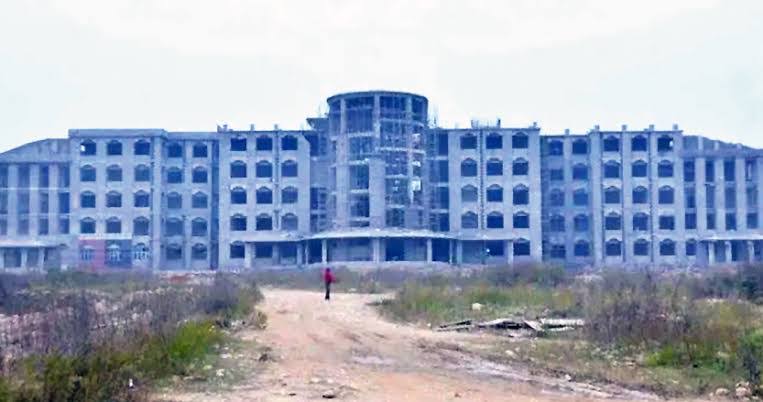
For nearly 8 years, the All India Institute of Medical Sciences at Awantipora has existed in the uneasy space between announcement and arrival.
The project has been repeatedly assigned deadlines, repeatedly given assurances, and repeatedly pushed toward a finish line that seems to move each time it comes into view.
Now, with the Union government reporting that the institute is 78 percent complete, the latest promise is strikingly modest: one block may become operational by the end of 2026.
That block, Chief Minister Omar Abdullah recently said, could begin offering outpatient department services and some other forms of treatment.
What is missing from the latest assurance is just as significant.
There was no fresh commitment on inpatient services. There was no mention of the promised MBBS classes. And the earlier ambition of making the institute “fully functional” by the end of this year has quietly receded into a more limited promise of opening a portion of the campus.
Speaking to reporters on the sidelines of the inauguration of a new abattoir project at Aluchi Bagh, Abdullah said construction at AIIMS Awantipora was progressing “quickly”.
“The work is progressing rapidly. The Health Minister reviews it from time to time,” he said.
The work, he added, was moving quickly and was being reviewed periodically by the Health Minister.
But when pressed about the project’s timeline, the chief minister offered a formulation that sounded less like a firm schedule than a hope pinned to an assurance from officials.
He said he had been assured that one block of the institute would be operationalised this year.
“OPD and some other treatment services will be started there. I hope they will stand by their word,” Abdullah said.
The wording was notable.
A year earlier, the timeline had been far more ambitious.
The shrinking promise
In September 2025, after visiting the AIIMS site at Awantipora, Abdullah had said the outpatient department would begin operations by March or April 2026.
He and the institute’s director had also indicated that MBBS classes would follow and that the institution would become “fully functional” by the end of 2026.
Those dates have now passed without the promised services materialising.
The latest assurance therefore represents a significant narrowing of the original commitment.
Instead of an institute offering the beginnings of a full medical and academic ecosystem, the immediate prospect is one operational block providing OPD and some other treatment services.
For a project conceived as a premier medical institution for Jammu and Kashmir, the distinction is not merely semantic.
An AIIMS is not simply a hospital building. Its intended role combines tertiary medical care, medical education, research and specialist services.
For patients in south Kashmir, an operational OPD would still represent progress. But for students awaiting the first MBBS intake and for patients expecting inpatient and specialist services, the latest timeline leaves much unresolved.
AIIMS Awantipora was one of two AIIMS institutions sanctioned for Jammu and Kashmir in 2019.
The project was initially expected to be completed by December 2025.
That deadline itself came after complications over the proposed site. The Army raised objections concerning the location, prompting a revision of the Detailed Project Report and pushing the expected completion date by roughly another year.
The project subsequently accumulated another series of deadlines.
In January 2026, J&K Chief Secretary Atal Dulloo attributed the continuing delay to “execution snags” while reaffirming that the project would be completed by the end of the year.
By April, physical progress had been reported at around 70 percent.
The figure suggested movement, but not enough to inspire confidence that the earlier operational targets would be met. The promised OPD launch did not happen. Neither did the first MBBS intake.
Then came the latest official accounting.
In a written reply submitted to the Lok Sabha on July 31, the Union Ministry of Health and Family Welfare put the physical progress of AIIMS Awantipora at 78 percent.
The ministry set December 2026 as the target for completion of the civil works.
But even that target comes with qualifications.
The ministry said full operationalisation would depend on site conditions, project management, regulatory clearances and the recruitment of faculty and non-faculty staff.
That distinction – between finishing construction and actually running an AIIMS – may prove crucial.
A building can be completed on paper while an institution remains years away from functioning at full capacity.
The Centre’s latest response indicates that staffing is already part of the equation.
For AIIMS Awantipora, 94 faculty posts and 252 non-faculty posts have been sanctioned.
Sanctioning posts, however, is different from filling them.
Recruitment, regulatory approvals, and the creation of the administrative and clinical systems required to operate the institute are separate stages in a process that construction alone cannot complete.
That is why the 78 percent figure, while offering evidence of progress, does not necessarily answer the question that matters most to residents of the region:
When will AIIMS Awantipora actually function as an AIIMS?
The answer remains uncertain.
The latest official target concerns civil works. The chief minister’s latest public assurance concerns a single block.
Neither provides a firm date for the start of MBBS classes. Neither establishes when inpatient services will begin. And neither restores the earlier promise that the institution would be fully functional by the end of 2026.
For years, the project’s progress has been communicated largely through percentages and deadlines.
First came the announcement. Then the revised project report. Then the construction milestones. Then assurances that the OPD would begin. Then the promise of MBBS classes. Then the declaration that the institute would become fully functional. Now, the benchmark is one block.
The changing language has created a peculiar kind of uncertainty around the project: every new deadline appears to offer movement while simultaneously reminding people of the previous deadline that was missed.
For residents of south Kashmir, the stakes are practical.
AIIMS Awantipora was envisaged as a major addition to the region’s public healthcare infrastructure, reducing the need for patients requiring advanced treatment to travel outside the valley.
Its academic component was expected to create opportunities for medical education within Jammu and Kashmir.
Its arrival was also meant to strengthen specialist care, research and the broader health system.
The longer the project remains incomplete, the longer those benefits remain theoretical.
The unfinished question of MBBS
Perhaps nowhere is the uncertainty more visible than in the question of medical education.
The earlier assurances that MBBS classes would begin in 2026 raised expectations among prospective students and the wider medical community.
But the chief minister’s latest remarks did not refer to an MBBS intake.
That omission matters because an operational OPD and an academic medical institute are not interchangeable milestones.
A functioning outpatient block can provide services without the institution being ready to train its first batch of medical students.
For that to happen, classrooms, laboratories, faculty, regulatory approvals, teaching hospitals and the wider academic infrastructure must be ready.
The Union government’s reference to recruitment and regulatory clearances suggests that the transition from construction project to medical institution involves another set of hurdles beyond the remaining 22 percent of civil works.
In that sense, the 78 percent figure may tell only half the story.
The government has not abandoned the December 2026 target for civil works.
The chief minister has also said that one block is expected to become operational this year.
But the language surrounding the project has changed.
The earlier certainty of a March-April OPD opening has disappeared.
The promise of MBBS classes has disappeared from the latest statement.
The phrase “fully functional” has disappeared as well.
In their place is a smaller, conditional promise: one block, OPD, and some other treatment services.
There has been no recent detailed public statement from AIIMS Awantipora, the Health and Medical Education Department, or the government clarifying the revised roadmap for the institute.
That silence leaves the most consequential questions unanswered.
Will the remaining civil works be completed by December? Will the first block actually begin services before the end of the year? When will MBBS classes start? When will inpatient services become available? And when, finally, will the institution move from being a construction project to functioning as the medical and academic centre it was intended to become? For now, the most concrete number is 78 percent. The most immediate promise is one block. The rest remains a matter of timelines, recruitment, approvals and assurances.
Eight years after AIIMS Awantipora was sanctioned, the project is closer to completion than it has ever been. But closer is not the same as complete.
And for the patients, students and families who have been waiting, the difference between the two is measured not in percentages but in another year of expectation.
About the Author
Moien Darial, an MBA, writes with the precision of an analyst and the sensitivity of a storyteller, exploring global economic shifts and emerging technologies.