
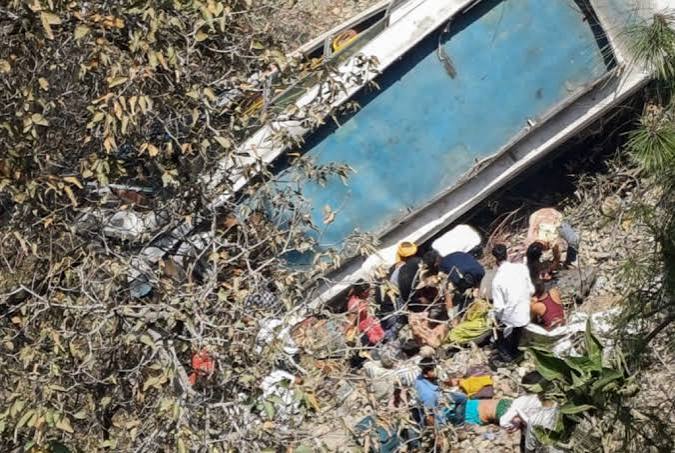
The death of 12-year-old Rizwan Ahmad Bhat after a mini load carrier plunged into a gorge near Barmuji in Ramban district is more than a tragic road accident. It is a devastating reminder of how quickly an ordinary journey can become a family’s worst nightmare, and how routinely lives are exposed to danger on Jammu and Kashmir’s mountainous roads. A child who should have been thinking about school, friends and tomorrow is gone. His family must now endure a loss no words can repair.
Rivzan, a resident of Gogwani village in the Neel area, sustained critical injuries when the vehicle skidded off the road on Monday. He was rushed to the Sub-District Hospital in Banihal, where doctors declared him dead on arrival. Sources said the driver allegedly fled the scene. The precise circumstances of the crash and the driver’s whereabouts were not immediately known.
These details demand more than expressions of condolence. They demand answers.
Road accidents in mountainous districts are often described as unfortunate incidents, as though tragedy were an unavoidable feature of life in difficult terrain. That fatalism is dangerous. Geography and weather can make driving exceptionally challenging, but the risks are neither mysterious nor beyond human intervention. Road design, vehicle condition, driving behaviour, enforcement and emergency response all influence whether a journey ends safely or in catastrophe.
Whenever a vehicle plunges into a gorge, the public deserves to know whether the road was adequately protected, the vehicle was roadworthy, the driver was operating it responsibly and necessary safety measures were in place. These questions must be answered through a credible investigation, not abandoned once public attention shifts elsewhere.
The death of a child makes the urgency even more profound. A 12-year-old passenger is among the most vulnerable people on any road. Children depend on adults to make responsible decisions about their safety. They cannot assess a vehicle’s mechanical condition, challenge reckless driving or insist that a dangerous journey be abandoned. Protecting them is a shared responsibility of drivers, vehicle owners, families, law enforcement agencies and the administration.
The reported flight of the driver, if established, raises another troubling question: can someone involved in a fatal crash evade immediate accountability? An allegation must not be treated as proven fact, and investigators must establish what happened. But fleeing an accident scene, if confirmed, would compound the tragedy by abandoning an injured person when timely assistance could be critical.
Police must establish the sequence of events, locate the driver, examine the vehicle and determine whether negligence or any other offence contributed to the crash. The investigation should proceed transparently, with the family informed of meaningful developments. Accountability cannot depend on whether a case remains in the headlines.
Yet focusing exclusively on the driver would be insufficient. Individual responsibility matters, but so does the wider system in which road deaths occur. The administration must examine accident-prone stretches across Ramban district, particularly routes where steep drops, narrow carriageways, inadequate barriers or poor visibility can magnify the consequences of a driving error. Where safety deficiencies exist, corrective action cannot wait for another family to suffer.
Authorities should assess commercial and load-carrying vehicles, enforce speed and roadworthiness requirements, and ensure drivers meet applicable licensing and safety standards. Regular inspections and consistent enforcement are more effective than occasional campaigns launched after fatalities. Safety rules that exist only on paper offer little protection to passengers travelling through vulnerable terrain.
Emergency response deserves equal attention. In mountainous areas, where access to medical facilities may be difficult and every minute can matter, ambulance availability, reliable communication and coordinated rescue arrangements are essential. The available information does not establish whether a delay affected Rizwan’s outcome. Nevertheless, authorities must ensure that accident victims receive timely assistance wherever a crash occurs.
The government must resist treating road safety as a seasonal concern or a public relations exercise. It requires sustained investment, transparent data, regular inspections and clear responsibility for correcting dangerous conditions. Authorities should publish accident figures, identify recurring causes and explain what action has followed. Without accountability, each death risks becoming another entry in a grim tally.
For Gogwani and neighbouring villages, grief is immediate and personal. For society, the danger is that familiarity will make the tragedy seem routine. It must not. A child’s death should provoke not only sorrow but also a determined examination of the conditions that made the journey perilous.
Rizwan cannot be brought back. No investigation, safety audit or administrative order can undo his family’s anguish. But his death must not be reduced to a brief news report followed by silence.
The authorities owe his family a thorough investigation and justice wherever responsibility is established. The public deserves a serious commitment to safer roads. Those entrusted with protecting lives must act before another child is lost to a preventable tragedy.
A gorge has claimed a young life. The response must not disappear into one.