
When a forest catches fire in Kashmir, the nearest fire engine may be of little use. The flames can be burning on a slope that has no motorable road, beyond a ridge that takes several hours to reach on foot. By the time a firefighting team arrives, it must rely on what its members have carried on their backs.
That reality was central to a training session at the Kashmir Forest Training School in Chitternar, Bandipora, as the region entered its main forest-fire season, which runs from October through February. Beat guards, foresters and divisional officers from north Kashmir joined the programme, some through video conference. The message was direct: the dry season has arrived, autumn leaves have accumulated on the forest floor, and the people expected to confront a blaze must be equipped for a kind of emergency that conventional fire services are not designed to handle.
The school, established in 1911, was the first forestry school in Jammu and Kashmir and is among the oldest in the country. Its training sessions are intended for the people who work closest to the forests. This year, the need is sharpened by the memory of the fires that swept through Bandipora and Gurez in November last year, after an extended dry spell.
The Forest Department says it is changing how equipment is distributed. Instead of keeping supplies mainly in central control rooms, it is placing portable tools directly with beat guards and foresters. Owais Farooq Mir, Divisional Forest Officer for the Kamraj Forest Division, said the change was intended to reduce the time needed to respond when a fire breaks out.
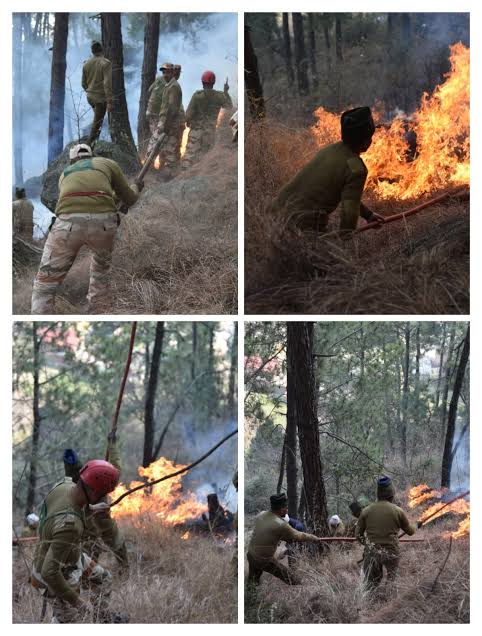
The approach reflects the geography of the problem. Mir told Greater Kashmir that some fires occur in places where it can take three or four hours to trek to the site. Fire engines cannot reach such locations, and heavy machinery cannot be taken across steep, unmotorable terrain. The staff who arrive can carry only as much equipment as they can physically manage.
The tools are necessarily basic: fire beaters and rakes, along with protective equipment such as helmets, safety kits and suitable footwear. These tools can help workers contain or redirect a fire, but their effectiveness depends on the terrain, the intensity of the blaze, the number of people available and how quickly they can reach the affected area.
Mir said the department had decentralised equipment so that frontline workers would not have to wait for supplies to be issued from a central location. He said the tools required for the department’s particular working conditions were available, while acknowledging that additional equipment would be useful. The one-day training programme, organised by the school’s principal, Danish Ahmad Khan, focused on manual containment methods and survival in forest conditions.
The department’s strategy also depends on understanding how fires begin. Officials said human activity remains one of the triggers. Fires may start accidentally when nomadic communities move through forests, or through the activities of tourists and adventure-seekers. The source material does not quantify the share of fires caused by human activity, but it identifies prevention and public awareness as part of the challenge.
Weather can make the difference between a manageable incident and a spreading fire. Prolonged dry spells leave vegetation and fallen leaves more combustible. Mir said the risk rises when autumn precipitation is absent and falls when rain replenishes moisture in the forest floor. During the training session, rain began to fall across Bandipora, offering a temporary reminder of the role that weather plays in forest-fire conditions.
Decentralising equipment may reduce the time spent collecting tools, but it cannot remove the distance between a road and a fire site. Nor can it substitute for enough trained personnel to cover large and difficult areas. The source material describes the distribution of portable equipment but does not provide figures on the number of kits issued, the number of staff trained or the response times achieved in previous fire seasons. Those measures would help assess whether the new approach is improving readiness.
The men and women sent into the forest face a different emergency from crews responding to a building fire. They may have to walk for hours, carry their own supplies and work without the support of a nearby road or water tender. Their safety depends on training, protective gear, local knowledge and a realistic assessment of whether a fire can be contained by a ground team.
The department’s shift towards putting equipment in the hands of beat guards and foresters is a practical response to that geography. But readiness should not be measured only by the presence of beaters and rakes. It should also be judged by staffing, communications, access to water, coordination between divisions and the availability of timely weather information.
The most effective forest fire is the one that never starts. That requires care from everyone who enters the woods, especially during dry periods. When a blaze does begin, the first response may come not from an engine but from a worker climbing a mountain with a tool on his shoulder. The system must be built around that reality.
About the Author
Danish Mohuiddin is a postgraduate in Convergent Journalism with interests in cinematography, filmmaking, and the human dimensions of news.