
There are World Cup finals that become monuments to football. There are others that become mirrors of the institutions surrounding the game. The 2026 final, in which Spain defeated Argentina 1-0 after extra time, somehow managed to be both.
Spain won the trophy. That should have been the entire story.
Instead, the tournament’s closing chapter became cluttered with questions about discipline, politics, spectacle and power – precisely the things football is supposed to rise above.
Spain, in the end, were the deserving champions. They played with the authority of a side that understood the occasion without allowing the occasion to overwhelm them. Argentina, by contrast, finished the tournament with a reputation that has been badly bruised by the behaviour surrounding their campaign and, most dramatically, the chaos that followed the final.
The criticism of Argentina is not criticism of their footballing quality. Quite the opposite. Argentina remain one of the world’s great football nations, blessed with technical ability, competitive intelligence and a culture that produces players who understand the emotional stakes of the game. But there is a difference between competitive fire and indiscipline. The line between the two cannot be allowed to disappear simply because the team involved wears one of football’s most famous shirts.
The post-final scenes were ugly. FIFA is investigating incidents arising from the confrontation, while Argentina’s assistant coach Roberto Ayala was reported to have been involved in an altercation with Spain players. Leandro Paredes was also at the centre of the post-match disorder.
That is where FIFA must answer a difficult question: does the identity and stature of a footballing nation influence the way its behaviour is perceived?
The suspicion among many observers is that Argentina have, at times, enjoyed a remarkable margin for error. Their competitive aggression is often romanticised as passion. Their confrontations are treated as part of the drama. Their provocations become folklore. Yet when the same behaviour comes from less celebrated teams, the language suddenly changes. It becomes misconduct. Unsporting behaviour. A disciplinary problem.
Football cannot have two standards.
If Argentina cross the line, they should be judged by the same rules as every other team. If they do not, then FIFA should say so clearly and explain why. Silence creates suspicion. Inconsistency creates resentment.
The same principle applies to FIFA itself.
The controversy surrounding the reversal of the suspension arising from Folarin Balogun’s red card has raised perhaps even more uncomfortable questions. The episode became controversial after U.S. President Donald Trump personally urged FIFA president Gianni Infantino to review the decision. FIFA subsequently suspended the one-match ban for a year, allowing Balogun to remain eligible. The Norwegian Football Association is now considering an ethics complaint, while critics have argued that the intervention created the appearance of political influence over sporting discipline.
FIFA may have a legal or regulatory explanation for the decision. But football governance is not merely about what is technically permissible. It is also about what is credible.
A red card is supposed to mean something. It is one of football’s clearest statements: the player crossed a line and must face a consequence. If that consequence can be reconsidered after intervention from a powerful political figure, the damage extends beyond one player and one match. It raises the broader question of whether football’s disciplinary machinery is truly independent.
That is especially troubling for a tournament marketed as a celebration of the world’s game.
The United States, as one of the principal hosts, had every right to celebrate its role in staging the World Cup. The tournament was always going to be a cultural and commercial spectacle. But there is a fine line between hosting football and becoming the story.
The final belonged to Spain. The trophy belonged to Spain. The football belonged to Spain.
And yet, in the theatre surrounding the final, there was an unmistakable sense that the host nation’s political and entertainment machinery was determined to occupy the frame. The presence of the US president, the prominence of American ceremony and the performance-heavy presentation inevitably created a debate about whether the football itself was being pushed into the background.
That matters because the World Cup is bigger than its host.
The host provides the stage. The players provide the drama. The champions write the history.
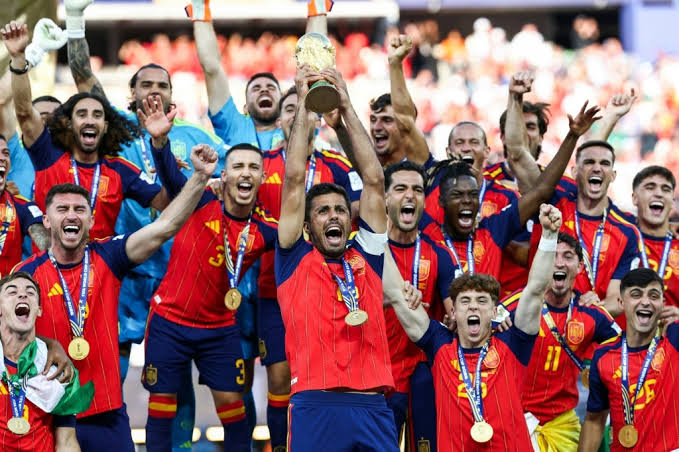
When Spain lifted the trophy, the images should have belonged entirely to the winners — to the players who had spent years building toward that moment, to the supporters who had travelled across continents, and to a footballing culture celebrating another remarkable achievement.
Instead, the closing ceremony became another example of modern sport’s growing struggle with the politics of visibility.
There is nothing wrong with music. There is nothing wrong with spectacle. There is nothing wrong with a host nation celebrating itself. But football must remain the main event. When ceremony becomes louder than competition, the sport risks becoming background decoration for a political and entertainment extravaganza.
The same criticism applies to the attempt by powerful personalities to insert themselves into the emotional centre of a team’s triumph. Whether through ceremonial appearances, photographs or the choreography of the podium, the winners should never be made to feel like supporting actors in someone else’s production.
Spain did not win the World Cup to become a backdrop. They won it because they were the best team left standing. That distinction should have been respected.
The final, therefore, leaves FIFA with a credibility challenge. The organisation has spent years insisting that football belongs to everyone. Its own decisions must reflect that universality. If Argentina are punished, they should be punished according to the rules. If the United States receive special consideration, FIFA must explain why. If a disciplinary decision is overturned, the rationale must be transparent enough that supporters do not suspect political influence.
The World Cup is too important to be governed by appearances.
Football fans can accept defeat. They can accept controversial refereeing decisions. They can even accept bad football. What they struggle to accept is the feeling that the rules are flexible depending on who is involved.
Spain’s triumph deserves better than that.
Their victory was the purest part of the final story: a football team winning football’s greatest prize. Yet the tournament’s closing images were clouded by Argentina’s indiscipline, questions over FIFA’s disciplinary consistency and the unavoidable collision between sport, politics and spectacle.
That is the uncomfortable legacy of this World Cup.
Argentina must look in the mirror. A great football nation cannot confuse aggression with entitlement or passion with impunity. FIFA must look in the mirror, too. The governing body cannot demand trust while allowing decisions that create the appearance of unequal treatment. And the hosts must remember that the World Cup is not a presidential campaign, not a celebrity concert and not a branding exercise.
It is football.
And on the final night, Spain played it better than everyone else. The champions deserved the spotlight. The rest should have had the grace to let them enjoy it.
About the Author
Syed Sameer Ahmad Nazki is filmmaker with command over film editing. With a parallel interest in videography, Nazki gravitates toward stories that live at the intersection of image and emotion. Away from the edit table, he remains an engaged observer of sport, particularly cricket and football.