
For residents of Rajouri and Poonch, the opening of a tunnel may sound like an ordinary infrastructure announcement. On August 17, it felt like something considerably larger.
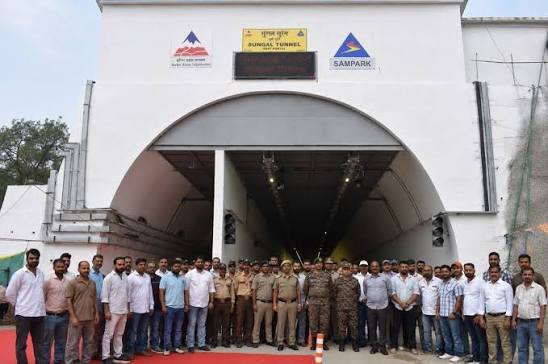
As the Border Roads Organisation allowed civilian traffic through the newly constructed Sungal Tunnel for the first time, people gathered near the facility, distributed sweets and celebrated what they saw not simply as the opening of a passage through a mountain, but as the removal of another barrier from a region that has spent decades negotiating its distance from the rest of Jammu and Kashmir.
The tunnel, on the Jammu-Rajouri-Poonch highway, was opened partially to light and medium motor vehicles during daylight hours. Traffic is currently limited to vehicles no wider than three metres and will operate from 8 am to 8 pm.
It was a modest first step. For many residents, however, it carried the emotional weight of a much bigger one.
The opening came after weeks of frustration over the delayed commissioning of a project that residents said had already been completed but remained inaccessible to ordinary motorists. Protests had intensified around the issue, with residents and several organisations questioning why a tunnel they believed was ready for use had not been opened.
Some protesters had gone further, calling it a “VIP tunnel” and alleging that officials and political leaders were able to use the facility while ordinary people continued to contend with the difficulties of travelling through the mountainous highway.
The BRO had subsequently announced that the tunnel would be opened on August 22.
Instead, the gates opened several days early.
The surprise appeared to amplify the celebrations.
Young people and residents gathered around the tunnel, exchanging sweets and welcoming the first civilian vehicles. For a place accustomed to waiting – for better roads, faster journeys and more dependable links with the wider region – the moment offered an unusually tangible symbol of change.
Rajouri and Poonch sit in a part of Jammu and Kashmir where geography has always been more than a backdrop.
The mountains shape daily life. They determine how long it takes to reach a hospital, how quickly goods can move, how easily students can travel, and how confidently families can make plans involving destinations beyond their immediate neighbourhoods.
The Jammu-Rajouri-Poonch highway is therefore not merely a road. It is a lifeline connecting the two border districts with Jammu and the larger transport network of the region.
Together, Rajouri and Poonch have a population of more than 1.3 million. The benefits of a more dependable highway can extend beyond those districts, reaching parts of Reasi and Jammu as well.
For residents, the significance of the Sungal Tunnel lies partly in what it removes: a difficult stretch of mountainous terrain and some of the uncertainty associated with travelling through it.
A tunnel does not change the geography of a place. It changes the relationship between people and that geography.
It can turn a steep, winding obstacle into a predictable passage. It can make a journey less vulnerable to weather and terrain. And, perhaps most importantly for residents of remote and border areas, it can make distance feel smaller.
That psychological shift can be as important as the minutes saved on a journey.
For decades, people in Rajouri and Poonch have lived with a sense of physical separation from the administrative and economic centres of Jammu and the Kashmir Valley. Their location at the edge of the Union territory has often meant that connectivity is discussed not as convenience but as necessity.
The tunnel’s opening is consequently being interpreted by residents as part of a larger promise: that the region’s difficult geography should no longer dictate the limits of its opportunities.
The celebrations also reflected something less visible than the concrete and steel of the tunnel itself.
They reflected accumulated frustration.
Residents had said the project was running about 18 months behind schedule. What particularly aggravated them was the perception that the infrastructure existed but remained beyond their reach.
For people accustomed to watching major projects take years to materialise, a completed tunnel that could not be used became a symbol of the distance between government announcements and everyday experience.
That is why the protests mattered.
They transformed a question of engineering and scheduling into a question of public trust.
The early opening, even if only partial, changed the mood almost immediately.
But the celebration has come with another demand: that the tunnel eventually operate around the clock.
The present restriction to daylight hours may be adequate for routine travel, but residents say emergencies do not follow a timetable.
A medical emergency at night, an urgent family journey or a breakdown on a difficult stretch of highway can turn a seemingly manageable restriction into a serious inconvenience.
The BRO has indicated that the current arrangement is only the first phase.
Ashish Srivastava, Commander of the Border Roads Task Force, said the tunnel had initially been opened to light motor vehicles during the day while safety arrangements were being monitored.
“We will progress the further opening of the tunnel that includes movement of heavy vehicles and 24-hour movement of vehicles from the tunnel,” he said.
That promise is likely to be closely watched.
For residents, the real measure of the tunnel will not ultimately be the ceremony surrounding its opening. It will be whether the facility becomes a dependable part of everyday life.
The emotional response to the opening can be understood only in the context of what connectivity means in a mountainous and strategically sensitive region.
A road is a route for commerce, but it is also a route for possibility.
A student travelling for an examination, a family taking a patient to a hospital, a trader moving goods, a worker commuting for employment or a young person travelling to Jammu for education all experience infrastructure differently from the engineers who build it.
For them, a few kilometres can represent hours. A landslide can disrupt a plan. Snow, rain or a damaged road can turn an ordinary journey into an uncertain one.
Reliable connectivity narrows those uncertainties.
It can also influence whether people feel that economic and administrative opportunities elsewhere are realistically available to them.
That is particularly significant for Rajouri and Poonch, where the question of connectivity has long been inseparable from the question of integration – not in the political sense alone, but in the everyday sense of belonging to a functioning network of roads, markets, hospitals, educational institutions and public services.
The tunnel does not erase that history of distance.
But it offers a physical answer to it.
There is a temptation to measure infrastructure only through statistics: tunnel length, construction cost, vehicle capacity, travel-time savings.
Those measures matter. Yet they do not fully explain why residents gathered to distribute sweets when traffic was finally permitted.
The celebration was about recognition as much as mobility.
People in remote areas often experience development incrementally. A road is widened. A bridge is built. A mobile network arrives. A hospital receives new equipment. A tunnel opens.
Each project may seem modest when considered alone.
Together, they alter how a place experiences itself.
For generations, residents of Rajouri and Poonch have had to account for their distance. The journey to Jammu, the movement of goods, access to services, and travel between districts have all been shaped by terrain.
The Sungal Tunnel represents a moment in which that terrain has, however briefly, yielded.
This is why the opening has produced such an outsized sense of relief.
The tunnel is not merely carrying vehicles. It is carrying expectations.
Residents now want the next phase to come quickly: heavier vehicles, unrestricted movement and eventually 24-hour access. They want the initial opening to become normal traffic, rather than another temporary arrangement that requires another campaign to expand.
The BRO’s phased approach reflects the practical demands of safety. Monitoring the tunnel before allowing heavy vehicles and continuous traffic is a reasonable part of commissioning a major piece of infrastructure.
But for the people living around it, the expectation is straightforward.
If a tunnel has been built to make their lives easier, they want it to be available when their lives require it.
The deepest significance of the Sungal Tunnel may therefore have little to do with the tunnel itself.
It lies in what people believe it represents.
For residents of Rajouri and Poonch, decades of difficult connectivity have produced a particular kind of disconnect – physical, economic and psychological. The mountains have separated communities from larger centres, while unreliable journeys have reinforced the feeling that development elsewhere can arrive faster than it does here.
The opening of a new passage cannot undo that history.
But it can challenge it.
Every vehicle passing through the tunnel is evidence that a barrier once considered unavoidable can be engineered around. Every minute saved on the highway is a small reduction in the distance that has shaped people’s lives. Every safer journey strengthens the possibility of treating Rajouri and Poonch not as peripheral destinations but as fully connected parts of the region.
That is why Monday’s celebrations were about more than asphalt, concrete and headlights.
They were about finally being able to move.
And after weeks of protests and years of waiting, movement itself was reason enough to celebrate.
For now, the Sungal Tunnel remains only partially open.
For the people who gathered outside it, though, the first vehicles passing through offered something larger than a beginning.
They offered a glimpse of a region that might no longer have to live quite so far away.
About the Author
Tabish Khan is a multimedia journalist and postgraduate in Convergent Journalism, working across text, video, social media, and digital storytelling.