
For decades, Jammu and Kashmir’s population debate was dominated by a familiar anxiety: that the region was growing too quickly.
The numbers now tell a different story.
The latest demographic data place the region’s total fertility rate at roughly 1.5 children per woman, far below the 2.1 generally regarded as the replacement level. At that level, assuming prevailing mortality and no migration, each generation is broadly able to replace itself over time.
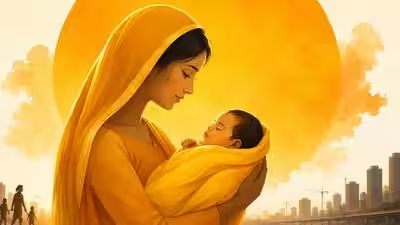
At 1.5, Jammu and Kashmir is not facing an immediate population collapse. But it is moving deeper into a demographic transition that could reshape the region over the coming decades – from the size of its schools and workforce to the way families care for older generations.
The change is particularly striking because it reverses the terms of a debate that has persisted for years.
Jammu and Kashmir was long discussed through the lens of population growth. Fertility, particularly among Muslims, was frequently presented as a measure of demographic expansion and political anxiety.
But the data increasingly complicate that narrative.
A fertility rate of 1.5 is about 71 percent of the replacement benchmark. If such levels persist, successive generations will be smaller than those preceding them.
That process will not necessarily be visible immediately.
Population momentum can continue to push the number of people upward even after fertility falls below replacement, because large cohorts already born continue to enter their reproductive years. But eventually the mathematics catches up. Smaller numbers of children become smaller cohorts of young adults. Those cohorts become the workers of the future.
The result can be a population that is older, with fewer people entering the labour market and relatively more people requiring support.
For Jammu and Kashmir, that raises questions that once seemed distant: Who will fill the jobs of the future? Who will care for ageing parents? Will schools have fewer pupils? What happens to villages when young adults leave or become fewer in number? And can an economy adapt if the working-age population grows more slowly – or eventually contracts?
These are not questions about one community. They are questions about demographic structure.
The decline was already underway. The region’s current fertility level did not appear suddenly. The National Family Health Survey-5 had already placed Jammu and Kashmir’s overall total fertility rate at about 1.4. Government data cited in a Times of India analysis put fertility at roughly 1.6 in 2015.
Taken together, the figures point toward a sustained transition rather than a one-year statistical anomaly.
The pattern fits a much larger global transformation.
More than half of the world’s countries and territories now have fertility below replacement level, according to United Nations estimates. In many societies, falling fertility has accompanied rising education, urbanisation, delayed marriage, improved child survival, greater access to contraception and changing expectations about family life.
Jammu and Kashmir is increasingly part of that world.
The implications may be most visible not in the next few years, but in the next few decades.
A child born into a small family today becomes part of a smaller generation tomorrow. When that generation reaches working age, there are fewer people available to replace those retiring. When it eventually has children of its own, the number of potential parents is smaller again.
Demography moves slowly. But once its direction is established, its effects can be remarkably persistent.
A stereotype meets the numbers
Perhaps the most politically charged part of Jammu and Kashmir’s demographic story concerns religion.
For years, the idea that Muslims have unusually large families has been used in India as shorthand for a wider claim: that Muslim population growth is exceptional, relentless and potentially destabilising.
Jammu and Kashmir’s own fertility data offer little support for such a simplistic interpretation.
NFHS-5 figures put the total fertility rate among Muslim women in the region at around 1.45 children per woman, compared with about 1.32 among Hindu women.
Both are dramatically below the replacement level of 2.1.
The difference between the two communities – roughly 0.13 children per woman – is also far smaller than the rhetoric surrounding Muslim fertility might suggest.
The broader Indian experience tells a similar story.
A major Pew Research Center analysis found that Muslim fertility in India fell from about 4.4 children per woman in 1992 to 2.6 in 2015. Hindu fertility declined over the same period from about 3.3 to 2.1.
The gap therefore narrowed from roughly 1.1 children per woman to about half a child.
That is not evidence of an immutable demographic divide. It is evidence of convergence.
The pattern matters because fertility is often discussed as though religious identity determines family size. Demographic research suggests something more complicated.
Education matters. Household income matters. Urbanisation matters. Women’s employment and autonomy matter. Access to health services and contraception matters. The age at which people marry matters. So do the costs of raising children and perceptions of economic security.
Religion can be part of a society’s cultural landscape, but it does not operate in isolation from these forces.
The differences within religious communities can be enormous.
Government data analysed by the Times of India, for example, showed Muslim fertility ranging from around 1.7 children per woman in Tamil Nadu to 4.1 in Bihar in NFHS-4 data.
The religion was the same. The demographic outcomes were not.
Geography, education, development, and social conditions clearly mattered.
Assam provides another example. NFHS-5 data showed Muslim fertility there falling from 3.6 children per woman in 2005-06 to 2.4 in 2019-20 – a decline of 1.2 children.
Jammu and Kashmir’s Muslim fertility rate of about 1.45 places it at the opposite end of that spectrum.
The figures do not support the idea that Muslims are inherently high-fertility.
They demonstrate a more ordinary, and more important, demographic truth: people change their reproductive behaviour.
The global picture is not as simple as saying that religion has no relationship to fertility.
Historically, Muslims have had higher fertility than many other major religious groups. Pew research estimated Muslim fertility at about 3.1 children per woman globally between 2010 and 2015, compared with a world average of roughly 2.5.
A younger Muslim population also contributed to faster population growth.
But neither fact establishes a permanent or biological tendency toward large families.
Pew projections have pointed toward substantial convergence in the decades ahead, with Muslim fertility projected to fall toward about 2.3 children per woman by 2050, while Hindu fertility was projected at around 1.8.
The same broader transition can be seen across societies with vastly different religious and cultural traditions.
Japan has endured exceptionally low fertility. South Korea has experienced some of the lowest fertility levels in the world. China has entered a period of population decline. Italy and several European countries have faced years of below-replacement fertility.
Their religions, histories and political systems differ.
Their demographic arithmetic does not.
Jammu and Kashmir is now confronting that arithmetic itself.
The regional figures also sit within a national transformation.
India, once widely described as a country defined by rapid population growth, has itself moved below replacement fertility. The United Nations Population Fund has noted a national total fertility rate of around 2.0, while NFHS-5 found that 31 states and Union territories had already fallen below replacement level.
The transition has occurred much faster than many older population narratives anticipated.
That does not mean India has stopped growing. Population momentum remains powerful because the country has a large population entering or already within reproductive ages.
But the direction is unmistakable.
For Jammu and Kashmir, the demographic transition may be particularly significant because fertility is already substantially below the national replacement threshold.
The question is therefore changing.
It is no longer simply: How many people will Jammu and Kashmir have?
It is: What kind of population will Jammu and Kashmir have?
A population with fewer children and a larger elderly share will have different economic needs from a young and rapidly expanding population.
Schools may eventually need fewer classrooms. Demand for childcare could change. Healthcare systems may face greater pressure from chronic conditions associated with ageing. Employers could confront tighter labour markets.
Families, too, will change.
An only child or one of two siblings may eventually be responsible for supporting ageing parents who once might have been cared for by several brothers and sisters.
Migration can alter some of these pressures, but it cannot erase the underlying fertility trend.
None of this makes population decline an immediate crisis.
Nor does it justify coercive measures designed to force people to have more or fewer children.
The more useful policy question is whether people are having the number of children they actually want – and, if they are not, what prevents them from doing so.
That distinction has become increasingly important in global demographic policy.
For young families, the decision to have a child can be shaped by housing costs, employment insecurity, childcare, healthcare, education expenses and the difficulty of balancing work and family life.
If Jammu and Kashmir wants to understand its demographic future, those are the questions worth asking.
The region may need to prepare simultaneously for two realities: a smaller flow of young people into the workforce and a growing need to support older generations.
That means thinking ahead about healthcare, pensions, employment, education, childcare and rural economies.
It also means resisting the temptation to turn demographic statistics into communal arithmetic.
The numbers are more revealing when stripped of political assumptions.
A replacement fertility rate of 2.1 is a demographic benchmark. Jammu and Kashmir’s fertility of roughly 1.5 is considerably below it. Muslim fertility in the region, at around 1.45, is lower still. Hindu fertility, at about 1.32, is lower again.
Across India, Muslim fertility has fallen sharply over the past generation, as has Hindu fertility.
The story is not one community multiplying while another disappears.
It is a society changing together, at different speeds and from different starting points.
For years, the dominant population fear in Jammu and Kashmir was that there would be too many people.
The emerging demographic warning is almost the mirror image.
There may eventually be too few young people to replace those who came before them.
And that may prove to be the more consequential population story of all.
About the Author
Mir Suneem is a filmmaker and postgraduate in filmmaking from Jamia Millia Islamia, with a strong interest in editing and narrative craft.