
There is something deeply uncomfortable about the numbers in the latest parliamentary data on forest fires in Jammu and Kashmir.
For four consecutive years, from 2021-22 through 2024-25, J&K received nothing from the Centre under the Centrally Sponsored Scheme for Forest Fire Prevention and Management.
Then, in 2025-26, after four years without an allocation, Jammu and Kashmir received Rs 11.08 lakh.
For the protection and management of forests spread across a mountainous region where forests cover nearly half of the geographical area.
The figure is not merely small. It raises a fundamental question about priorities.
If forests are described as critical ecological infrastructure — protecting watersheds, stabilising slopes, supporting wildlife, sustaining livelihoods and helping regulate climate — why is their protection being financed as though it were a peripheral concern?
The government has every right to point to the national systems it has established. The Forest Survey of India operates FAST 3.0, a satellite-based Forest Fire Alert System providing pre-fire warnings and near-real-time alerts. There are fire-danger ratings, risk-zonation maps, the Van Agni Geo-portal, standard operating procedures, and a Forest Fire Preparedness Index.
These are valuable tools.
But a satellite cannot put out a fire.
An alert cannot reach a remote slope without people capable of responding.
A map cannot replace fire lines, equipment, trained personnel, vehicles and local preparedness.
Technology is useful only when it is connected to capacity on the ground.
That is precisely where the funding question becomes difficult to ignore.
Nationally, the Centre released Rs 164.90 crore under the forest-fire prevention scheme between 2021-22 and 2025-26. Jammu and Kashmir received no funds for four of those years and Rs 11.08 lakh in the fifth.
At the same time, the Centre says a separate forest-fire mitigation programme funded through the National Disaster Mitigation Fund covers 144 high-priority fire-prone districts across 19 states, with an approved outlay of Rs 818.92 crore.
Jammu and Kashmir and Ladakh are not covered by that programme.
That omission deserves an explanation.
The argument cannot simply be that Jammu and Kashmir has fewer forest fires than some other parts of India. Forest-fire risk should not be assessed only by counting flames. The ecological consequences of losing forests in a Himalayan landscape can be disproportionately large.
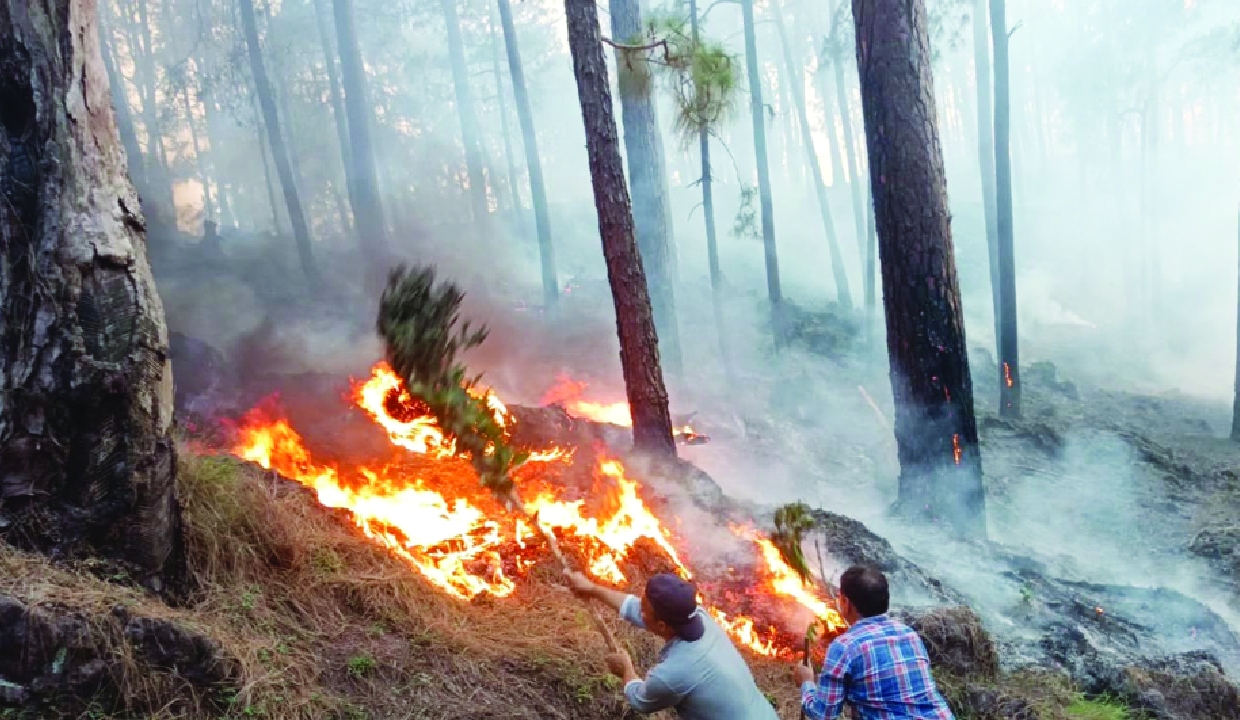
A forest fire in a mountain ecosystem is not just a local event.
Vegetation loss can expose slopes to erosion. It can affect soil moisture and water retention. It can damage habitats and disrupt wildlife. Repeated fires can alter forest composition. Smoke can affect nearby communities. And after vegetation is lost, heavy rainfall can turn a fire-damaged landscape into a vulnerability for landslides and runoff.
The cost of prevention is therefore not simply the cost of putting out a fire.
It is the cost of avoiding a chain of consequences.
Jammu and Kashmir’s geography makes the question even more pressing. Its forests stretch across difficult terrain, where access itself can be a challenge. A fire that begins in a remote area may not be easy to reach by conventional firefighting crews.
This should make preparedness more important, not less.
The government should consider whether funding formulas adequately reflect geography and ecological value rather than relying primarily on past fire incidence or administrative categories.
A forest that is difficult to reach needs more planning, not less. A forest that protects a watershed deserves to be treated as infrastructure. A forest located on a vulnerable mountain slope should be regarded as part of the region’s disaster-prevention system.
There is also a lesson in the four-year funding gap.
Prevention cannot be switched on when fire season begins.
Fire lines need maintenance. Equipment needs replacement. Personnel need training. Communication systems need testing. Communities need awareness programmes. Vulnerable areas need mapping. Access routes need planning.
All of this requires sustained funding.
A stop-start approach is particularly dangerous because the absence of a major fire in one year can create the illusion that preparedness is unnecessary. But risk does not disappear because flames did not make the headlines.
Climate change makes complacency even harder to justify.
Across the world, warmer conditions, changing precipitation patterns and prolonged dry periods are increasing concerns about wildfire risk. Jammu and Kashmir cannot assume that historical patterns will remain unchanged.
The government’s own investment in early-warning technology suggests that it recognises the importance of the threat.
The next step should be to match early warnings with adequate resources.
The Rs 11.08 lakh allocation is difficult to reconcile with the scale of the task.
Even a modest allocation must cover multiple requirements: prevention, equipment, training, monitoring, awareness and response. Once divided across a large forest landscape, the amount becomes even less meaningful.
This is where policymakers should ask a basic question: What exactly can Rs 11.08 lakh accomplish?
If the answer is limited, then the problem is not merely implementation.
It is allocation.
Jammu and Kashmir should also have a stronger voice in determining how forest-fire funding is structured.
If it is excluded from a major national mitigation programme covering hundreds of high-priority districts, there should be transparent criteria explaining why.
If the region does qualify under some circumstances, those criteria should be reviewed.
And if existing schemes do not adequately account for Himalayan fire risks, the framework itself should be reconsidered.
There is no contradiction between economic development and forest protection.
In fact, they are increasingly inseparable.
Jammu and Kashmir depends heavily on its natural landscape for tourism, agriculture, water security, and livelihoods. Destroying that natural capital while spending heavily on repairing its consequences is poor economics.
Prevention is almost always cheaper than recovery.
A forest fire that is prevented requires equipment and personnel. A burned forest can require years of ecological recovery.
The public conversation must therefore move beyond how much money was released and ask whether the money is sufficient for the responsibility being assigned.
The Centre has built impressive monitoring architecture. But the strongest warning system in the world is of limited value if the people receiving the alert do not have the equipment or resources to respond.
J&K does not need symbolic funding for its forests.
It needs predictable, multi-year investment. It needs access to national mitigation programmes where the risks justify it. It needs modern firefighting equipment, trained local teams, stronger community participation and reliable early-warning networks. And it needs a funding formula that recognises the value of Himalayan forests not merely as acreage, but as natural protection against a range of disasters.
The question is not whether Jammu and Kashmir deserves special treatment.
It is whether the country’s forest-fire policy is adequately protecting forests that perform a national ecological function.
Four years without funding, followed by Rs 11.08 lakh, is not a strategy. It is a warning.
The government already has the satellites, the alerts and the maps.
Now it needs to put enough resources behind them to ensure that when the warning comes, someone has the means to act.
About the Author
Wajahat Iqbal Kashtwari is a filmmaker and multimedia professional with a keen interest in environment, ecology, and climate change.