
Kashmir Impulse Desk
New Delhi, Aug 14
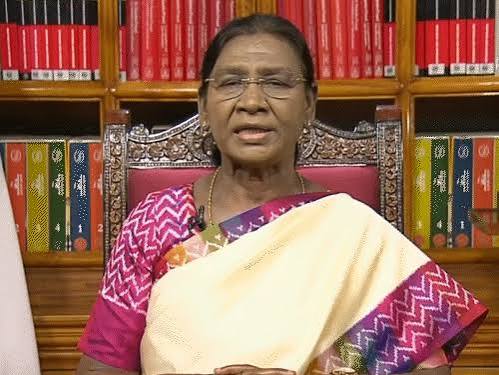
President Droupadi Murmu on Friday described India’s suspension of the Indus Waters Treaty with Pakistan as a “decisive step” in the national interest, particularly for farmers, while citing the country’s military response to terrorism as part of India’s broader security posture.
In an address to the nation on the eve of India’s 80th Independence Day, Murmu linked the suspension of the treaty to India’s response to terrorism and praised the armed forces for what she called their “unmatched valour”.
“Suspension of the IWT with the country that harbours terrorism is a decisive step in the interest of our nation, especially the farmers,” she said.
Murmu referred to Kargil Vijay Diwas, observed on July 26, and the anniversary of Operation Sindoor, launched on May 7, while highlighting India’s military capabilities.
She said Operation Sindoor had demonstrated the ability of the armed forces to conduct precision operations against terrorism.
“It sent a clear and firm message to terrorists and those who support them that no matter where they hide, they will have to face the consequences of their actions,” she said.
Murmu also described the reduction of Naxalism as a major national achievement, saying areas once affected by the insurgency were witnessing development and cultural activity. She cited participation in the Bastar Olympics and Bastar Pandum cultural festival as examples.
The president highlighted India’s cultural heritage, noting that 12 forts associated with the Maratha military tradition were added to the UNESCO World Heritage List last year and that Sarnath, where the Buddha delivered his first sermon, was added this year.
Opening her address, Murmu said Indians in the country and abroad celebrated Independence Day with the tricolour as a symbol of freedom.
She said the meaning of independence extended beyond political freedom to ensuring that citizens had the opportunities needed to fulfil their aspirations and help India become a leading global nation.
The president credited students, teachers, scientists, engineers, healthcare workers, farmers, workers, athletes, artists, craftspeople, intellectuals, public servants, investors, social workers and sanitation workers with contributing to nation-building.
She also praised India’s soldiers and police personnel and the Indian diaspora for contributing to the country’s global standing.
Murmu said India was working towards becoming a developed nation by 2047, guided by the principle of Antyodaya and seeking to ensure that development reached every section of society.
She recalled the freedom movement, saying people with differing ideologies had united around the goal of independence, and paid tribute to Mahatma Gandhi, B.R. Ambedkar and other leaders.
She also marked Partition Horrors Remembrance Day, saying millions were affected by Partition-related violence and displacement.
India faced the additional challenge of integrating more than 550 princely states after independence, she said, paying tribute to Sardar Vallabhbhai Patel for his role in integrating them into the newly independent country.
On democracy, Murmu said India’s Constitution was founded on public participation and stressed the respective responsibilities of the legislature, executive and judiciary.
She called for equal access to timely justice, particularly for disadvantaged sections.
The president said India had undergone rapid and inclusive development over the past decade, while seeking to combine economic growth with cultural heritage.
She highlighted the contributions of Jyotiba Phule and Savitribai Phule to social justice, education, women’s empowerment and equality and said more than 25 crore people had been lifted out of poverty.
According to figures cited by Murmu, nearly 59 crore people had joined the banking system under the Pradhan Mantri Jan Dhan Yojana, including more than 32 crore women. She said more than 80 crore people received free food rations and 60 crore people had access to healthcare coverage of up to Rs 5 lakh annually under Ayushman Bharat.
She also cited support for farmers through Kisan Samman Nidhi and Kisan Credit Cards.
Murmu said India’s digital infrastructure had expanded rapidly, with digital payments becoming commonplace even among small businesses and street vendors. She said more than half of the world’s real-time digital transactions took place in India.
Infrastructure expansion in highways, waterways, railways and airways was creating opportunities for new businesses, employment and investment, she said.
Despite global instability and wars in different parts of the world, India remained the world’s fastest-growing major economy, Murmu said, adding that projections showed India’s growth rate would be more than twice the global average.
She said the Atmanirbhar Bharat initiative had strengthened the country’s economic and national-security foundations.
On climate policy, Murmu said India was pursuing modern development while protecting the environment and had achieved some Sustainable Development Goals ahead of schedule. She called for greater conservation and cited the campaigns “Ek Ped Maa Ke Naam” and Lifestyle for Environment.
The president also highlighted women’s economic and political participation. More than 10 crore women were members of Self Help Groups, she said, while three crore Lakhpati Didis had already been created, with a further target of three crore.
She said about two-thirds of entrepreneurs receiving financial assistance under the MUDRA scheme were women and noted the enactment of the Nari Shakti Vandan Adhiniyam, which provides for 33 percent representation for women in the Lok Sabha and state legislative assemblies.
Murmu described India’s youth as a major national asset, noting that 65% of the population was below the age of 35.
She highlighted young entrepreneurs, start-ups, employment creation and a recent space launch led by a team with an average age of 28.
She also called for reforms to make public examinations more transparent and secure and said sports were being used as a tool for youth development and nation-building.
Under Khelo India, she said, India’s sports ecosystem was being expanded from the grassroots to the national level.
Murmu also noted the growing number of senior citizens and said about six crore people aged 70 and above could access free healthcare coverage of up to Rs 5 lakh a year.
On foreign policy, Murmu said India’s national interest remained its foundation, while peace, cooperation, dialogue and the principle of Vasudhaiva Kutumbakam remained key pillars.
She said India was strengthening economic ties through free trade agreements, playing a leading role among developing countries and advocating a rules-based international order and greater representation for the global community in multilateral institutions.
Murmu said the ultimate objective of building a developed India was the welfare of every citizen.
Quoting Telugu writer Gurajada Apparao, she said a nation was defined not merely by its land but by its people, and called for collective efforts to make India healthier, happier and more prosperous by 2047.