
Kashmir Impulse Desk
New Delhi, July 25
India’s Education Minister Dharmendra Pradhan resigned on Saturday after weeks of nationwide student protests over alleged irregularities in competitive examinations, prompting organisers of the 36-day agitation to call off their campaign after the government agreed to their remaining demands.
The resignation marked a major political setback for Prime Minister Narendra Modi’s government, which had initially resisted the student-led campaign but eventually opened negotiations with protesters as the agitation gathered momentum and drew growing public attention.
The Cockroach Janta Party (CJP), which emerged from an online satirical campaign and evolved into the driving force behind the protests, said it was ending the agitation after the government agreed to provide compensation to the families of students who allegedly died by suicide following the controversy surrounding the National Eligibility-cum-Entrance Test (NEET), and to withdraw criminal cases filed against protesters.
“Keeping all these considerations in mind, I have sent my resignation to the Hon’ble Prime Minister,” Pradhan said in a statement, adding that developments over the previous 10 days had deeply saddened him.
He said the issue was not one of “personal prestige” and that he wanted to prevent the situation from being exploited by “anti-national forces”, preserve national unity and ensure that the future of students did not become entangled in legal disputes.
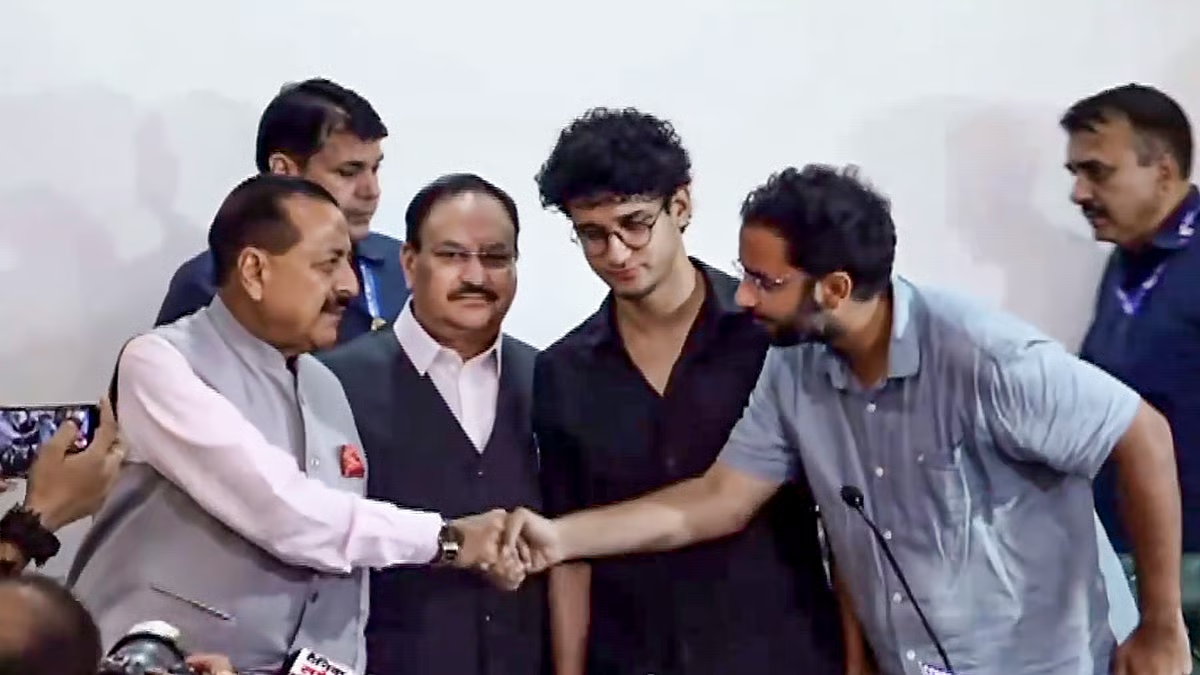
The announcement followed a third round of negotiations between government representatives and CJP leaders at the Constitution Club of India in New Delhi. Union ministers J P Nadda and Jitendra Singh met CJP representatives Saurav Das and Ashutosh Ranka.
Nadda later said the government would provide “honourable compensation” within the applicable rules to families of students who died by suicide after the NEET controversy. He also said criminal cases registered against protesters would be withdrawn.
“As the government accepted all our demands, we call off our protests with immediate effect,” Das told reporters, urging demonstrators to return home peacefully.
At New Delhi’s Jantar Mantar, where the agitation had been centred, protesters broke into celebrations after news of Pradhan’s resignation spread. Demonstrators waved the national flag, embraced one another and chanted “Hum Jeet Gaye”, or “We have won”, as authorities began overseeing the dispersal of the crowd.
The Delhi Metro Rail Corporation reopened entry and exit gates at nearby stations to facilitate the movement of protesters.
The resignation is one of the rare instances since Modi became prime minister in 2014 in which sustained public pressure has resulted in the departure of a senior minister. Pradhan is the second Union minister in Modi’s tenure to resign following a prolonged public controversy, after former minister of state for external affairs M J Akbar stepped down in 2018 amid sexual harassment allegations during India’s #MeToo movement.
The episode also adds to a limited number of occasions when the Modi government has backed away from contentious policies following sustained opposition. These include its decision to shelve proposed changes to India’s land acquisition law in 2015 and the repeal of three farm laws in 2021 after prolonged protests by farmers.
The CJP-led agitation began at Jantar Mantar on June 20, initially focusing on demands for accountability over alleged examination irregularities and the NEET paper leak. It gained wider national visibility after activist Sonam Wangchuk joined the protest on June 28 and began an indefinite hunger strike alongside six All India Students’ Association activists.
Wangchuk ended his fast on Thursday following outreach from the central government.
The government’s first formal talks with CJP representatives took place on July 20 at Nadda’s residence, even as police detained protesters marching towards Parliament. The confrontation became a turning point for the movement, according to organisers, and helped broaden public support.
A second round of talks followed on Friday after the protesters demanded that negotiations be held at a neutral venue rather than at a minister’s residence.
Wangchuk’s forcible removal from Jantar Mantar to Safdarjung Hospital on July 18 had also triggered criticism and intensified public attention on the protests.
Reacting to Pradhan’s resignation, Wangchuk called it a victory for democracy and for a movement that had remained peaceful despite mounting pressure.
“It is a victory of peace, patience and perseverance,” he said, congratulating the CJP, young people and citizens who had joined the campaign.
Opposition parties, however, said the resignation did not resolve all the issues surrounding the protests.
Congress leader and Leader of Opposition in the Lok Sabha Rahul Gandhi said two demands remained outstanding – action against those responsible for alleged violence against protesting students and an apology from Prime Minister Narendra Modi.
Gandhi accused the government of using excessive force against demonstrators and said the issue would remain a major point of confrontation in Parliament. The government has not accepted those allegations.
The ruling Bharatiya Janata Party defended Pradhan, with party president Nitin Nabin describing his resignation as an act reflecting integrity and selfless service.
“As Union education minister, he played a pivotal role in reforming India’s education landscape and implementing the landmark National Education Policy,” Nabin said in a post on X, adding that the party stood firmly behind Pradhan.
Pradhan’s departure came a day after the government announced measures aimed at addressing concerns over examination irregularities, including a proposed law providing stringent punishment for those involved in paper leaks and plans for fast-track courts to accelerate trials.
The government has faced mounting scrutiny over the integrity of India’s competitive examination system, where millions of young people compete each year for university places and public-sector jobs.
The resignation and the government’s concessions bring an end to the immediate phase of the agitation, but the controversy over examination security, accountability and the treatment of protesters is likely to remain a political issue, particularly as Parliament prepares to debate the government’s response.