
Kashmir Impulse Desk
Srinagar, Nov 6
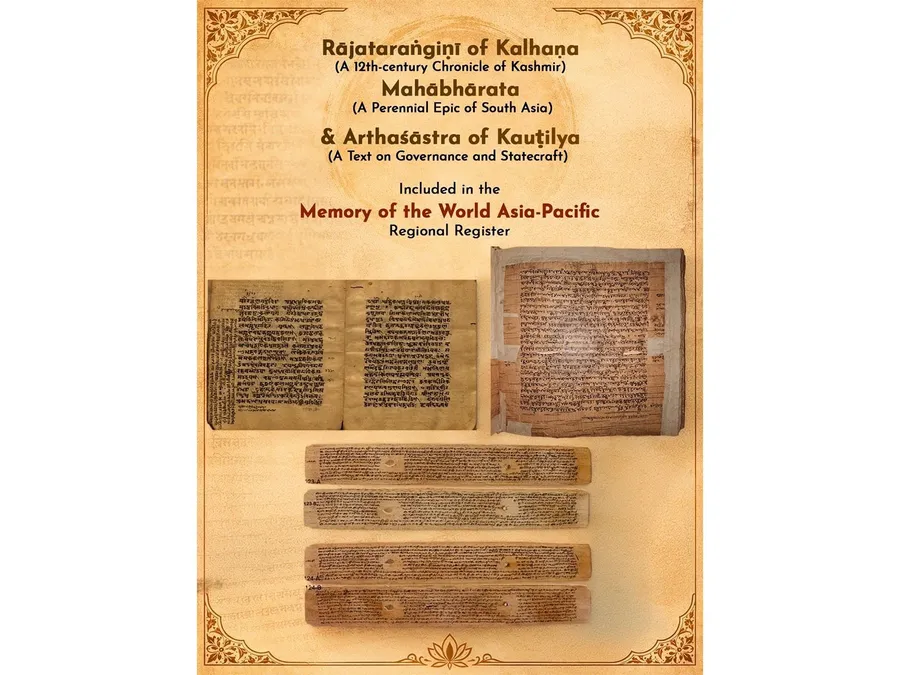
Kalhana’s 12th-century chronicle of Kashmir, Rajatarangini, has been inscribed on UNESCO’s Memory of the World Asia-Pacific Regional Register, bringing international recognition to one of the earliest systematic historical accounts of the Indian subcontinent.
Two other Indian works, the Mahabharata and Kautilya’s Arthashastra, have also been added to the register following decisions taken at the 11th session of UNESCO’s Memory of the World Committee for Asia and the Pacific (MOWCAP) in Jakarta, Indonesia.
The Union Ministry of Culture announced the inscriptions on Thursday through the Press Information Bureau. The nomination dossiers for all three works were prepared by the Indira Gandhi National Centre for the Arts (IGNCA).
With the latest additions, India’s entries in the regional register have increased to six. The three earlier inscriptions, made in 2024, were illustrated manuscripts of Tulsidas’s Ramcharitmanas, a 15th-century manuscript of the Panchatantra and Sahrdayaloka-Locana, a treatise on Indian literary aesthetics.
The inscription of Rajatarangini is particularly significant for Kashmir because the recognised manuscript is preserved at the Oriental Research Library in the Sri Pratap Singh Library Complex in Srinagar.
Written in Sanskrit between 1148 and 1149 CE, the chronicle comprises 7,826 verses divided into eight books, known as Tarangas. It documents the history of Kashmir’s rulers and dynasties, political developments and social and cultural life, tracing the region’s past from its legendary beginnings to the reign of King Jayasimha in the 12th century.
Kalhana’s work is distinguished by its use of earlier accounts and available historical sources, alongside critical assessment of events, rather than relying exclusively on royal genealogies.
The manuscript is written in the Sharada script on traditional Kashmiri birch bark, making it an important record of the region’s literary and manuscript traditions.
The Mahabharata manuscript, officially titled “The Birch-bark (burjapatra) Manuscript of Mahabharata – A Perennial Epic of South Asia”, is preserved at the Bhandarkar Oriental Research Institute in Pune. It represents an important witness to an older Kashmiri recension of the Sanskrit epic.
Indologist Georg Bühler acquired the manuscript in Kashmir in 1875. It is regarded as a significant textual source for the study of the epic.
The third inscription, “Kautilya’s Arthashastra, Ancient Palm-leaf Manuscript on Governance and Statecraft”, is preserved at the Oriental Research Institute in Mysuru.
Attributed to Kautilya, also known as Chanakya or Vishnugupta, the Sanskrit treatise examines governance, administration, economic policy, diplomacy, military strategy and statecraft. The surviving document is a 16th-century palm-leaf manuscript written in the Grantha script.
Union Culture Minister Gajendra Singh Shekhawat described the inscriptions as recognition of India’s documentary and civilisational heritage, saying the works represented traditions of historical inquiry, philosophical thought and statecraft.
The UNESCO Memory of the World Programme seeks to preserve documentary heritage and promote its accessibility and recognition across generations.
Lieutenant Governor Manoj Sinha welcomed the inscriptions, describing them as a proud moment for Jammu and Kashmir and the country.
In a post on X, Sinha said the inclusion of Rajatarangini recognised the Union Territory’s intellectual heritage and highlighted the contribution of India’s civilisational traditions to humanity. He also stressed the responsibility to preserve the works for future generations.
Chief Minister Omar Abdullah also congratulated the people of Jammu and Kashmir, saying the recognition had brought international attention to the region’s historical and cultural legacy.
He said the inscription highlighted the importance of safeguarding manuscripts and historical records and would strengthen efforts to preserve, document and promote Jammu and Kashmir’s cultural heritage.