
There is something both comforting and unsettling about seeing Kashmiri literature bound between two covers.
For Kashmiris, literature has rarely been confined to books. It has lived in the voice of a grandmother, in the wanwun sung at weddings, in the ladishah that mocked authority, in the vaakh remembered without its author, and in lullabies whose words survived even as their meanings faded. It travelled orally across generations, often without institutions, archives or literacy.
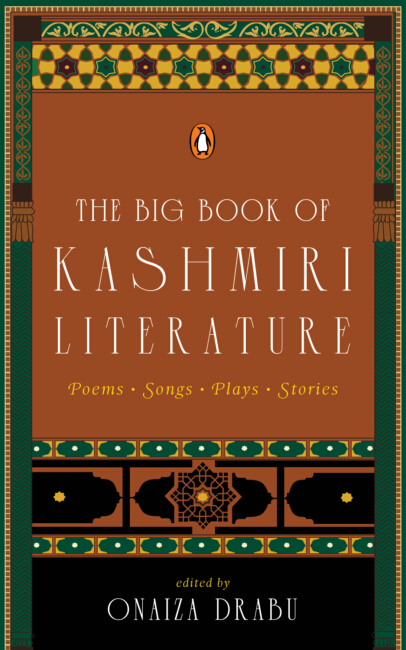
That is what makes The Big Book of Kashmiri Literature: Poems, Songs, Plays, Stories, compiled and translated by Onaiza Drabu, more consequential than its plain title suggests.
Published by Penguin India, the 664-page anthology introduces English-language readers to Kashmiri literature from the 14th century to the present. It brings together canonical poets and lesser-known voices, devotional verse and folk traditions, ghazals and songs, theatre and radio plays, flash fiction and excerpts from novels.
It is an ambitious attempt to make a literary culture visible beyond its linguistic borders.
But it also poses a difficult question: What happens to Kashmiri literature when Kashmiri is taken out of Kashmiri?
The answer is neither simple nor entirely comfortable. Translation opens a door, but it also changes the room.
Drabu has written about growing up in Srinagar in a multilingual environment, understanding Kashmiri more readily than she could speak it, and later confronting the experience of learning to read her mother tongue.
That reflects a condition familiar to many younger, English-educated Kashmiris. Kashmiri may be the language of home, relatives and memory while English becomes the language of education and professional life.
In that sense, Drabu’s project is not merely a translation of Kashmiri literature for outsiders. It is also a bridge back to Kashmiri literature for Kashmiris who have inherited the language without inheriting its written tradition.
That may be the book’s most compelling reason to exist.
Drabu approaches Kashmiri literature not simply as a canon of celebrated writers but as a broader cultural inheritance. The anthology includes saints and scholars, poets and dramatists, as well as what Penguin describes as “unlettered poets.”
That category matters.
For centuries, Kashmir’s literary culture was sustained by people whose work was spoken, sung and remembered. A woman singing at a wedding was participating in literature. A shepherd’s song could become literature. A satirical verse passed from village to village could survive without an author’s name.
The community, in such cases, became the author.
This is one of the anthology’s strongest ideas: Kashmiri literature is not merely what Kashmiri writers wrote. It is also what Kashmiris remembered.
That broader definition prevents the familiar flattening of Kashmir’s literary history into a procession of famous names.
Lal Ded, Sheikh Nooruddin Noorani, Habba Khatoon and Mahjoor are indispensable, but they do not constitute the whole story.
Lal Ded remains one of the foundational voices of Kashmir’s literary and spiritual imagination. Her vaakhs move between philosophy, mysticism, and intimate reflection, while their oral transmission allowed them to cross religious and social boundaries.
Sheikh Nooruddin Noorani, or Nund Rishi, similarly became part of Kashmir’s moral vocabulary through his shrukhs, which speak of spiritual discipline, compassion and social reflection.
Together, Lal Ded and Nund Rishi represent something essential about Kashmir: a literary culture in which spiritual traditions could overlap and enter popular memory.
Then comes Habba Khatoon, whose poetry changes the register.
Her songs bring longing, separation, love and domestic experience to the centre of Kashmiri poetic expression. Her enduring place in popular memory is itself a reminder that literature does not always require a library. It can survive in melody.
Mahjoor brought lyric poetry into conversation with social consciousness and modern political feeling. Dina Nath Nadim pushed Kashmiri poetry toward modernism, free verse and new dramatic forms, while writers such as Akhtar Mohiuddin expanded Kashmiri prose.
This matters because Kashmir is too often represented as if its culture begins and ends with saints, mystics, mountains and lakes.
Its literature tells a messier story.
There is desire and jealousy, humour and grief, poverty and social hierarchy, domestic conflict and political anxiety. There is absurdity as well as beauty.
The Kashmir of literature is not the Kashmir of a tourism brochure.
That makes translation particularly important — and particularly difficult.
A Kashmiri poem is not only its dictionary meaning. Sound matters. Rhythm matters. Syntax matters. A word can carry geography, class, age or intimacy. Another can evoke a landscape or custom that has no neat equivalent in English.
A translation can communicate what a poet said while losing something of how the poet sounded.
This is not necessarily a flaw in Drabu’s work. It is the basic dilemma of translating poetry from a language whose cultural associations are deeply embedded in oral performance.
The Big Book of Kashmiri Literature should therefore not be regarded as a substitute for Kashmiri literature. It is better understood as an invitation to enter it.
For a Kashmiri reader, that distinction can be powerful. A person may recognise a phrase heard from a grandparent but never previously encountered in written form. A poem remembered as a song may suddenly acquire a literary history. A familiar expression may reveal itself as part of a centuries-old tradition.
The book can produce recognition as much as discovery.
There is, however, a legitimate question about authority.
Drabu’s acknowledged limitations as an active speaker of Kashmiri have prompted discussion about whether someone who is receptive-bilingual rather than fully fluent can adequately translate the language’s deepest nuances.
Such criticism should not automatically be dismissed. Nor should it become a simplistic argument that only a “native speaker” can translate Kashmiri.
Translation requires linguistic competence, cultural knowledge, historical understanding and literary judgment. A project of this scale should invite sustained scrutiny from Kashmiri writers, scholars, linguists and translators across generations.
That does not diminish Drabu’s contribution. It raises the standard for what comes next.
Because no single anthology can be definitive.
There will always be omissions, disputed selections, competing translations and arguments over literary importance. In a language with such a strong oral tradition, the problem becomes even more complicated: What happens to material that was never formally written down? Who owns a folk song? Who is its author?
These are not peripheral questions. They are at the heart of Kashmiri literary history.
The anthology’s greatest achievement may therefore be that it makes the scale of that history visible.
For decades, the outside world’s understanding of Kashmir has been overwhelmingly political.
Conflict. Militancy. India. Pakistan. Article 370. Borders. Elections.
Those words describe important realities, but they do not describe a civilisation.
Literature supplies another vocabulary.
A poem can reveal an emotional world that a political report cannot. A folk song can illuminate women’s lives. Satire can expose the relationship between ordinary people and authority. A play can capture the anxieties of a generation.
Literature does not make politics irrelevant. It makes the people who live through politics visible.
That may be the book’s greatest service to readers outside Kashmir.
But the book contains a paradox.
The attempt to preserve Kashmiri literature through English translation can also underline the linguistic displacement that threatens the literature’s future.
A young Kashmiri who reads Lal Ded in English has gained access to Lal Ded. But if that reader never learns to read Lal Ded in Kashmiri, something remains unresolved.
The anthology cannot solve that problem.
Its task is to make the literature accessible. The larger cultural task belongs to families, schools, universities, publishers and institutions: ensuring that Kashmiri remains a language in which people read, write, teach and create.
That is why the anthology may be most meaningful to the Kashmiri who has inherited the language without inheriting its literary library.
Some people speak Kashmiri fluently but have never read a Kashmiri poem. Others understand every word of a wanwun but cannot read the script in which Kashmiri literature is preserved. There are English-educated Kashmiris who know the names of Lal Ded, Habba Khatoon, Mahjoor, Nadim and Rahi but have encountered only fragments of their work.
For them, the English-language anthology is not an end point.
It is a bridge.
The book is not important because it settles every argument about Kashmiri literature. It is important because it starts conversations about what belongs to that literature, who gets to translate it, who gets to read it, and what happens when a culture’s literary inheritance becomes increasingly distant from its speakers.
Its 664 pages cannot contain Kashmir’s literary universe. No book could.
But they can provide a map.
And maps are useful precisely because they show us where we are while reminding us how much remains unexplored.
For the outsider, The Big Book of Kashmiri Literature is an introduction to a literary tradition far richer than the usual images of Kashmir suggest.
For the Kashmiri, it can be more unsettling.
It may remind us that we know Kashmir better than we know Kashmiri literature.
That is not entirely the translator’s failure.
It is ours.
A language does not survive merely because it is spoken around the dinner table. It needs readers. It needs writers, teachers, publishers, archives and critics. It needs children who can encounter their literary inheritance in the original rather than discovering it only after it has passed through another language.
Drabu’s anthology cannot provide all of that.
But it can make the absence visible.
And perhaps that is enough.
The strongest way to read The Big Book of Kashmiri Literature is not as the final word on Kashmiri literature but as an invitation to hear it again.
If an English-speaking Kashmiri encounters Lal Ded here and searches for the vaakh in Koshur; if Habba Khatoon’s poems lead someone back to her songs; if Nadim prompts a reader to explore modern Kashmiri literature; if a young person discovers that the language spoken by grandparents carries seven centuries of literary memory – then the anthology will have achieved something beyond translation.
It will have created readers.
And that may be the most important measure of a literary revival.
Kashmir does not need another book telling the world that it is beautiful.
It needs its own people to rediscover the beauty of their language.
The Big Book of Kashmiri Literature cannot accomplish that alone. But it can open the door.
The rest is up to those willing to walk through it.
About the Author
Amir Yaseen is a Srinagar-based journalist interested in Kashmir, policy, progress, and the human stories shaping everyday life.