

Kashmir Impulse Desk
New Delhi, July 18
India on Saturday successfully launched its first privately developed orbital-class rocket, marking a milestone in the country’s efforts to build a globally competitive commercial space industry as the government expands the role of private enterprise in a sector long dominated by the state.
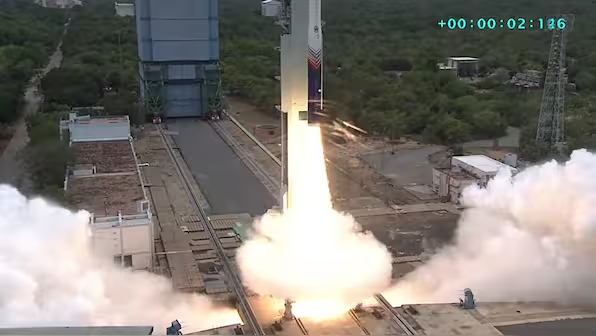
The four-stage Vikram-1 launch vehicle, developed by Hyderabad-based Skyroot Aerospace, lifted off from the Satish Dhawan Space Centre in Sriharikota at 12:05 p.m. local time, becoming the first Indian private rocket to carry payloads into low Earth orbit. The launch followed a brief delay of about 35 minutes to resolve an apparent navigation issue before liftoff.
Dubbed Mission Aagaman, the maiden orbital flight is designed to demonstrate India’s indigenous private launch capability. The rocket, named after Indian space pioneer Vikram Sarabhai, can place payloads of up to 350 kg into low Earth orbit and carries multiple technology demonstration payloads from domestic and international customers, along with Skyroot’s own SCOPE satellite.
Prime Minister Narendra Modi hailed the mission as “a defining moment in India’s space journey”, saying the growing participation of private companies was accelerating innovation and opening new frontiers in the country’s space programme. He said the achievement would inspire a new generation of entrepreneurs and innovators. Union Home Minister Amit Shah and Jammu and Kashmir Lieutenant Governor Manoj Sinha also congratulated the company, describing the mission as a landmark for India’s expanding space sector.
The launch underscores the rapid transformation of India’s space industry since reforms opened satellite manufacturing, launch services and other space activities to private companies under the Indian Space Policy 2023. The government has since established the Indian National Space Promotion and Authorisation Centre (IN-SPACe) as the sector’s single-window regulator while introducing dedicated funding mechanisms to support emerging space startups.
India’s space startup ecosystem has expanded from a single company in 2014 to more than 400 in 2026, according to official figures. The country’s space economy, currently valued at about $8.4 billion, is projected to grow to $40-45 billion by 2030, with policymakers aiming to position India as a major player in the global commercial space market.
Amit Shah, LG Sinha say mission marks milestone for India’s private space sector
Union Home Minister Amit Shah and Lieutenant Governor Manoj Sinha on Saturday congratulated Skyroot Aerospace on the successful launch of Vikram-1, describing the mission as a major milestone for India’s growing private space industry and its ambitions to emerge as a global space power.
Shah said the successful launch of the country’s first privately developed orbital launch vehicle marked “a new horizon” for India’s space programme and would strengthen the country’s position in the global space sector. He described the mission as a step towards Prime Minister Narendra Modi’s vision of making space more accessible through greater private sector participation.
Vikram-1, a four-stage launch vehicle developed by Hyderabad-based Skyroot Aerospace, lifted off from the Satish Dhawan Space Centre in Sriharikota earlier on Saturday, successfully deploying multiple technology demonstration payloads into low Earth orbit during its maiden mission, dubbed Mission Aagaman. The company described the launch as a success, marking India’s entry into the private orbital launch market.
Lieutenant Governor Manoj Sinha called the launch a historic achievement and congratulated the Skyroot team for its pioneering work, saying the mission reflected India’s growing emphasis on innovation and private enterprise in the space sector. He expressed hope that the achievement would inspire more young Indians to pursue careers in science, technology and space research.