
Kashmir Impulse Desk
Drass, July 26
Defence Minister Rajnath Singh said on Sunday that India had the capability and political will to respond to any future aggression from Pakistan with a force greater than its adversary could anticipate, while ruling out dialogue with Islamabad unless it concerned Pakistan-occupied Kashmir (PoK).
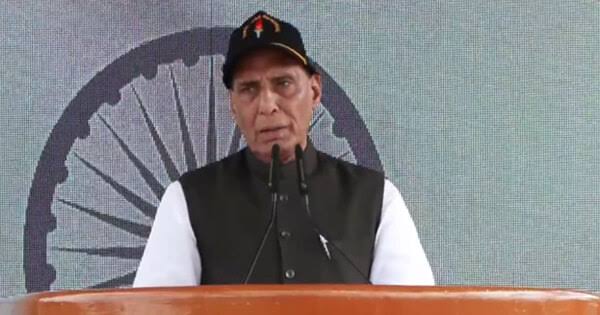
Addressing the 27th Kargil Vijay Diwas commemorations at the Kargil War Memorial in Drass, Singh said the outcome of Operation Sindoor had demonstrated India’s ability to respond decisively to threats and accused Pakistan of blurring the distinction between its military establishment and militant groups.
“Every nefarious act against India’s sovereignty would be met with the same resolute response that the Indian defence forces delivered to terrorists and their patrons through Op Sindoor with unmatched bravery,” Singh said.
He said India would not engage in talks with Pakistan on issues other than PoK, which New Delhi regards as an integral part of India under illegal Pakistani occupation.
Singh’s remarks came as India marked the anniversary of the 1999 Kargil War, when Indian forces recaptured strategic positions occupied by Pakistani troops in the high-altitude Kargil sector.
The defence minister said Pakistan’s military and militant organisations had become increasingly intertwined, arguing that India’s approach to cross-border terrorism had therefore changed.
“Pakistan’s military not only shelters terrorist organisations but also works with them. That is why, during Op Sindoor, we made it clear that India no longer views terrorists and the governments that nurture them as separate entities,” he said.
Singh contrasted the development paths of India and Pakistan, saying that while India was investing in technology, innovation, manufacturing and digital infrastructure, Pakistan was continuing to support terrorism and infiltration.
“While India is exploring new avenues of innovation, Pakistan is seeking new routes for infiltration,” he said, drawing a series of comparisons between India’s technology and manufacturing ambitions and what he described as Pakistan’s support for militant networks.
The minister said the government had given the armed forces the political backing needed to respond to security threats and expressed confidence that India’s military preparedness would deter adversaries from challenging the country’s territorial integrity.
He also paid tribute to soldiers killed during the Kargil conflict, remembering among them Param Vir Chakra awardees Captain Vikram Batra and Captain Manoj Kumar Pandey.
Singh described Kargil Vijay Diwas as a day of national remembrance and inspiration, particularly for young Indians seeking to understand the difference between individual achievement and service to the nation.
“This day teaches us that the spirit of ‘sacrifice’ and ‘service’ forms the backbone of any nation,” he said.
He said the Kargil War Memorial represented the country’s unity, noting that the soldiers commemorated there came from different parts of India.
“This wall of unity, despite diversities, stands tall against those who wish to harm us,” Singh said.
Referring to conflicts in West Asia and the continuing Russia-Ukraine war, Singh said modern conflicts had tested not only military capabilities but also the resilience and resolve of nations.
He said national security was a collective responsibility and called on citizens to develop a sense of discipline and duty, arguing that every Indian should be mentally prepared to support the country in times of crisis.
“I am not suggesting that every citizen must become a soldier, but should the nation ever face a situation requiring the direct or indirect support of its people, every Indian must be mentally, morally and physically prepared to step forward in defence of the country,” he said.
Singh also linked the government’s vision of a developed India by 2047 to national security, cultural confidence and social cohesion, saying economic progress alone would not be sufficient to achieve the country’s long-term ambitions.
He said the government was prioritising national security and the welfare of soldiers, while drawing lessons from the Kargil conflict about the need for constant vigilance along India’s borders.
Singh said border infrastructure was being strengthened and the armed forces were being modernised to meet changing security challenges.
Highlighting India’s push for defence self-reliance, the minister said the country had significantly reduced its dependence on imports and was now manufacturing a larger share of its defence equipment domestically.
He cited a range of indigenously developed systems and platforms, including the Akash-Teer air defence control system, the next-generation Akash missile, the aircraft carrier INS Vikrant, Tejas light combat aircraft, Prachand light combat helicopters, Dhruv advanced light helicopters, Arjun main battle tanks, Pinaka rocket launchers, Astra air-to-air missiles and modern drone and counter-drone systems.
Singh said the government intended to accelerate domestic defence production and develop more advanced weapons, fighter aircraft, submarines and missiles within India.
During the commemorative ceremony, Singh laid a wreath at the Kargil War Memorial and observed silence in memory of soldiers killed during Operation Vijay.
Ladakh Lieutenant Governor Vinai Kumar Saxena, Chief of the Army Staff General Dhiraj Seth, Northern Army Commander Lieutenant General Pratik Sharma, 14 Corps commander Lieutenant General Madanraj Pande and 8 Mountain Division commander Major General A.P. Singh joined the ceremony, alongside senior civil and military officials, veterans, gallantry award recipients and families of fallen soldiers.
Singh also witnessed “Gaurav Gatha”, a presentation recounting the conduct of Indian troops during Operation Vijay, and inaugurated a virtual walkthrough portal intended to provide wider public access to the history of the Kargil War.
He later visited the Hut of Remembrance and paid homage at Veer Bhoomi before interacting with soldiers, dignitaries and families.
The defence minister also flagged in the “Shaurya Vijay Yatra”, a motorcycle rally that had begun at the National War Memorial in New Delhi on July 14 as part of the Kargil Vijay Diwas commemorations.
In New Delhi, Minister of State for Defence Sanjay Seth laid a wreath at the National War Memorial, while Chief of Defence Staff General N S Raja Subramani, Air Chief Marshal A.P. Singh, Navy Chief Admiral Krishna Swaminathan, Defence Secretary Rajesh Kumar Singh and Vice Chief of Army Staff Lieutenant General Sandeep Jain also paid tribute to the soldiers who died in the line of duty.
The commemorations in Drass came amid heightened attention to India’s security posture and its relations with Pakistan, with Singh’s remarks signalling that New Delhi’s position on cross-border terrorism and dialogue remains uncompromising.