
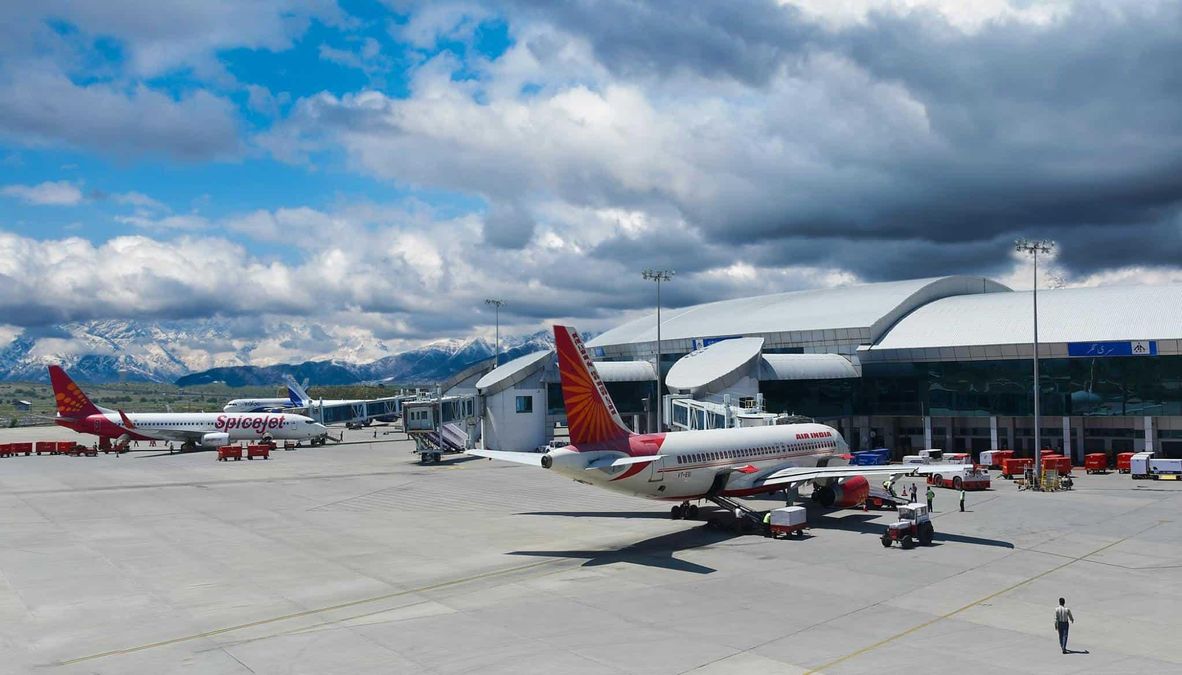
For years, Srinagar’s airport has been asked to absorb a steadily expanding stream of travellers – tourists arriving for Kashmir’s peak seasons, residents flying out for work and education, pilgrims and business travellers moving through the Valley, and increasingly, passengers who have come to rely on air travel as one of the region’s fastest links with the rest of India.
Now, the airport is set for its biggest capacity expansion in years.
The Jammu and Kashmir administration has informed the Ministry of Home Affairs that the proposed expansion of the Civil Enclave at Srinagar will involve an estimated investment of Rs 1,667 crore, with a new integrated terminal designed to handle as many as 1 crore passengers annually.
The project was approved by the Cabinet Committee on Economic Affairs on February 24, 2026, according to details submitted by the J&K government.
The proposed terminal will have a built-up area of 71,500 square metres and is designed to handle 2900 passengers during peak hours.
The project has an estimated implementation period of 48 months and is currently in the tendering process. The administration expects it to be completed by 2031.
For Kashmir, where air connectivity has become closely tied to tourism and the wider economy, the expansion represents more than an airport construction project.
It is an attempt to build infrastructure for a region whose dependence on air travel has grown faster than the capacity of its existing facilities.
And alongside Srinagar’s expansion, another aviation possibility is being examined: whether Katra, the gateway to the Shri Mata Vaishno Devi shrine, can support an airport or another suitable aviation facility of its own.
The case for expanding Srinagar begins with a simple reality: the airport is increasingly carrying the weight of Kashmir’s growth.
Passenger traffic rises sharply during the tourist season, when aircraft carrying visitors from across the country converge on the Valley. The same infrastructure must simultaneously accommodate local residents, business travellers and others dependent on air connectivity.
The proposed terminal is intended to provide additional capacity while improving the way passengers move through the airport.
Its 71,500-square-metre footprint is designed around a much larger scale of operation than the present system. With a planned annual handling capacity of 1 crore passengers, the terminal is being built with future growth in mind rather than simply today’s congestion.
Peak-hour capacity is projected at 2,900 passengers.
The aim, officials said, is to improve passenger movement, reduce congestion and provide modern facilities capable of handling the expected increase in traffic.
That expansion could matter particularly during the periods when Kashmir’s tourism economy is under the greatest pressure.
An airport is often the first and last major point of contact for a visitor arriving in a destination. Queues, crowded terminal spaces and delays can shape perceptions of a trip as much as hotels or tourist attractions do.
A larger terminal does not by itself guarantee smoother travel. But increased processing capacity can give airlines and airport operators more room to manage rising passenger volumes.
For Kashmir, that additional room could become economically important.
Air connectivity is one of the foundations of Kashmir’s tourism industry.
The Valley’s geography makes air travel particularly important for visitors arriving from distant parts of India. Although road and rail links have improved, aviation remains the fastest way for many travellers to reach Srinagar.
The proposed expansion therefore has implications well beyond the airport’s boundary.
More capacity can support the movement of tourists into the Valley, while also making it easier for residents to travel out.
Hotels, restaurants, taxis, tour operators, handicraft businesses, airlines and other tourism-dependent enterprises all benefit from the movement of visitors.
So do sectors less obviously associated with tourism.
Business travellers depend on predictable connections. Traders require access to markets. Horticulture businesses depend on transport networks capable of moving people and, where aviation logistics permit, high-value time-sensitive produce.
A more capable airport can therefore function as economic infrastructure rather than merely transport infrastructure.
Officials have described the Srinagar project in those broader terms, linking improved aviation facilities with regional connectivity and socio-economic development.
The administration has also stressed that the project should be delivered on schedule while maintaining quality, aviation safety and sustainability.
Those objectives may become increasingly important as the airport expands.
Building a larger terminal is one challenge. Integrating it efficiently with roads, security systems, aircraft operations, parking and passenger access is another.
While Srinagar prepares for a larger terminal, the government is also examining whether Katra should have a direct aviation connection.
The proposal is at a much earlier stage.
The administration has recommended a feasibility study to examine the possibility of establishing an airport or another suitable aviation facility in the Katra region.
There is no approval yet to construct a Katra airport.
Instead, the first question is whether such a project makes sense at all.
That assessment would have to examine technical, economic and environmental feasibility, along with terrain, land availability, aviation-safety requirements, projected passenger demand and the environmental consequences of construction.
It would also have to consider how an airport would connect with Katra’s existing road and railway infrastructure.
The exercise is being proposed against the backdrop of Katra’s growing importance as a pilgrimage and tourism centre.
Every year, large numbers of pilgrims travel to Katra before beginning the journey to the Shri Mata Vaishno Devi shrine. The town has consequently evolved from a transit point into a major economic centre built around pilgrimage, hospitality and tourism.
The government’s argument is that a suitable aviation facility closer to Katra could reduce travel time for pilgrims and tourists and make the Jammu region more accessible.
But geography may prove decisive.
An airport requires more than demand. It needs a suitable site, adequate land, safe approach and departure paths, compatible terrain, infrastructure, environmental clearance and an economic case strong enough to justify the investment.
Katra’s mountainous surroundings make those questions particularly important.
The Himalayan landscape that makes Jammu and Kashmir attractive to visitors also makes major infrastructure projects difficult.
For any Katra aviation proposal, the terrain would have to be examined in detail.
Airports require carefully defined flight paths and safety zones. Nearby mountains, valleys and built-up areas can constrain where runways and associated facilities can be developed.
Land availability would be another major consideration.
So would the environmental footprint.
A new airport could bring substantial economic benefits, but construction in a sensitive mountain environment can affect drainage, vegetation, land use and surrounding communities.
That is why the proposed feasibility study will matter more than the announcement itself.
A study can determine whether the idea is technically achievable and whether projected passenger numbers can justify the cost.
It can also identify alternatives.
If a full-scale airport proves impractical, an alternative aviation facility could potentially be considered, depending on the findings.
The proposal is therefore best understood as an opening of the question, not an answer to it.
Srinagar and Katra serve different parts of Jammu and Kashmir’s travel economy.
Srinagar is the principal aviation gateway to the Valley. Its airport serves residents, tourists, businesses and the broader Kashmir economy.
Katra, by contrast, is anchored strongly in pilgrimage.
That difference could shape how the two projects evolve.
The Srinagar expansion is already approved, funded at an estimated Rs 1,667 crore and moving through the tendering process. Its completion is expected by 2031.
The Katra proposal remains at the feasibility stage.
Yet together, the two developments point toward a broader shift in the region’s aviation strategy: building capacity around the places where passenger demand is concentrated rather than relying entirely on a single major gateway.
If Katra’s feasibility assessment finds a viable model, an aviation facility there could create a more direct connection between the country’s major cities and one of J&K’s most important pilgrimage centres.
That could change the geography of travel within the Jammu region.
A visitor who currently flies to Jammu and continues by road or rail could, depending on the eventual design and feasibility of the project, have another option.
For pilgrims, even a modest reduction in travel time can be significant.
For businesses, the value could lie in more predictable access to a large and steady flow of visitors.
For the region, the larger question would be whether the additional connectivity produces sustained economic activity rather than simply moving passengers more quickly.
Infrastructure promises often arrive in the language of capacity: more passengers, larger terminals, more flights, faster journeys.
But the real test comes after construction.
A terminal capable of handling 1 crore passengers annually will need airlines willing to serve the market. Roads leading to the airport must be able to handle increased traffic. Security and passenger-processing systems must keep pace. The airport’s operations must remain reliable through changing weather and seasonal peaks.
Similarly, a Katra aviation facility would need sufficient and sustained demand to justify its construction and operation.
Connectivity works best when it becomes part of a network.
Srinagar’s airport expansion, for instance, will matter not only to passengers standing inside the new terminal but also to hotels waiting for guests, taxi operators waiting for fares, businesses arranging meetings and families travelling for work or personal reasons.
Katra’s proposal carries a similar possibility, tied particularly to pilgrimage tourism.
The government has therefore framed both developments as part of a larger effort to strengthen regional connectivity and support Jammu and Kashmir’s socio-economic growth.
By 2031, if the Srinagar project stays on schedule, Kashmir’s principal airport could look markedly different from the facility travellers know today.
A 71,500-square-metre integrated terminal designed for 1 crore passengers a year would give the Valley an aviation gateway built for a substantially larger future.
The expansion also arrives at a moment when connectivity is increasingly central to the region’s economic ambitions.
Tourism depends on access. Business depends on access. Families depend on access. And for a geographically complex region, the quality of that access can influence how quickly economic opportunities move.
The Katra proposal suggests that the government is also beginning to ask whether one gateway is enough.
For now, one project is moving toward construction while the other is still being tested on paper.
Srinagar has its approval, its budget and its deadline. Katra has a question.
The answer to that question will depend on mountains, markets, environmental constraints, safety requirements and the number of people expected to travel through them.
But if both pieces eventually fall into place, Jammu and Kashmir could enter the next decade with an aviation network designed not merely to accommodate the travellers it has today, but the ones it expects tomorrow.
About the Author
Mir Suneem is a filmmaker and postgraduate in filmmaking from Jamia Millia Islamia, with a strong interest in editing and narrative craft.