
Kashmir Impulse Desk
Srinagar, Aug 27
Chief Minister Omar Abdullah on Thursday called for a balanced healthcare strategy combining advanced quaternary care with stronger primary and secondary services across the Union Territory.
Addressing the valedictory session of the Quaternary Healthcare and Research Summit at the Sher-e-Kashmir International Convention Centre, Abdullah said expanding tertiary institutions into the fourth tier would increase capacity for specialised treatment but would not by itself address weaknesses at the grassroots.
The three-day summit, held from August 25 to 27, was organised by the Sher-e-Kashmir Institute of Medical Sciences, Soura, under the aegis of NITI Aayog and in collaboration with AIIMS New Delhi, PGIMER Chandigarh, AIIMS Jammu and AIIMS Awantipora.
The conference was themed “Scaling Tertiary into Quaternary Healthcare: A National Strategy for Advanced Care.”
Abdullah said providing quality healthcare was a fundamental obligation of government and described quaternary care as an important step in expanding specialised services and reducing pressure on tertiary institutions.
But he said the burden on hospitals such as SKIMS stemmed largely from weaknesses in primary and secondary healthcare.
“While there are certain aspects of quality care that can certainly be improved by upgrading SKIMS to a quaternary healthcare institution, the fact is that it will not resolve the pressures that SKIMS finds itself under,” Abdullah said.
He said referral hospitals were being required to undertake procedures that should ideally be available at lower levels, citing routine gallbladder and appendicitis surgeries.
“This defeats the purpose of the entire three-tier model of tertiary, secondary and primary healthcare,” he said.
Abdullah said the government needed to ensure good-quality basic healthcare beyond Jammu and Srinagar.
“We need to ensure good quality healthcare in rural J&K,” he said, adding that the aim was not to replicate SKIMS-level care in every rural area but to provide reliable basic services.
He said combining strong primary and secondary healthcare with advanced quaternary services would better meet the needs of people in Jammu and Kashmir.
The chief minister also said patients should not have to travel outside the Union Territory for advanced treatment.
He recalled that SKIMS was established to provide the best possible healthcare to needy patients within J&K and said the government would support its transition to quaternary care within financial constraints.
Abdullah said infrastructure was crucial to attracting and retaining skilled medical professionals and praised the quality of doctors, nurses and paramedical staff from J&K.
“Our human resource is second to none,” he said.
He said many J&K-trained doctors working abroad had left because of limitations in facilities and infrastructure and called for conditions that could encourage a “reverse brain drain”.
He urged doctors working outside J&K to return and contribute to the region’s healthcare system.
Abdullah also called for the summit’s recommendations to be translated into practical measures rather than remaining theoretical proposals.
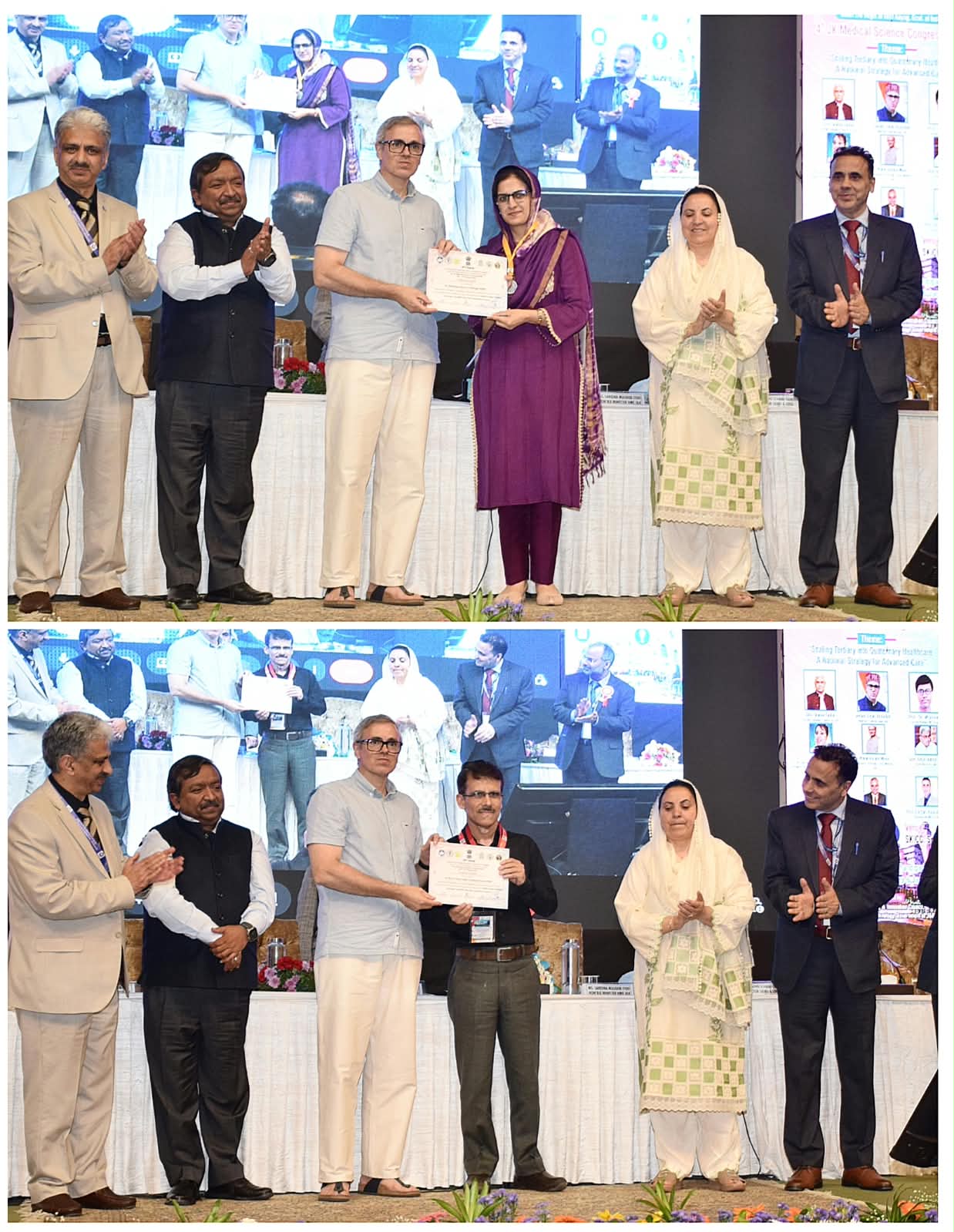
The chief minister released a book titled “Platinum Pearls in General Surgery Super Specialities” and the souvenir “SKIMS Journey of Transformation”. He also presented awards to winners in quiz, poster and oral presentation categories.
Health and Medical Education Minister Sakeena Masood Itoo, MLA Pampore, Retd Justice Hasnain Masoodi, Additional Chief Secretary to the Chief Minister Dheeraj Gupta, and senior SKIMS officials attended the event.