
For decades, the journey to Kashmir has been shaped as much by the terrain as by the destination. The mountains have dictated how quickly people could move, how reliably goods could arrive, and how easily families could travel between the Valley and the rest of the country.
A new train service will not change the Himalayas. But it can change what those mountains mean to the people who live among them.
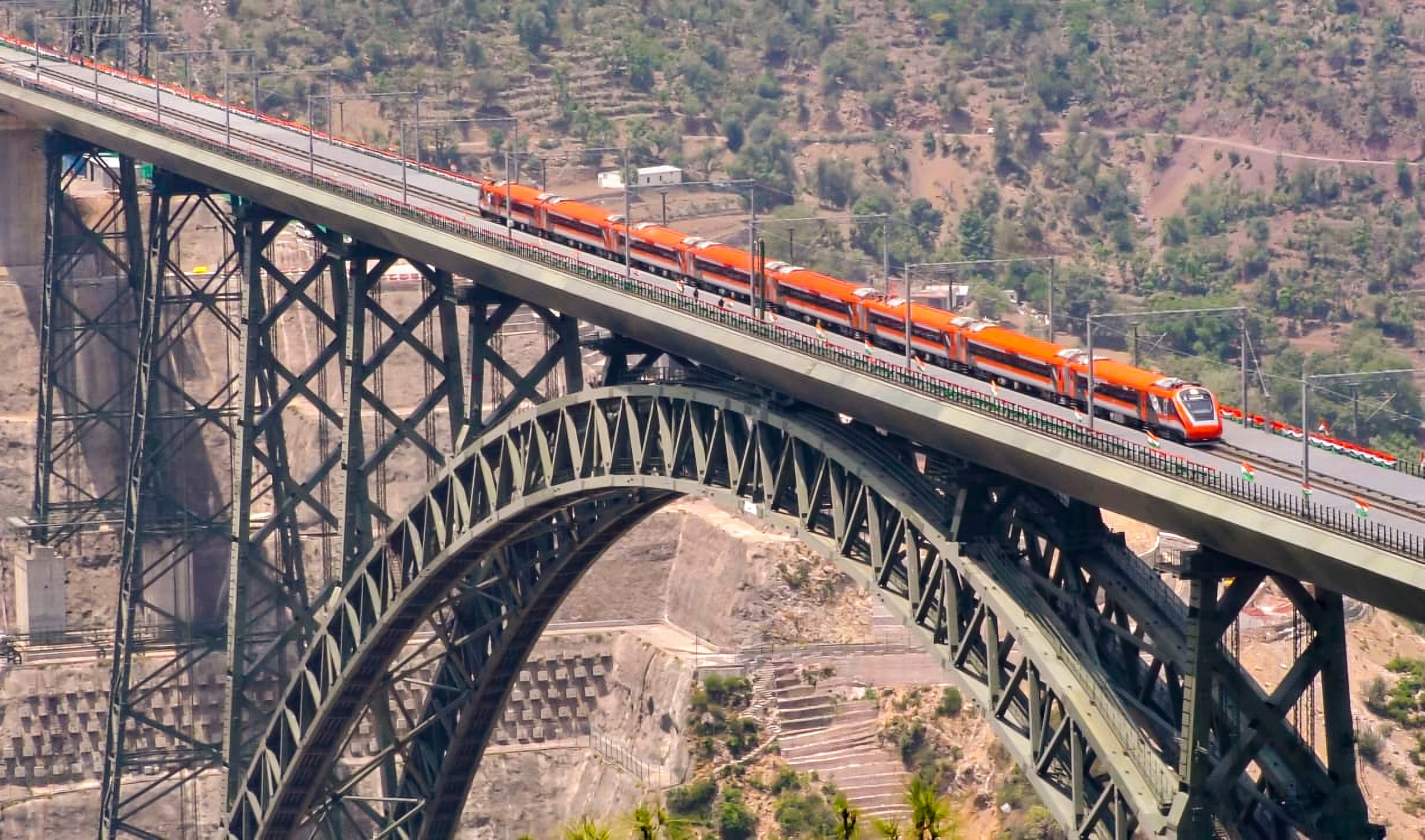
Indian Railways has approved a third pair of Vande Bharat Express trains between Srinagar and Jammu, adding another premium service on the 269-kilometre route and introducing a scheduled halt at Udhampur. The trains, numbered 26407 and 26408, will run between Srinagar and Jammu Tawi through Shaheed Captain Tushar Mahajan Udhampur railway station.
The decision, announced by Union Minister of State in the Prime Minister’s Office Jitendra Singh after Railway Minister Ashwini Vaishnaw conveyed the approval, followed a demand from residents of Udhampur.
On paper, it is another train. For Kashmir, it is something larger.
The new service comes less than four months after direct Vande Bharat trains began operating between Jammu Tawi and Srinagar. It is the latest sign that rail connectivity to the Valley is moving from an ambitious infrastructure project toward an everyday public utility – one that could increasingly shape the way people study, work, trade and travel.
The journey between Jammu and Srinagar takes about four hours and 45 minutes on the Vande Bharat service. The route passes through Udhampur, Katra, Reasi and Banihal before reaching the Valley.
For a region where road travel can be vulnerable to snowfall, landslides and other disruptions, the importance of having another dependable transport option is difficult to measure only in kilometres.
It is measured in missed classes avoided, business trips made possible, family visits undertaken and holidays that do not have to be cancelled because a road has closed.
For students, the railway can become a bridge to opportunities beyond the Valley.
Kashmir’s young people increasingly travel for education, examinations, entrance tests, coaching, internships and university admissions. For many, the journey to Jammu is only one part of a longer trip. Jammu is itself a gateway to universities, professional institutions, government offices and onward rail connections to cities across India.
A faster, scheduled train can make that journey more predictable. That predictability matters.
A student travelling for an examination cannot control a landslide on a mountain road. A family cannot schedule winter weather. A young person travelling for an interview may have little room for uncertainty.
The value of rail connectivity, therefore, is not simply that a train may reach Jammu faster than a road vehicle. It is that a railway offers a structured timetable and another layer of resilience to a region whose geography routinely tests its transport networks. The same logic applies to traders.
Kashmir’s economy is closely connected to markets outside the Valley. Its handicrafts, handloom products, horticultural produce and other goods travel well beyond the mountains. Traders also need to travel themselves – to meet buyers, attend markets, negotiate contracts and maintain relationships with customers in other parts of the country. For them, connectivity is part of commerce.
Every additional reliable passenger service between Kashmir and Jammu expands the number of practical choices available to businesspeople. A trader who can make a trip to Jammu and return within a predictable window has more flexibility. A small business owner who can reach a wider market without depending entirely on road conditions has another tool at his or her disposal.
The third Vande Bharat is not, by itself, a freight corridor. Nor should its economic importance be exaggerated. But passenger mobility and commercial mobility are closely related. Traders are people first; they need to travel before their products can travel with them.
There is also the less measurable value of connectivity: the reduction of psychological distance.
For years, Kashmir’s physical separation from the rest of the country has been an everyday reality. Mountains, weather and difficult roads have made a journey to Jammu feel like a journey between different worlds. A dependable railway begins to narrow that gap.
The railway can carry not just passengers but a sense of normality: that Srinagar is connected to Jammu by a regular service, that a trip can be planned around a timetable rather than uncertainty, and that the Valley is increasingly part of a wider national transport network.
The third service also matters to tourists.
Kashmir’s tourism economy depends heavily on accessibility. Visitors deciding whether to travel to the Valley consider not only its landscapes, hotels and attractions but also the ease and reliability of reaching them.
A direct train from Jammu to Srinagar offers another option for tourists arriving in Jammu by rail from other parts of India. The expansion of services could help distribute travel more evenly across the year, although the broader impact will depend on schedules, capacity, fares, weather and the continuing development of rail infrastructure.
For the visitor, the train is part of the holiday. For the resident, it is part of life. That distinction is important.
Kashmir is often discussed through the eyes of the tourist: snow-covered mountains, lakes, gardens and valleys. But transport infrastructure is experienced most intensely by those who live there.
A resident does not take a train merely to see the mountains. The resident may be travelling to Jammu for work, education, healthcare, government business, shopping, family obligations or onward travel.
The significance of better connectivity is therefore broader than tourism. It is about making Kashmir easier to reach for Kashmiris themselves.
The expansion also reflects the rapid transformation of the railway network in Jammu and Kashmir. Direct Vande Bharat services between Jammu Tawi and Srinagar began commercial operations on May 2, following their inauguration by Vaishnaw on April 30. Before that, Vande Bharat trains had operated between Katra and Srinagar from June 2025.
The extension to Jammu Tawi created a direct rail link between Jammu and Kashmir’s two capitals. The approval of a third service now adds frequency to that connection.
Frequency can be as important as speed. One fast train is useful. Several trains spread across the day can be transformative.
More services give passengers greater choice and reduce the consequences of missing one departure. They can also make rail travel more compatible with school, university, office and business schedules.
That is why the third service should be seen less as an isolated announcement and more as part of an evolving transport system.
Indian Railways says the expansion of services depends on factors including passenger demand, occupancy, line capacity, availability of train paths and rolling stock, maintenance requirements and supporting infrastructure. Those constraints are particularly relevant on a railway passing through some of the most challenging terrain in the country.
The railway itself is an engineering achievement. But its ultimate test will be more ordinary: whether people can depend on it.
The Jammu division, created in January 2025 as the 70th division of Indian Railways, is already handling significant traffic. Jammu Tawi currently handles 114 train services, while Katra handles 46 and Budgam 19, according to figures cited by Vaishnaw in Parliament in July.
The numbers suggest a network that is no longer merely being built but increasingly being used.
For Kashmir, that distinction matters. Infrastructure acquires meaning only when it becomes part of everyday life. A railway line may represent engineering ambition; a timetable represents accessibility. The difference is the passenger standing on a platform early in the morning, knowing when the train will arrive and when it is expected to reach the other side of the mountains. There will remain limits.
No railway can eliminate the effects of extreme weather. Capacity will have to keep pace with demand. More trains will require rolling stock, maintenance and supporting infrastructure. And connectivity is meaningful only when services are affordable and convenient enough for ordinary passengers, not merely available in principle. Yet the direction is unmistakable.
The third Vande Bharat is another step toward a Kashmir in which the Valley is less dependent on a single mode of transport and less vulnerable to the uncertainty that geography can impose. For a student, that may mean a more manageable journey to an examination or university. For a trader, it may mean another day spent in a market rather than on a road. For a family, it may mean making a journey that was once postponed. For a tourist, it may mean discovering that the distance between Jammu and Srinagar is not quite as daunting as it once seemed. And for Kashmir itself, the railway represents something deeper: connection not as a slogan, but as a daily experience.
The third Vande Bharat will not erase the mountains between Srinagar and Jammu. It will do something more practical. It will give more people a timetable by which to cross them.
About the Author
Moien Darial writes with the precision of an analyst and the sensitivity of a storyteller, exploring global economic shifts and emerging technologies.