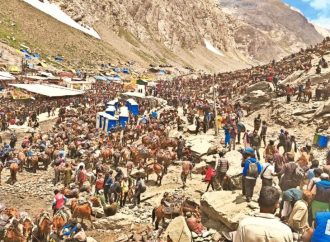





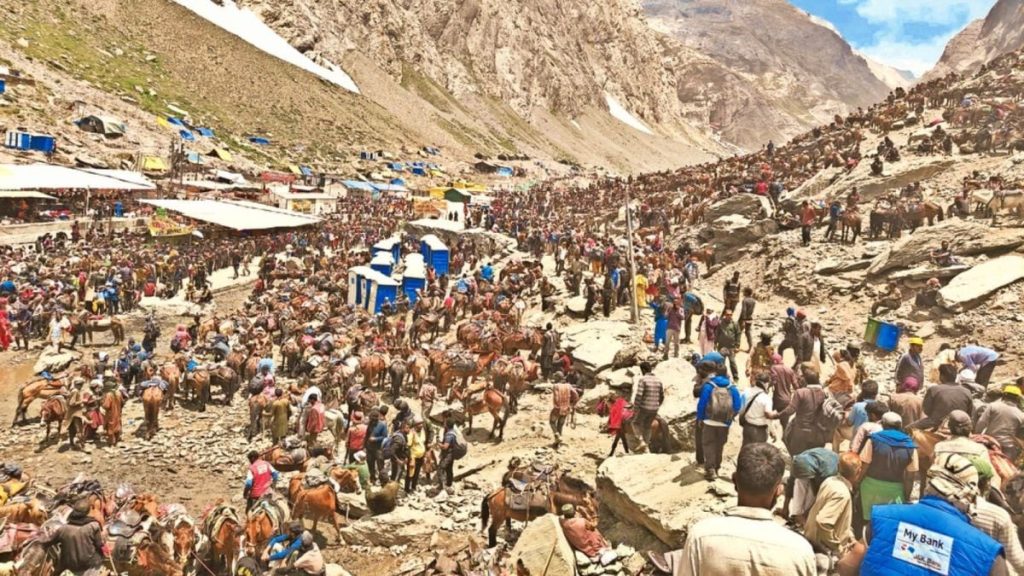
For devotees, the journey is an act of faith.
As thousands prepare for the Amarnath Yatra, Kashmir’s mountains become the stage for a choreography of devotion, logistics, and national security. Aasif Bashir reports.
In the predawn darkness of a Himalayan summer, long before the first pilgrim begins the climb toward the Amarnath cave, another journey is already underway.
Soldiers move into forward positions. Roads are inspected. Communication systems are tested. Surveillance cameras come online. Drones rise silently above valleys carved by glaciers thousands of years ago.
Somewhere in a control room, an operator watches a live feed from a mountain ridge. Somewhere else, a convoy commander studies weather forecasts. Along the pilgrimage route, security personnel check equipment that will remain in use for nearly two months.
The annual Amarnath Yatra is often described as a religious pilgrimage. It is that. But it is also one of the largest peacetime security operations conducted in India.
This year, as the yatra prepares to begin on July 3 and continue until August 28, the scale of that operation is becoming increasingly visible. Union Home Minister Amit Shah has directed security agencies to establish what officials describe as an integrated and multi-layered security grid, combining traditional deployments with modern surveillance technology, including drones, CCTV networks and advanced monitoring systems.
The instructions came during a high-level review meeting in New Delhi attended by some of the country’s most senior security officials, including National Security Adviser Ajit Doval, Army Chief General Upendra Dwivedi, Intelligence Bureau Director Tapan Deka, Lieutenant Governor Manoj Sinha and top commanders of the Central Armed Police Forces.
The message was unmistakable. The pilgrimage must remain secure.
To understand why such extraordinary preparations accompany the Yatra, one must first understand the geography.
The Amarnath cave is not situated beside a highway or within a populated town. It lies high in the Himalayas at an altitude of nearly 13,000 feet, accessible only through demanding mountain routes that pass through remote valleys, steep ridges and terrain vulnerable to sudden weather changes.
For devotees, the journey is an act of faith. For administrators, it is a logistical challenge. For security agencies, it is a constantly evolving operational exercise.
Every year, hundreds of thousands of pilgrims travel from across India to pay obeisance at the cave shrine, where an ice stalagmite revered as a manifestation of Lord Shiva forms naturally inside the cavern.
The routes leading to the shrine are ancient. The security architecture surrounding them is increasingly modern.
This year, officials say drones will play a significantly larger role in surveillance and monitoring. CCTV systems will provide continuous coverage at vulnerable locations, while advanced monitoring platforms will help security agencies maintain real-time situational awareness across the pilgrimage corridor.
The transformation reflects a broader shift occurring within security planning worldwide. Mountains once watched by sentries are now watched by sensors. Observation posts are increasingly supplemented by cameras.
Human vigilance remains essential, but technology has become another layer in the defensive landscape.
The Home Ministry’s approach reflects that evolution. Amit Shah has specifically instructed agencies to combine traditional security measures with technological capabilities, creating what officials hope will be an “impregnable” framework along both the Baltal and Pahalgam routes. Yet technology alone cannot secure a pilgrimage stretching across some of the most challenging terrain in the Himalayas. The human dimension remains enormous.
The Ministry of Home Affairs has sanctioned approximately 670 companies of Central Armed Police Forces for Yatra-related duties. These forces will operate alongside the Jammu and Kashmir Police, the Indian Army, intelligence agencies and civil administration personnel.
The CRPF alone is expected to deploy 128 companies, including women contingents tasked with crowd management, route protection, convoy security and area domination operations.
Together, they form a security network extending far beyond the immediate pilgrimage route.
Security planning begins not at the cave but hundreds of kilometres away. Pilgrim registration centres. Transit camps. National highways. Base camps. Accommodation facilities. Convoy assembly points. Every location becomes part of a larger system.
This year, authorities are also introducing QR code-enabled identity cards for local service providers, pony operators and others associated with the pilgrimage.
The measure serves practical purposes – verification, regulation and accountability – but it also reflects the increasing digitisation of large public gatherings across India.
Even the animals supporting the pilgrimage have entered the administrative framework.
Officials informed the Home Minister that health and fitness assessment camps would be organised for horses, mules and other animals engaged in Yatra-related activities. Such details may seem minor. They are not. The yatra is a temporary city moving through mountains. Everything matters. Road conditions matter. Weather forecasts matter. Medical facilities matter. Telecommunications matter. Animal health matters.
The failure of any one component can affect thousands of people. This explains why Lieutenant Governor Manoj Sinha’s recent review meeting focused not only on security but also on sanitation, healthcare, water supply, electricity, telecommunications and disaster preparedness. The pilgrimage is often described as a religious event. Administratively, it resembles a large-scale seasonal migration.
Tracks along the Baltal and Pahalgam routes have been widened. Crash barriers are being installed. Ambulance networks are being expanded. Emergency response systems are being strengthened. Telecom operators have been instructed to ensure uninterrupted connectivity. Additional holding areas are being prepared. The objective is straightforward. Reduce uncertainty.
That goal has acquired renewed urgency in recent years. Security planners remain attentive to evolving challenges, including infiltration attempts along the Line of Control and broader regional developments.
Senior military commanders have repeatedly reviewed counter-infiltration measures and operational readiness ahead of the pilgrimage.
Army Chief General Upendra Dwivedi’s recent visit to Northern Command headquarters in Udhampur focused heavily on these concerns. During the review, he emphasised technological innovation, operational preparedness and vigilance in what officials described as an increasingly dynamic security environment.
The language of modern security planning often sounds clinical. Preparedness. Coordination. Response mechanisms. Surveillance.
But beneath those terms lies a simple objective. Allow pilgrims to focus on prayer rather than danger. That aspiration has shaped the Yatra’s security architecture for decades. The challenge is that security and spirituality occupy the same physical space. A devotee arriving at Baltal encounters prayer tents and security checkpoints. Langars and surveillance cameras. Religious chants and convoy protocols. The coexistence can appear paradoxical. Yet it has become an accepted reality of the modern pilgrimage. Perhaps nowhere else in India does the relationship between faith and state capacity appear quite so visible. The mountains demand it. The scale demands it. The risks demand it. And so every summer, a remarkable transformation occurs.
Remote Himalayan valleys become corridors of movement. Temporary infrastructure rises from alpine meadows. Security personnel establish positions overlooking routes used by pilgrims. Medical teams prepare for emergencies. Engineers monitor roads. Meteorologists track weather systems. Administrators coordinate resources. Religious organisations prepare to receive devotees. For nearly two months, an entire ecosystem functions around a single pilgrimage. By the time the first pilgrims begin their ascent in July, much of this work will already be invisible. Visitors will see checkpoints and personnel. They may notice drones overhead. They may encounter registration procedures and security screenings.
What they will not see are the months of planning, reviews, coordination meetings and operational assessments that made those arrangements possible. And perhaps that invisibility is the ultimate measure of success. Security works best when it recedes into the background.
When pilgrims remember the cave rather than the checkpoint. The prayer rather than the protocol. The mountain rather than the monitoring system.
As another Amarnath Yatra approaches, that remains the ambition of one of India’s largest annual security operations: to create conditions in which faith can travel safely through the Himalayas, protected by a network that most devotees will scarcely notice, even as it watches over every step of their journey.
About the Author
Aasif Bashir is a visual journalist with a postgraduate degree in convergent journalism. He works at the intersection of imagery and narrative.