


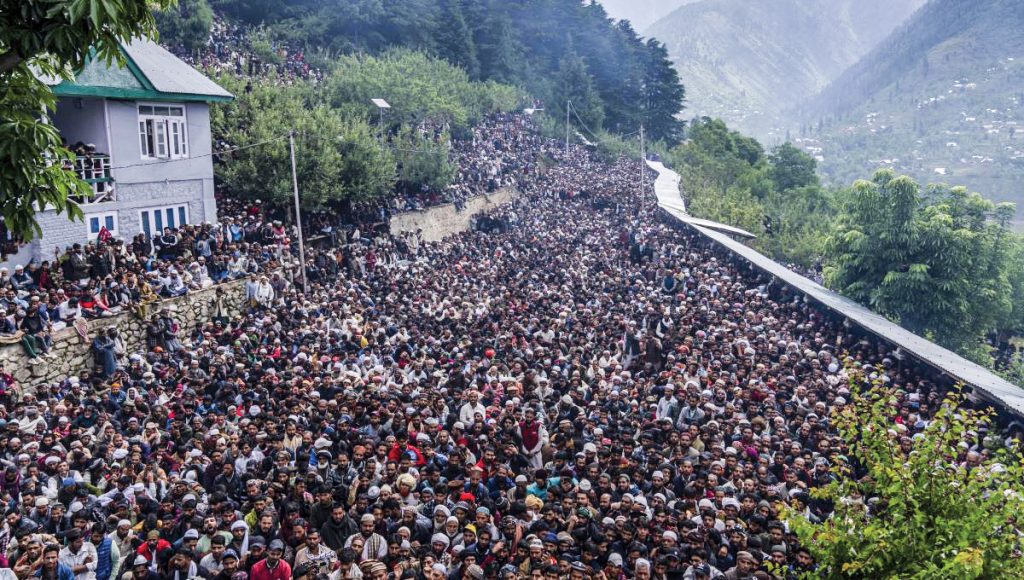
Seen from a distance, the congregation resembles a river flowing uphill.
Each June, beneath the pines of Wangath, tens of thousands climb to Baba Nagri, where faith, memory, and Kashmir’s enduring spirit converge in a valley transformed by devotion. Mir Suneem reports.
Before dawn, the road into Wangath begins to glow.
Not from streetlights. There are few of those here. The illumination comes from headlights crawling through the darkness of the Sindh Valley, hundreds of vehicles moving slowly toward a mountain shrine tucked beneath a thick wall of pine forest. Buses from Rajouri. Sumos from Kupwara. Trucks carrying entire families from Poonch. Nomadic Gujjar and Bakerwal herders arriving with livestock. Men wrapped in pherans despite the June warmth. Women carrying bundles of food. Children asleep against windows.
Every year, during the first fortnight of June, they come to a place known simply as Baba Nagri.
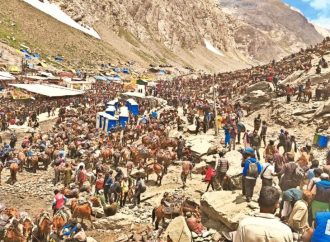
For two days, a quiet settlement in central Kashmir becomes one of the largest religious gatherings in the region. This year, tens of thousands of devotees converged on the shrine of Hazrat Mian Nizam-ud-Din Kiyani (RA) to mark the 130th annual Urs, transforming a forested corner of Ganderbal district into a temporary city of prayer, devotion and memory.
Seen from a distance, the congregation resembles a river flowing uphill.
Seen from within, it feels like something older than an event.
It feels like a tradition carrying itself forward.
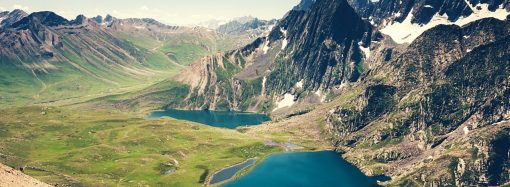
The shrine stands beneath a mountain slope at Wangath in Kangan, where the valley narrows and forests begin to climb toward the higher reaches of the Himalayas. During most of the year, Baba Nagri is peaceful. During the Urs, however, the landscape changes entirely. Vast crowds fill the grounds. Loudspeakers broadcast Quranic recitations through the trees. Community kitchens operate continuously. Prayer circles form beneath canopies and along pathways crowded with pilgrims.
The atmosphere is difficult to describe to anyone unfamiliar with Kashmir’s Sufi traditions.
Part pilgrimage. Part reunion. Part spiritual retreat. Part social institution.
People arrive seeking different things. Some come to fulfil vows. Some come because their parents came before them. Others come carrying private burdens—a sick relative, financial hardship, grief, uncertainty. Many simply come because attendance itself has become a family inheritance.
“My father brought me here when I was a child,” one devotee told local reporters last year. “Now I bring my own children.”
That continuity is central to understanding Baba Nagri.
The shrine honours Hazrat Mian Nizam-ud-Din Kiyani (RA), a revered Sufi scholar and preacher whose influence continues to shape religious life across parts of Jammu and Kashmir more than a century after his death. Historical accounts describe him as a Kashmiri who travelled to the Hazara region—now in Pakistan’s Khyber Pakhtunkhwa province—where he received spiritual training before returning to Kashmir to preach and establish a religious centre that would later become one of the Valley’s most significant shrines.
The annual Urs commemorates not death in the ordinary sense but union with the Divine—a concept deeply rooted in Sufi tradition. Across South Asia, Urs celebrations often blend remembrance, devotion and communal gathering. In Kashmir, where Sufi shrines have historically served as centres of both spirituality and social life, such gatherings carry additional significance.
The Urs at Baba Nagri is not confined to one district, one social class or even one region.
This year’s congregation drew devotees from Rajouri, Poonch, Doda, Kishtwar, Udhampur, Kupwara, Bandipora, Baramulla, Shopian, Anantnag and several other areas, as well as visitors from outside Jammu and Kashmir.
What emerges is a rare phenomenon in a region often discussed through the language of division.
People from mountains, plains and border districts gathering in one place for the same purpose.
In contemporary Kashmir, where politics frequently dominates public discourse, Baba Nagri represents another story – one about continuity.
For generations, the shrine has functioned as a spiritual crossroads.
The annual congregation coincides with the seasonal migration of Gujjar and Bakerwal communities, many of whom travel through the region during summer. Their presence gives the gathering a distinct character. Colourful turbans, embroidered waistcoats, livestock caravans and traditional attire become part of the visual landscape. The annual pilgrimage is therefore not merely religious. It is cultural, social and geographical. Entire communities move through the mountains and converge around a shared sacred space.
Photographers who documented the Urs in recent years described roads filled with nomadic pilgrims, brightly coloured clothing and worshippers tying threads to trees as symbols of hope and prayer.
Yet the most remarkable feature of Baba Nagri may be neither its scale nor its history. It may be its hospitality.
The shrine’s community kitchen operates throughout the year and expands dramatically during the Urs, feeding thousands of visitors regardless of economic background. Large cauldrons simmer continuously. Volunteers move through crowds carrying trays and containers. Food arrives from donations made by devotees—rice, maize, livestock, pulses and cash contributions offered as acts of faith.
The kitchen is not merely logistical support. It is part of the shrine’s theology.
Feeding strangers has long occupied a central place in South Asian Sufi traditions, where service to humanity is viewed as inseparable from devotion to God.
That ethos was repeatedly invoked during this year’s Urs.
Speaking to the congregation, Mian Altaf Ahmad Larvi, the hereditary custodian of the shrine and Member of Parliament from Anantnag-Rajouri, urged devotees to embrace compassion, communal harmony and service to humanity.
He also used the occasion to address a concern increasingly visible across Kashmir: drug addiction among young people.
Religious gatherings in Kashmir have historically functioned as forums for moral and social reflection. At Baba Nagri this year, clerics and scholars highlighted the teachings of Hazrat Mian Nizam-ud-Din Kiyani (RA) while warning against substance abuse and urging parents to guide younger generations toward education, discipline and faith. The message reflected a broader reality.
Even as the Urs celebrates a saint who lived in the nineteenth century, the concerns voiced from the shrine are unmistakably contemporary.
The gathering remains rooted in tradition, yet it speaks to present anxieties.
Perhaps that explains its continued growth.
Shrine authorities say attendance has increased steadily over recent years, with this year’s congregation among the largest in memory.
Growth alone, however, does not explain endurance. Many religious gatherings attract crowds. Few become institutions.
Baba Nagri has survived political upheaval, conflict, economic change and generational transformation. It endured periods when travel was difficult. It resumed after pandemic interruptions. It continues to attract devotees from areas separated by mountains, administrative boundaries and vastly different local realities.
In that sense, the shrine serves as a reminder of something often overlooked in discussions about Kashmir.
The region possesses networks of connection older than modern politics. Trade routes once linked valleys and mountain communities. Pilgrimage routes linked villages. Sufi shrines linked people. The annual Urs at Baba Nagri sits within that tradition.
When the final prayers concluded this year, thousands of hands rose simultaneously toward the sky. Prayers were offered for peace, prosperity, brotherhood and communal harmony. Some devotees wept. Others stood silently. Families prepared for long journeys home. Volunteers began clearing grounds that only hours earlier had held a sea of worshippers. By evening, the crowds had begun to thin. The buses departed. The caravans moved on. The mountain returned to silence. But for those who come every June, Baba Nagri is not merely a destination.
It is a reassurance. A reminder that amid change, some traditions still endure. That people still gather not because they are required to, but because they believe.
And that beneath the forests of Wangath, at the foot of a Himalayan mountain, there remains a place where Kashmir continues to meet itself.
About the Author
Mir Suneem is a filmmaker and a postgraduate in filmmaking from Jamia Millia Islamia. With a strong grounding in film editing and narrative craft, she is drawn to stories the frame extends beyond the visible into the lived.