



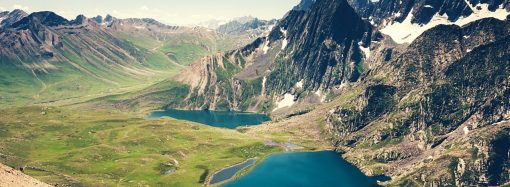

For one day every year, the springs of Panzath belong to everyone.
A centuries-old spring ritual in south Kashmir becomes a moving story of memory, faith, ecology, and a community fighting to keep its waters alive. Bisma Rafiq reports.
By sunrise, the men had already entered the water.
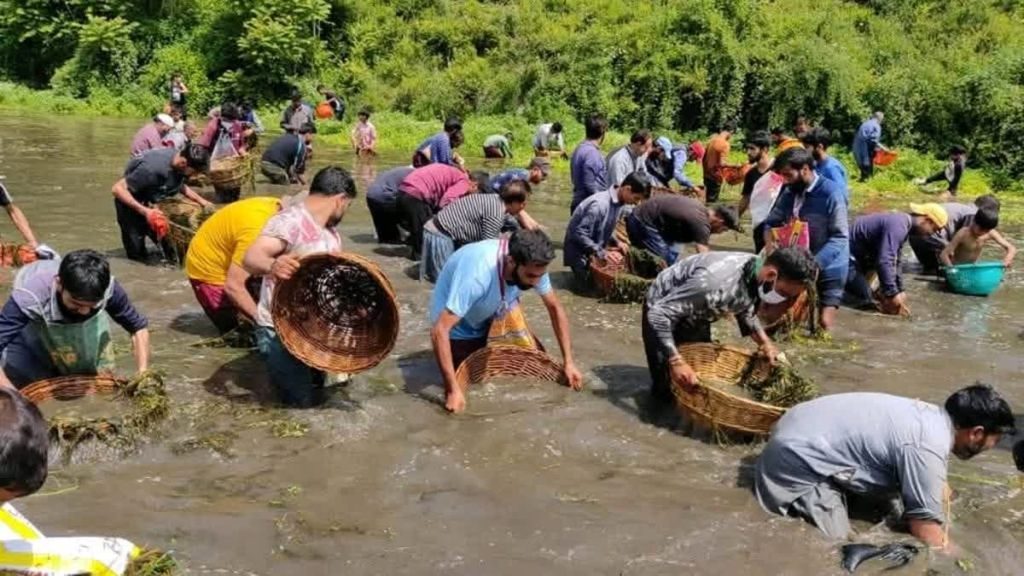
From a distance, the spring looked alive with movement – dozens of figures wading knee-deep through greenish currents, lifting wicker baskets through weeds, shouting instructions across the banks, slipping occasionally in the mud while children laughed nearby. Some carried old mosquito nets tied to wooden sticks. Others dragged sacks heavy with algae and garbage toward the shore. Around them, women stood beneath poplar trees watching quietly, while boys darted between rocks clutching silver fish in their hands like trophies.
For one day every year, the springs of Panzath belong to everyone.
The village of Panzath lies quietly in the Qazigund belt of south Kashmir, surrounded by paddy fields, walnut trees, and roads that disappear into orchards. To outsiders, it appears like many Kashmiri villages – modest homes, grazing cattle, tea shops where cricket commentary hums from radios. But beneath its soil flows one of the Valley’s oldest living water systems: a network of freshwater springs known locally as Panzath Nag.
The springs are not merely geographic features here. They are inheritance.
And every May, the village gathers to protect them through a ritual that feels part festival, part prayer, part environmental rescue mission.
The event coincides with Rohan Posh, an old Kashmiri observance tied to memory, mourning, and spring blossoms. On the evening before the cleanup, children move quietly through graveyards carrying flowers mixed with rice. They scatter the petals across graves believed to hold grandparents, parents, siblings, forgotten ancestors. Elders distribute homemade chapatis. Prayers drift softly into the fading light.
Then, by morning, grief gives way to water.
“It used to feel like Eid for us when we were children,” said Ghulam Nabi, a seventy-year-old resident wrapped in a loose pheran despite the mild weather. He stood near the banks watching boys splash through the shallows. “We would wake before dawn carrying baskets because nobody wanted to miss the first catch.”
His face brightened while remembering it.
“In those days the water was so clear you could see the fish moving beneath stones.”
Today the springs are still beautiful, but beauty here now carries exhaustion.
Aquatic weeds spread thickly across sections of the water. Plastic waste gathers near embankments. Some smaller springs have disappeared altogether beneath construction and neglect. Residents speak about shrinking water levels the way elderly people speak about fading memory – slowly, reluctantly, with visible grief.
According to local belief, the name Panzath comes from Paanch Hath, meaning “five hundred,” because the spring system once fed nearly five hundred smaller water sources across the region. Whether the number is historically precise matters less than what it reveals about local imagination: abundance once defined this place.
Even now, nearly forty-five villages depend on the springs for drinking water and irrigation. A trout hatchery nearby survives because of the perennial flow. Streams from the spring irrigate paddy fields stretching across the Qazigund landscape.
In Kashmir, water has always meant survival before scenery.
Yet survival itself has become uncertain.
Across the Valley, environmental scientists have repeatedly warned that Kashmir’s springs are under stress from climate change, urbanisation, pollution, and shrinking groundwater recharge. Traditional water bodies that sustained villages for centuries are drying at alarming rates. In some places, concrete has swallowed natural channels entirely.
Panzath survives partly because villagers refuse to abandon it.
By midmorning, the cleanup had become almost theatrical. Young men wrestled tangled weeds from the spring bed while children searched for trapped fish beneath muddy corners. Spectators gathered along the banks shouting directions and jokes. Occasionally someone lifted a large fish above the water and cheers rippled outward instantly.
But beneath the celebration was labour.
The work is exhausting. Participants spend hours waist-deep in freezing water pulling algae, removing plastic waste, and clearing clogged channels. Fishing, villagers insist, is secondary.
“The fish are only an excuse to bring people together,” said Yousuf Mir, a schoolteacher from a nearby village who has participated in the event since adolescence. “The real purpose is cleaning the spring. Without this water, half this area suffers.”
He pointed toward nearby fields where farmers were already preparing land for paddy cultivation.
“People understand now that if springs die, villages change forever.”
In earlier generations, the tradition functioned largely as communal festivity. Men fished. Children played. Families picnicked along the banks. Environmental conservation existed implicitly rather than consciously. But climate anxiety has changed the emotional texture of the ritual.
People now speak about the springs with urgency.
Prof Rashid Wani, a retired political scientist, believes the tradition may predate the Dogra era and perhaps stretches back toward Mughal Kashmir, when rulers landscaped major springs into elaborate gardens throughout the Valley.
“The Mughals left traces near almost every important spring in Kashmir,” he said while observing workers clear weeds near the edge of the water. “Verinag, Achabal, Kokernag — these water systems shaped settlement patterns and agriculture for centuries. Panzath somehow remained quieter, less monumental, but equally important.”
He paused briefly.
“What was once folklore is now becoming environmental necessity.”
There is something distinctly Kashmiri about the way ecology and spirituality overlap here. Springs are not viewed merely as resources; they possess emotional and even sacred dimensions. Water flows through the Valley’s poetry, shrines, folklore, and agricultural rhythms. Entire communities were historically built around natural springs whose names became inseparable from identity itself.
When springs shrink, something cultural disappears alongside the water.
By afternoon, piles of weeds lined the banks in dark green heaps drying beneath the sun. The water already appeared clearer in sections where channels had been reopened. Children continued scooping fish using handmade nets while older villagers distributed tea in steel cups.
Nearby, a group of young men discussed tourism.
Three years ago, administrative control of the area shifted to the Verinag Development Authority, raising hopes that Panzath might emerge as a tourist destination alongside Kashmir’s better-known spring resorts. But villagers say little meaningful infrastructure has followed except for a small park.
“This place could attract visitors easily if developed properly,” said Basharat Ahmad, a local shopkeeper. “But development should not destroy the spring itself.”
That tension – between tourism and preservation – now shadows much of Kashmir’s environmental future. Every untouched landscape risks becoming a destination. Every destination risks becoming damaged by the attention it attracts.
Some villagers instead hope for smaller-scale economic support linked directly to conservation. Trout farming, eco-tourism, local homestays – modest livelihood models that preserve rather than overwhelm the ecosystem.
“People here traditionally survived through water,” said Nisar Shah, whose family has long been associated with fishing. “If the government supports local trout farming, young people might stay connected to this place instead of leaving.”
Migration hovers quietly behind many rural conversations in Kashmir now. Young people leave villages seeking education, work, or urban life, while traditional ecological knowledge fades alongside older generations.
And yet, on this particular day, continuity still feels possible.
Toward evening, as sunlight softened across the spring, the crowds slowly thinned. Mud-streaked boys walked home carrying small catches wrapped in cloth. Elderly men sat beneath trees discussing how much the water level might improve after the cleanup. Somewhere nearby, smoke from cooking fires began rising gently into the cooling air.
The spring continued flowing quietly through all of it.
For centuries, people here have returned every May carrying baskets, prayers, and memory toward the same water.
Perhaps that is what traditions are ultimately for — not preserving the past exactly as it was, but teaching communities how to survive the future together.
About the Author
Bisma Rafiq is interested in human resources and wants to improve journalism from the human resources point of view. She is also a passionate story teller.
















Leave a Comment
Your email address will not be published. Required fields are marked with *