




This time, the exercise carries unusual significance.
In Kashmir, food has always meant more than survival. Noon chai warming winter mornings. Fresh milk arriving before dawn. Kalari crackling on iron pans. Wazwan prepared with ritual precision. Bread carried home in warm cloth from neighbourhood bakeries. Food here is tied to memory, trust, hospitality, and identity itself.
Which is why the recent revelations about adulterated food products in Jammu and Kashmir feel so deeply disturbing.
Over the past year, authorities have repeatedly uncovered rotten meat, fake cheese, expired oils, adulterated ghee, counterfeit honey, and unsafe dairy products entering Kashmir’s markets and kitchens. The Jammu and Kashmir government recently informed the Legislative Assembly that more than 12,000 kilograms of rotten and unsafe meat had been seized and destroyed during the current financial year. Hundreds of inspections were conducted, with multiple samples found unsafe or substandard.
Elsewhere, food safety teams seized adulterated cheese and expired mustard oil from illegal storage units. In Srinagar, officials busted operators allegedly selling fake honey and synthetic ghee falsely marketed as “pure Kashmiri” products.
This is no longer about isolated violations.
It reflects the growth of a dangerous shadow economy willing to compromise public health for profit.
The danger of food adulteration is not merely economic fraud. It is the silent harm inflicted on public health. Adulterated dairy products, decomposed meat, reused oils, and counterfeit food items can cause food poisoning, gastrointestinal disease, liver complications, hormonal disorders, and long-term organ damage. Children and the elderly remain especially vulnerable.
Yet despite repeated raids and seizures, unsafe food continues entering the market. The problem lies partly in the nature of enforcement itself. Authorities often intensify inspections only after scandals emerge, after videos circulate online, or after unsafe products have already entered homes and restaurants.
Food safety cannot function like emergency firefighting.
It requires continuous surveillance, modern testing systems, strict licensing, traceable supply chains, and visible punishment strong enough to deter offenders. Right now, deterrence appears weak.
Kashmir’s food economy is especially vulnerable because the Valley depends heavily on supplies transported through long and fragile routes. Weak monitoring during transportation, storage, wholesale distribution, or retail sale allows unsafe products to spread quickly across markets.
The danger increases during festive and wedding seasons when demand rises sharply. Paneer, ghee, milk, sweets, and meat products become especially vulnerable to contamination and counterfeit production.
What makes the situation even more damaging is the erosion of trust. Increasingly, consumers no longer know what they are eating. Is the paneer genuine? Is the honey pure? Is the ghee authentic? Is the meat safe? Ordinary shopping itself has become shadowed by suspicion.
That uncertainty harms both society and the economy.
Kashmir’s food identity depends heavily on authenticity. If adulteration becomes normalised, genuine local producers suffer alongside consumers. Honest traders cannot compete with counterfeiters flooding markets with cheaper synthetic alternatives.
The government therefore faces a challenge larger than conducting occasional raids. It must rebuild public confidence in Kashmir’s food system.
That requires continuous inspections, faster food-testing laboratories, stricter licensing, and stronger legal action against repeat offenders. Authorities must ensure that food safety enforcement remains permanent rather than seasonal or reactionary.
Public awareness matters equally. Consumers need better understanding of food labels, expiry dates, and common adulteration methods so they can protect themselves more effectively.
But ultimately, this is not merely a regulatory issue. It is a moral one.
Anyone knowingly selling rotten meat, counterfeit cheese, synthetic ghee, or adulterated food is not committing ordinary business fraud. They are endangering public health for private profit. They are violating trust at the most intimate level possible — the dinner table.
In Kashmir, where food remains central to culture and community, that betrayal feels especially corrosive.
Because no society can call itself healthy while allowing poison to circulate quietly through its kitchens.
Counting Kashmir
As Census 2027 begins in Kashmir, the Valley’s future may depend as much on accurate data as on politics itself. Bilquees Punjabi writes.
As Census 2027 begins in Kashmir, the Valley’s future may depend as much on accurate data as on politics itself. Bilquees Punjabi writes.
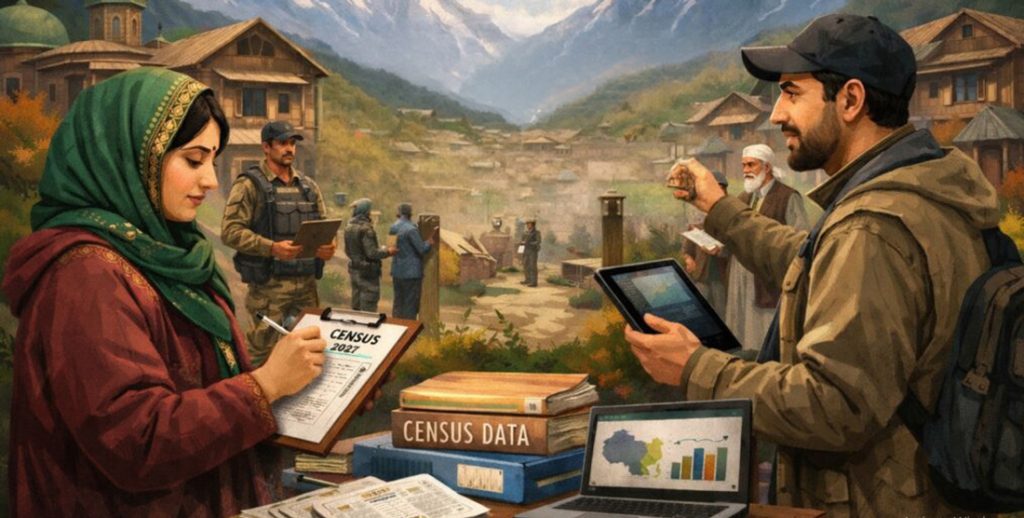
On a quiet Sunday morning in Srinagar, government officials, schoolteachers assigned enumeration duties, and ordinary residents opened laptops and phones to participate in something deceptively simple: counting themselves. Across Jammu and Kashmir, the first phase of Census 2027 quietly began through digital self-enumeration portals, marking India’s first largely paperless census exercise.
For most people, census operations rarely inspire excitement. Yet in Kashmir, where politics, migration, economics, and identity intersect intensely, counting people is never merely administrative. Census data determines how resources are distributed, where roads are built, how hospitals are planned, and how welfare schemes are targeted.
This time, the exercise carries unusual significance.
The last full census was conducted in 2011, while the 2021 exercise was delayed because of the Covid-19 pandemic. In the intervening years, Kashmir has changed dramatically. Urban neighbourhoods expanded across Srinagar’s outskirts, migration altered villages, tourism surged, fertility rates fell sharply, and youth unemployment deepened. Entire demographics shifted without updated official numbers fully capturing them.
Now, after years of delay, House Listing Operations and digital self-enumeration have begun across Jammu and Kashmir. Officials have urged residents to participate actively to ensure accurate data collection.
In Kashmir, outdated or inaccurate data can shape everyday life in profound ways. Residents in many areas complain that healthcare infrastructure has failed to keep pace with population growth. Srinagar’s rapid urban expansion has strained drainage systems, roads, transport, and electricity supply. Some schools remain overcrowded while others face declining enrolment because of migration and falling birth rates.
A census attempts to correct that distortion.
At its core, a census is not only a population count but a detailed social map documenting housing conditions, education levels, migration trends, employment patterns, sanitation access, internet connectivity, literacy, and family structures. Governments rely on such information to design policy and allocate resources.
For Kashmir, this becomes particularly important because the region has undergone prolonged political and economic turbulence over the past decade.
Migration has significantly altered the Valley’s social geography. Thousands of young Kashmiris now leave every year for education and employment in cities such as Delhi, Bengaluru, Chandigarh, and Pune. Simultaneously, urbanisation within Kashmir has accelerated rapidly, with agricultural land around Srinagar steadily transforming into residential colonies and commercial hubs.
Without reliable data, planning becomes guesswork.
Updated census figures could help authorities expand transport networks, healthcare infrastructure, and welfare programmes in areas where population pressures have increased. Fertility trends showing ageing populations may require greater investment in geriatric healthcare, while granular unemployment data could guide skill-development initiatives and industrial planning.
The census also carries political implications. Population figures influence electoral delimitation, constituency boundaries, and resource allocation. In Jammu and Kashmir, where representation has historically remained sensitive, demographic data inevitably acquires broader political meaning.
But beyond politics lies another quieter importance: visibility.
Informal workers, migrants, widows, disabled citizens, rented households, and economically vulnerable families often remain statistically invisible when records are outdated. A census, ideally, forces the state to acknowledge their existence.
The shift to digital enumeration itself marks a major transformation. Officials say online self-enumeration could improve efficiency and reduce delays, though concerns remain over internet access and digital literacy in remote and rural areas.
Because beneath every statistic lies a human story: a family migrating for work, a shrinking household in an ageing village, a growing suburb without adequate drainage, or a child living farther from healthcare than official maps suggest.
Numbers alone cannot explain Kashmir.
But without accurate numbers, governing Kashmir becomes even harder.
About the Author
With a Masters in Computer Applications, Bilquees Punjabi approaches journalism not just as storytelling, but as a system – one shaped by algorithms, audiences, and the quiet mechanics of the web. Her interests lie in the evolving world of online journalism, where headlines compete for attention, metrics shape narratives, and clicks, traction, and ads become part of the story itself.











Leave a Comment
Your email address will not be published. Required fields are marked with *