
Amir Yaseen
Srinagar, July 20
For nearly four years, Argentina seemed almost untouchable.
World champions in Qatar. Copa América champions. A team that had mastered the art of winning ugly, surviving pressure, and finding a way when logic suggested otherwise. Lionel Messi’s final act had become a global pilgrimage, with millions hoping to witness one last triumph from football’s greatest magician.
Standing in their way at MetLife Stadium on July 19 was a Spain side many admired but few truly understood.
They weren’t simply talented. They were relentless.
For 120 minutes, Spain dismantled the mythology surrounding Argentina – not with moments of brilliance alone, but with complete tactical superiority. Every passing lane disappeared. Every Argentine counterattack fizzled before it began. Every attempt to wrestle control from Spain’s grasp was met with another wave of red shirts calmly recycling possession.
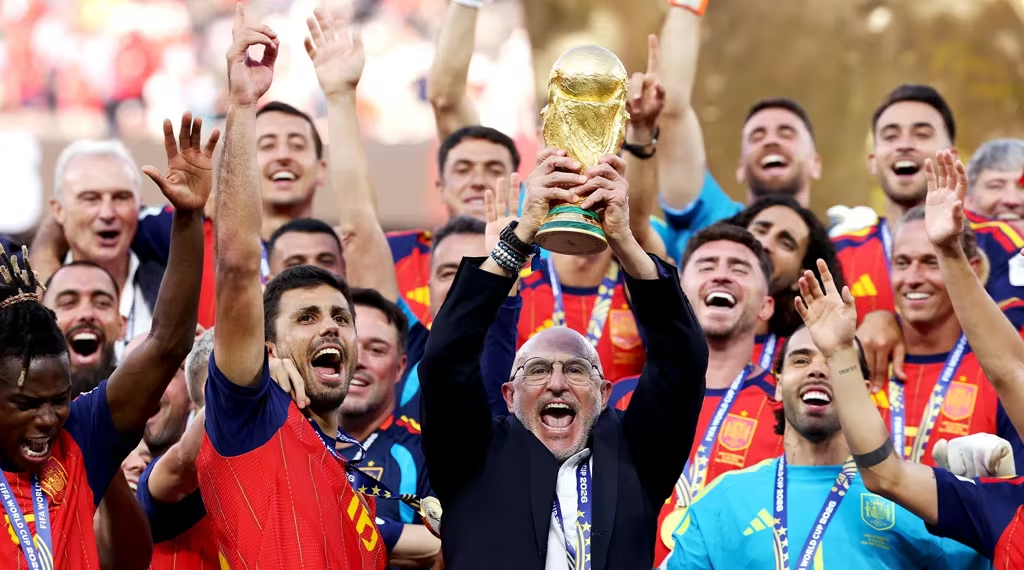
The scoreboard eventually read Spain 1, Argentina 0 after Ferran Torres struck in the 106th minute, but the margin scarcely reflected the gulf between the two sides. Spain monopolised possession, created chance after chance and forced Emiliano Martínez into one of the finest goalkeeping performances ever seen in a World Cup final. Argentina, by contrast, spent most of the evening chasing shadows. According to post-match statistics, they failed to register a shot during regulation time – a remarkable illustration of Spain’s defensive control and midfield dominance.
The defending champions arrived seeking history. Instead, they became spectators to the coronation of football’s newest dynasty. The pre-match narrative practically wrote itself.
On one side stood Lionel Messi, carrying the hopes of an entire nation and perhaps making the final World Cup appearance of an extraordinary career.
On the other was a fearless Spanish generation led by Lamine Yamal, Pedri, Rodri, Pau Cubarsí and Nico Williams – a collection of players who had already conquered Europe and now stood one victory away from football’s greatest prize.
Much of the world’s attention centred on Messi. Spain focused only on Argentina. That difference became obvious from the opening whistle.
Luis de la Fuente’s side immediately imposed the rhythm they had perfected over the previous two years. Their midfield triangle suffocated Argentina’s attempts to build through Enzo Fernández and Alexis Mac Allister. Rodri dictated tempo with remarkable calmness, Pedri drifted into spaces Argentina could never close, while Spain’s full-backs pushed relentlessly forward without ever compromising defensive balance.
Argentina looked uncomfortable. Then anxious. Eventually, almost resigned.
Every time Messi dropped deep searching for possession, one Spanish midfielder followed while another sealed the passing lane ahead of him. The captain who had dictated countless matches throughout his career found himself touching the ball further and further from Spain’s penalty area.
It was not individual marking. It was collective intelligence. Spain never chased Messi.
They simply denied him the football. By half-time the pattern had become unmistakable. Spain controlled possession. Spain controlled territory. Spain controlled the rhythm. Argentina merely endured.
Had it not been for Emiliano Martínez, the final might have been decided before the interval.
The Argentine goalkeeper produced save after save, denying Lamine Yamal, Álvaro Morata, Nico Williams and later Ferran Torres with extraordinary reflexes. His positioning, anticipation and courage kept Argentina alive long after the rest of his teammates had lost control of the contest. Multiple observers described Martínez as the principal reason the match remained scoreless through ninety minutes.
Ironically, the man who prolonged Argentina’s hopes also magnified Spain’s dominance.
Every spectacular save underlined the same uncomfortable truth: Spain kept coming. Argentina rarely did.
Match information, quotes, and photos courtesy of FIFA.com