
In Srinagar’s colleges, students gathered not only to study Kashmir’s heritage, but to consider what it means to protect a culture increasingly vulnerable to neglect, development and time. Danish Mohiuddin reports.
In Kashmir, heritage is everywhere and nowhere at once.
It survives in old wooden balconies leaning over downtown streets, in shrines weathered by centuries of snow and rain, in lattice windows darkened by age, in stories repeated across generations and in crafts still practised by hand.
It lives in the rhythm of language, the geometry of khatamband ceilings, the silence of abandoned homes, the calligraphy fading slowly from old grave markers.
And yet much of it exists in a fragile state – admired, photographed, spoken about often, but not always protected.
This week in Srinagar, inside classrooms far removed from the Valley’s crumbling shrines and ageing architecture, students were asked to think about what it means to inherit that fragility.
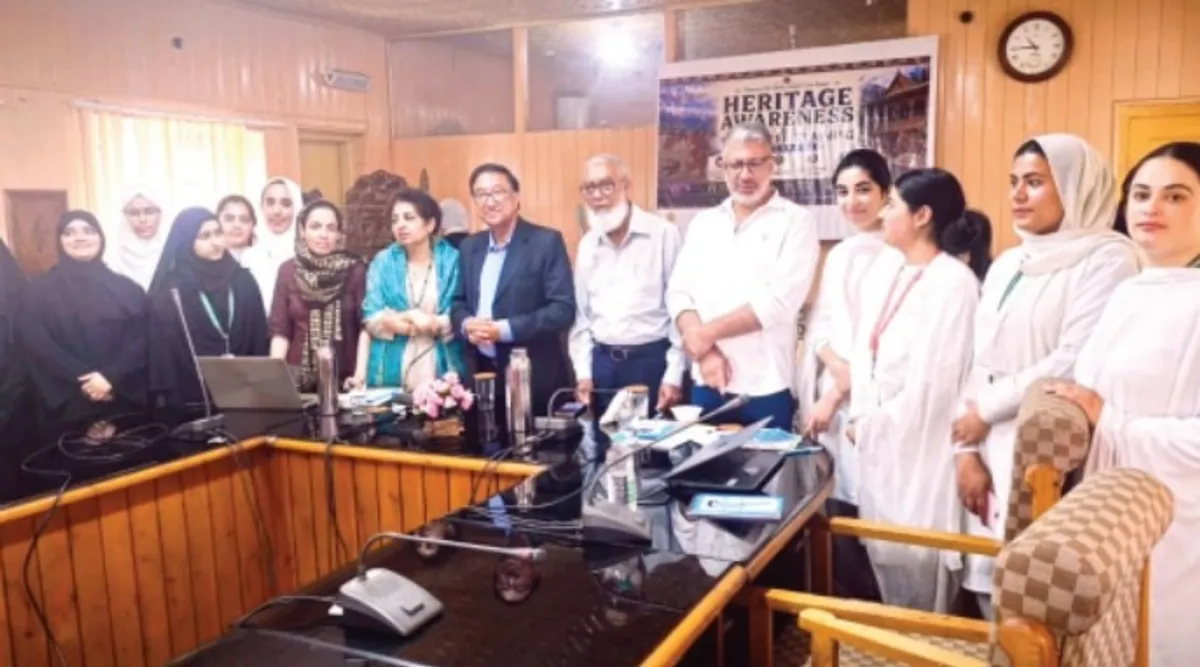
The Indian National Trust for Art and Cultural Heritage (INTACH) Kashmir Chapter organised heritage awareness and volunteer training workshops at Government College for Women M A Road and Amar Singh College, bringing together students, conservationists and educators in an effort to draw younger Kashmiris into conversations about preservation.
The workshops, conducted in collaboration with the Heritage Education and Communication Service division of INTACH, were designed not merely as lectures on monuments or history, but as an attempt to turn heritage into something participatory – something students could see themselves responsible for.
That shift matters in Kashmir, where the debate around heritage increasingly intersects with questions of identity, memory and modernisation.
For years, conservationists in the Valley have warned that rapid urban change, unregulated construction, environmental pressures and public indifference are steadily erasing architectural and cultural landmarks.
Old Srinagar’s traditional houses continue to disappear.
Historic structures decay behind scaffolding or bureaucracy.
Craftspeople struggle to sustain generational work in a market increasingly shaped by machine-made alternatives and shifting aspirations.
Against that backdrop, the workshops carried a quieter urgency.
The sessions began with welcome addresses from the principals of both colleges, who spoke about the importance of involving young people in heritage conservation efforts.
An INTACH heritage film screened during the programme offered students visual glimpses of cultural sites and traditions that many know only partially despite living among them.
But the larger theme running through the discussions was that heritage is not simply about the past.
It is about continuity.
Purnima Datt introduced students to the broader idea of heritage and its role in shaping collective memory and social identity, encouraging them to think beyond monuments and toward the everyday cultural practices that define communities.
Senior conservation architect and art historian Sameer Hamdani spoke about Kashmir’s architectural heritage with the familiarity of someone describing a living archive under strain. He emphasised the need for preservation not as nostalgia, but as cultural responsibility.
In Kashmir, architecture often tells political and social history more honestly than official narratives do. A collapsing mosque, a neglected haveli or an abandoned temple carries traces of migration, conflict, craftsmanship, trade and coexistence embedded within its walls.
To preserve such spaces is also to preserve context.
Saleem Beg, addressing the participants, discussed the changing dimensions of cultural heritage and the possibilities available for youth engagement in the field. His remarks reflected a growing recognition among heritage groups that preservation cannot remain confined to historians and specialists alone.
It requires public ownership.
Especially from younger generations raised in a rapidly digitising and transforming Kashmir, where the pressure to modernise often arrives faster than conversations about what may be lost in the process.
The post-lunch sessions focused on volunteerism, with students participating in group discussions and interactive activities around heritage-related themes. The emphasis was practical as much as educational: documenting sites, raising awareness, participating in conservation campaigns and viewing heritage not as static history but as a living civic concern.
There is a particular irony to teaching heritage awareness inside college classrooms in Kashmir.
Many students pass historic buildings every day without knowing their stories. Others grow up near shrines, bridges or neighbourhoods that older generations consider culturally invaluable but which younger residents increasingly experience as ordinary background scenery.
Familiarity can dull significance.
And modern life, especially in expanding cities like Srinagar, often moves faster than preservation efforts can keep up with.
Yet organisations like INTACH continue to push against that erosion carefully, workshop by workshop, lecture by lecture, student by student.
Not because a single seminar can preserve a monument.
But because conservation begins first with attention.
With teaching someone to look closely at a window frame, a street, a shrine, a language, a craft – and to recognise that survival is never automatic.
By the end of the workshops, the students had participated in discussions, viewed presentations and spoken about heritage as volunteers rather than spectators.
Outside, Srinagar continued to modernise around them.
Inside, for a few hours, the conversation was about what should remain.
About the Author
A postgraduate in Convergent Journalism, the author approaches storytelling as a visual and narrative craft. With a strong interest in cinematography and filmmaking, his work often lingers on the human dimensions of news. Drawn to stories that matter to people, he writes with an eye for both movement and meaning.