
Kashmir Impulse Desk
Srinagar, July 5
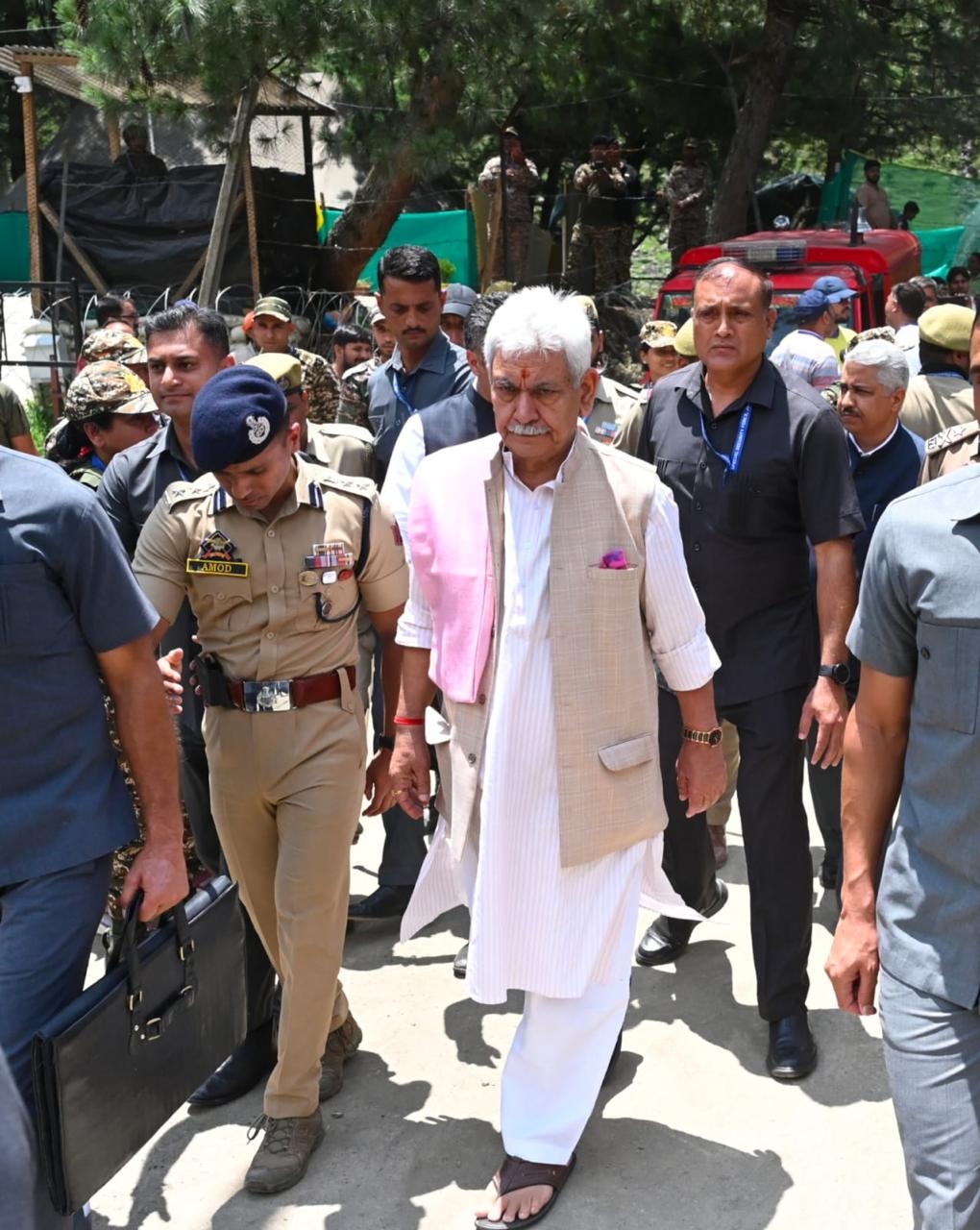
Lieutenant Governor Manoj Sinha on Sunday reviewed security, healthcare, and logistical arrangements for the annual Amarnath Yatra, directing officials to maintain round-the-clock coordination while urging yatris without valid registration to postpone their journey as authorities grapple with an unprecedented rush.
Sinha visited the Chandanwari transit camp in south Kashmir’s Anantnag district before proceeding to the Nunwan base camp, where he chaired meetings with civil administration, police, security agencies and the Shri Amarnathji Shrine Board (SASB) to assess the progress of the yatra, officials said.
The visit comes as this year’s pilgrimage has witnessed a sharp increase in the number of devotees, prompting authorities to reinforce crowd management measures while reiterating that the daily cap on pilgrims travelling through the twin Pahalgam and Baltal routes cannot be exceeded.
Interacting with officials, volunteers, langar organisers and pilgrims at Chandanwari, Sinha instructed Yatra management teams to continuously monitor feedback from devotees and ensure prompt redressal of grievances.
He said the administration had adopted a “whole-of-government” approach to provide accommodation, food, medical care and other essential services for pilgrims undertaking the annual pilgrimage to the Himalayan cave shrine dedicated to Lord Shiva.
During his inspection of the Chandanwari Base Hospital, the Lieutenant Governor reviewed emergency facilities, wards, laboratories and outpatient services and interacted with patients receiving treatment.
Officials briefed him that specialist doctors, nursing staff and paramedics had been deployed at the facility, with adequate stocks of medicines and emergency equipment available. The hospital is handling around 2,500 outpatient visits daily, catering not only to yatris but also to volunteers and support personnel engaged in the Yatra.
Sinha praised healthcare workers for maintaining medical services under challenging high-altitude conditions and stressed the need to sustain preparedness throughout the yatra season.
Addressing reporters later, Sinha said the administration had observed a significant increase in yatri arrivals compared with previous years but expressed concern over the growing number of devotees reaching Jammu and Kashmir without prior registration.
He appealed to intending yatris to adhere strictly to the registration schedule, saying only those holding valid permits for designated dates should proceed to the shrine.
“The daily quota for yatris using both the Chandanwari and Baltal routes is fixed and cannot be increased. Following the prescribed registration system is essential for ensuring both safety and a smooth yatra,” he said.
He noted that the 100-bed hospital at Chandanwari, operational for the past two years, had strengthened emergency healthcare facilities along the traditional Pahalgam route.
At the Nunwan base camp, Sinha chaired a high-level review meeting with senior civil and security officials to evaluate yatra movement, accommodation, security deployment, registration management and other logistical arrangements.
He directed officials to adopt a yatri-centric approach and maintain close coordination among departments to minimise inconvenience while ensuring rapid resolution of complaints.
The Lieutenant Governor also instructed officials to facilitate travel for families arriving together where one member lacks valid registration, provided assistance is extended in accordance with existing regulations.
Separately, Sinha expressed concern over reports that some travel agents were allegedly issuing fraudulent registrations, resulting in yatris arriving without valid verification.
He directed police and other authorities to identify those involved and initiate strict legal action against individuals or agencies found facilitating fake registrations, officials said.
The annual Amarnath Yatra, one of Hinduism’s most important yatra, is conducted under a multi-layered security and administrative framework involving the SASB, civil administration, police, armed forces and disaster response agencies, with authorities balancing growing yatri demand against safety considerations in the ecologically sensitive Himalayan terrain.