
Kashmir Impulse Desk
Srinagar, June 27
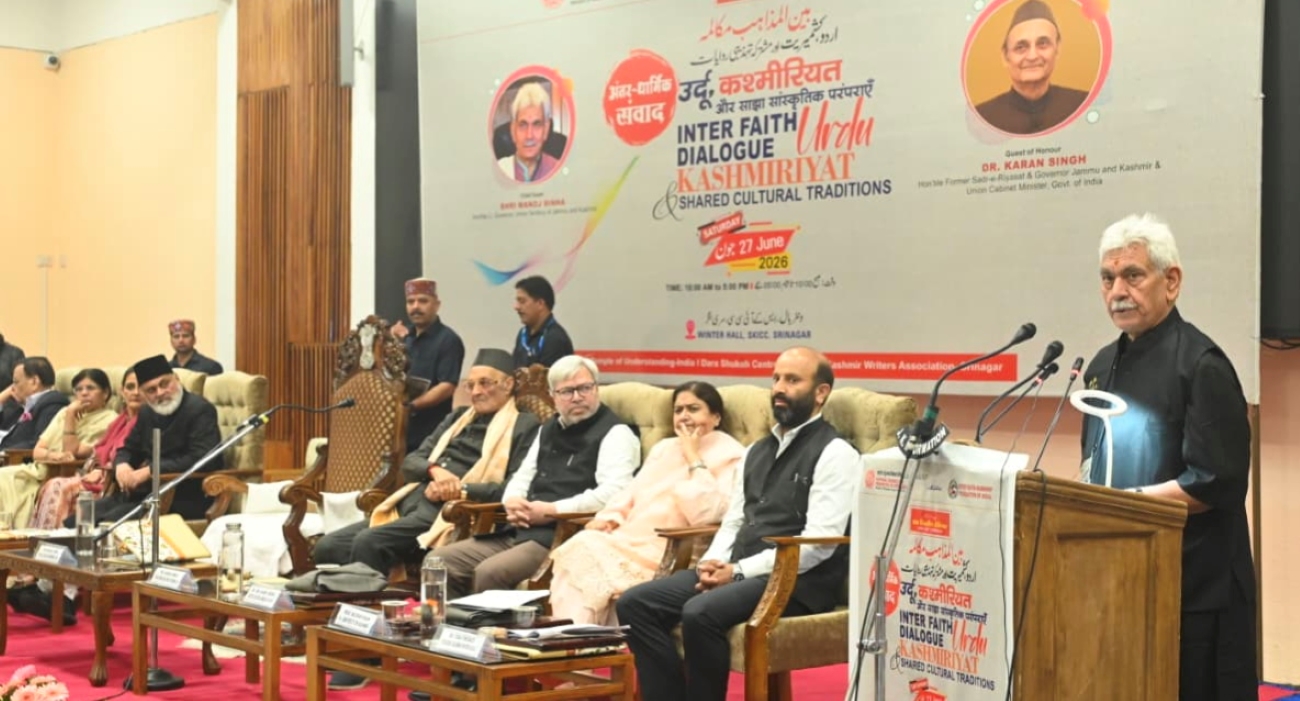
Lieutenant Governor Manoj Sinha on Saturday said India’s tradition of religious pluralism was rooted in the inclusive philosophy of Hinduism, arguing that the country’s civilisational ethos had historically enabled multiple faiths to flourish side by side without coercion.
Speaking at an interfaith dialogue in Srinagar, Sinha said the principles of Sanatana Dharma, or Hinduism, had fostered coexistence and mutual respect among different religious communities over centuries, describing India’s cultural identity as a model for societies grappling with religious and ethnic conflict.
“The world recognises that Hinduism, or Sanatana Dharma, never imposed itself,” Sinha said. “Instead, it embraced diversity and coexistence. Ancient India created an environment where Christianity, Islam, Judaism and Zoroastrianism found the freedom to flourish.”
The event, organised by the National Council for Promotion of Urdu Language and the Inter-Faith Harmony Foundation of India, brought together religious scholars, academics, writers and public representatives to discuss the role of interfaith dialogue in promoting communal harmony.
Sinha’s remarks come against the backdrop of recurring debates in India over secularism, religious identity and social cohesion, issues that have assumed particular significance in Jammu and Kashmir, a Muslim-majority region that has witnessed decades of political conflict and periodic communal tensions.
Calling India a civilisation rather than merely a nation-state, Sinha said the country’s philosophical traditions offered a framework for peaceful coexistence at a time when societies across the world were increasingly divided by religion, ethnicity and race.
“In a world facing conflict and intolerance, Indian philosophy can serve as a guiding light,” he said. “The idea that humanity should live together as one family remains one of India’s greatest contributions to the world.”
The LG urged younger generations to preserve that legacy, saying peace could only be sustained through mutual respect and understanding among communities.
Referring to the concept of Bhartiyata, or “Indianness”, Sinha described it as a civilisational ethos encompassing equal respect for all religions, unity in diversity and the ancient Indian ideal of Vasudhaiva Kutumbakam – the belief that the world is one family.
“Our ancient scriptures taught that truth is not confined to a single path,” he said. “India has always regarded diversity as a strength rather than a source of division.”
Turning to Jammu and Kashmir, Sinha said the region had long reflected that philosophy through its traditions of communal coexistence.
He linked the idea of Kashmiriyat – a term commonly associated with Kashmir’s syncretic cultural heritage – to what he described as the broader philosophy of Bhartiyata, saying both were founded on respect for different faiths and shared cultural traditions.
Sinha also referred to the arrival of Islam in the Indian subcontinent, saying Sufi saints and Islamic scholars who travelled to India encountered a society rooted in spirituality, compassion and philosophical inquiry.
He said interactions between Islamic scholars and Indian traditions led to cultural exchanges, including the translation of Sanskrit texts into Arabic, contributing to a shared intellectual heritage.
“India never asked anyone to abandon their faith,” he said. “It has always welcomed people to preserve their own traditions while living together in harmony.”
The lieutenant governor concluded by invoking the ancient Sanskrit prayer Sarve Bhavantu Sukhinah (“May all be happy”), describing it as a universal message transcending religious boundaries.
Among those attending the programme were veteran statesman Karan Singh, University of Kashmir Vice Chancellor Nilofer Khan, Inter-Faith Harmony Foundation of India President Khwaja Iftikhar Ahmed, National Council for Promotion of Urdu Language Director Mohammad Shams Eqbal, Dara Shikoh Centre founder Jyotsna Singh and representatives from academia, civil society and the administration.
The conference forms part of a series of interfaith initiatives in Jammu and Kashmir aimed at encouraging dialogue among religious communities and promoting social harmony in a region where cultural and religious diversity has historically shaped public life.