
Kashmir Impulse Desk
New Delhi, June 23
India on Tuesday dismissed remarks by Pakistan’s defence minister threatening war over the suspension of the Indus Waters Treaty, accusing Islamabad of attempting to deflect attention from its own shortcomings and alleged human rights violations.
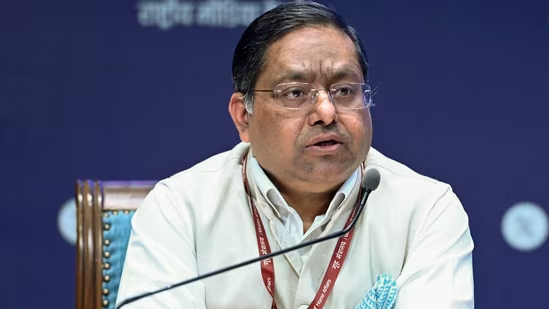
Responding to comments made by Pakistani Defence Minister Khawaja Asif, Indian foreign ministry spokesperson Randhir Jaiswal said New Delhi “categorically rejects” what it described as fabricated claims.
“Such remarks are desperate attempts by Pakistan to cover up its own failings and divert attention away from its human rights abuses,” Jaiswal told a weekly media briefing.
The comments came days after Asif warned that Pakistan could go to war if its water security was threatened following India’s decision to keep the Indus Waters Treaty in abeyance.
Referring to unrest in Pakistan-administered Kashmir, Jaiswal said the situation was a consequence of what he described as decades of economic exploitation, denial of fundamental rights and administrative oppression by Pakistan in territories under its control.
He alleged that Pakistani authorities had employed measures including internet shutdowns, restrictions on essential supplies and the use of force against civilians, resulting in loss of lives.
“We hope that the international community will hold Pakistan accountable for its actions, misdeeds and human rights abuses,” Jaiswal said.
Speaking to ARY News on Saturday, Asif said Pakistan would consider military action if it believed India was threatening its water security.
“The moment we feel that our national security, and water is part of our national security, is being threatened, we will go to war against India. Definitely,” he said.
Asif also accused India of “weaponising water” and manipulating flows in the Chenab River while withholding hydrological data, allegations New Delhi has rejected.
India placed the 1960 Indus Waters Treaty in abeyance in May following the deadly attack in Pahalgam in Jammu and Kashmir that killed 26 people, as part of a series of measures announced against Pakistan.
Brokered by the World Bank, the treaty governs the sharing of waters from the Indus river system between the two countries. Under the agreement, Pakistan receives the waters of the Indus, Jhelum and Chenab rivers, while India has unrestricted use of the Ravi, Beas and Sutlej rivers. India is also permitted limited use of western river waters for domestic, agricultural and hydroelectric purposes.