
Kashmir Impulse Desk
Srinagar, June 30
There comes a point in every heatwave when a government must answer a simple question: Who exactly is expected to endure the weather?
Today, Kashmir received an answer.
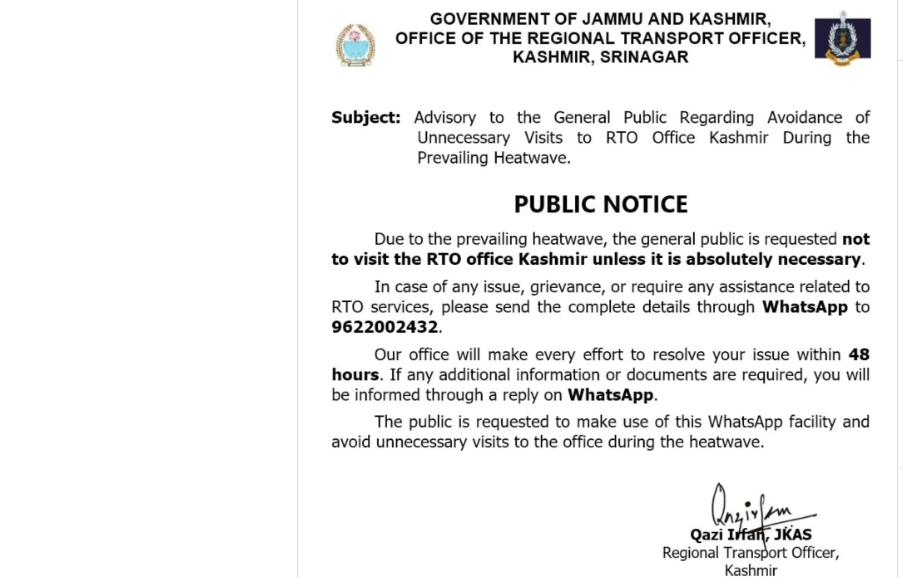
The Regional Transport Office (RTO), Kashmir, displayed a remarkable concern for public welfare.
In a refreshingly humane advisory, citizens were requested to avoid visiting government offices unless necessary because of the extreme heat.
Instead, they were encouraged to use WhatsApp for services, with promises of grievance redressal within 48 hours.
A thoughtful move.
Progressive, even.
After all, why should anyone venture out in scorching temperatures merely to renew a driving licence?
Curiously, the same logic appears to evaporate somewhere between the RTO gate and the school gate.
While adults are politely advised to stay away from government buildings, lakhs of schoolchildren continue to report every morning, many standing shoulder to shoulder in open playgrounds for assemblies under an unforgiving sun before spending the day in classrooms that often resemble greenhouses with blackboards.
Apparently, ultraviolet rays distinguish between an applicant seeking a permit and an eight-year-old reciting the morning prayer.
The government, meanwhile, continues to “mull” summer vacations.
The Education Minister has assured everyone that a decision would be taken after returning from New Delhi, while also requesting parents not to believe social media rumours.
Fair enough.
Rumours are dangerous.
Heatstroke, it seems, can wait.
One wonders whether the weather has been instructed to postpone its peak until the file returns from the capital.
Across Kashmir, parents have become unwilling meteorologists, checking temperature forecasts before packing school bags.
Doctors advise limiting children’s exposure during peak afternoon hours.
Schools dismiss students at precisely those hours.
Many children spend over an hour in buses and vans that offer all the ventilation of a parked pressure cooker.
Several schools still function without adequate fans or reliable drinking water.
Yet the daily routine remains untouched, as though climate change is merely another chapter in the environmental science textbook.
Government employees, however, have been offered an alternative: stay home if the work can be done digitally.
Children, unfortunately, haven’t yet been introduced to the revolutionary concept of attending the morning assembly over WhatsApp.
Perhaps that innovation is reserved for the next academic session.
The irony is difficult to ignore.
If the weather is severe enough to discourage adults from walking into an air-conditioned government office, what magical atmospheric phenomenon makes it perfectly suitable for thousands of children to stand outdoors every morning?
Maybe resilience begins early.
Maybe childhood is considered the ideal time to develop resistance to dehydration.
Or perhaps the heat is following a government notification of its own, exempting educational institutions until further orders.
None of this diminishes the RTO’s commendable initiative.
On the contrary, it deserves appreciation.
It acknowledges an obvious reality: extreme heat is dangerous.
The puzzle is why that reality seems applicable only to people carrying driving licences and not those carrying schoolbags.
Public policy should not create two categories of citizens during a heatwave – those advised to stay indoors and those expected to build character outdoors.
Because if the sun is too harsh for a visit to the transport office, it is certainly too harsh for a seven-year-old standing through a morning assembly.
The weather, unlike official notifications, does not discriminate.