
Kashmir Impulse Desk
Srinagar, Aug 6
The Forum for Human Rights in Jammu and Kashmir has called for the immediate restoration of full statehood to J&K, saying the move is essential to strengthen democratic accountability and improve human rights protections, while warning that governance remains caught in a prolonged institutional stalemate despite improvements in the security situation.
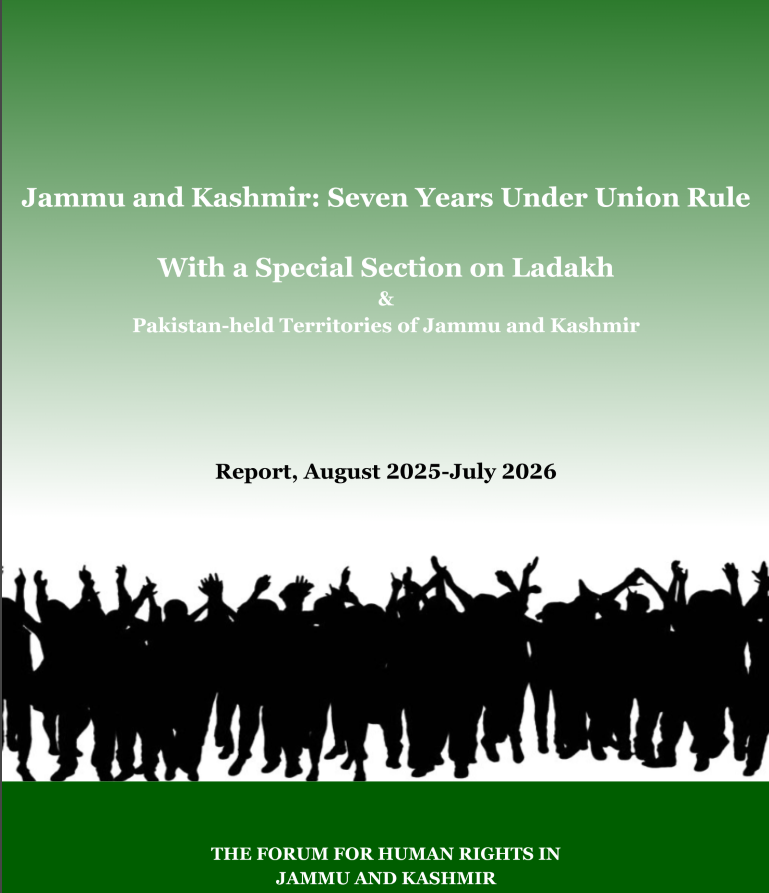
In its seventh annual report, titled Jammu and Kashmir: Seven Years Under Union Rule, covering the period from August 2025 to July 2026, the independent group of former judges, civil servants, security officials, and academics said the region witnessed “contradictory trends” over the past year, with declining levels of armed violence accompanied by continuing concerns over civil liberties, preventive detentions, political rights, and economic distress.
The report said the overall security environment appeared to have improved, although it remained fragile, pointing to the November 2025 Red Fort bombing as evidence that militancy linked to Jammu and Kashmir continues to pose a threat beyond the region.
According to the report, armed conflict fatalities fell during the review period, with no civilian deaths reported in militant violence, while arrests and recoveries of arms also declined compared with the previous year.
However, the Forum argued that the security gains have not translated into stronger democratic governance.
It said power continues to remain concentrated in the office of the Lieutenant Governor, while the elected government has limited administrative authority, creating what it described as a governance imbalance between an unelected administration exercising executive control and an elected government accountable to the public but possessing little effective power.
The report also expressed concern over the granting of emergency telecommunications powers to the Lieutenant Governor, saying the arrangement further weakened democratic accountability.
The forum reiterated its longstanding recommendation that Jammu and Kashmir’s statehood be restored without delay.
It argued that the 2019 reorganisation fundamentally altered India’s federal structure by reducing a full-fledged state to a Union Territory and maintained that the restoration of statehood would provide the institutional framework necessary for greater accountability and protection of civil liberties.
The report also criticised the continued absence of independent oversight institutions, including the Human Rights Commission, Women’s Commission, Accountability Commission, and Information Commission, stating that these bodies have not been revived despite the return of an elected government.
It further noted that the Legislative Assembly has yet to establish a dedicated human rights committee despite repeated recommendations by the forum.
A major section of the report focused on the use of preventive detention and anti-terror legislation.
The forum welcomed what it described as increasing judicial scrutiny by the Jammu and Kashmir High Court, which during the reporting period quashed several detention orders issued under the Public Safety Act (PSA) and granted relief in several cases under the Unlawful Activities (Prevention) Act (UAPA).
The report said the court repeatedly criticised police investigations, inadequate evidence, and the mechanical use of preventive detention, although many detainees had already spent long periods in custody before obtaining relief.
Despite those judicial interventions, the forum said police practices showed little sign of changing, arguing that repeated court observations had not resulted in meaningful institutional reforms.
The report also documented the aftermath of the Red Fort bombing, saying the attack triggered heightened security measures across J&K, particularly during the Amarnath Yatra, where authorities introduced unprecedented surveillance, identity verification, and movement restrictions.
It said these measures contributed to growing public resentment, alongside large-scale detentions following subsequent militant incidents, including the killing of a police constable in Anantnag.
According to the forum, the report also raises concerns over the treatment of Kashmiri Muslims following the Red Fort attack, alleging instances of housing discrimination, harassment, forced evictions, and enhanced verification measures in different parts of India.
It further refers to police detentions, demolitions, and increased surveillance within J&K, as well as data collection exercises involving religious institutions.
Economically, the report paints a difficult picture, saying unemployment remains around twice the national average while the apple industry experienced one of its poorest seasons in a decade.
It also refers to continuing demolition of tribal homes, which it says occurred in violation of the Forest Rights Act.
The forum devoted a separate section to Ladakh, where it said tensions following the September 2025 police firing on protesters demanding statehood and constitutional safeguards have eased but remain unresolved.
It noted that discussions between the Union Home Ministry and representatives of the Apex Body Leh and the Kargil Democratic Alliance continue, with recent informal talks suggesting a possible breakthrough through special constitutional provisions, although negotiations remain incomplete.
For the first time, the forum also included a chapter examining developments across the Line of Control (LoC), citing continuing public protests over governance, electoral reforms, electricity tariffs, and civil liberties.
The report says the scale of the demonstrations made it difficult to ignore developments across the LoC despite limited access to independent information from the region.
Among its principal recommendations, the forum urged the Centre to restore J&K’s full statehood, expedite police reforms, review and withdraw improperly applied PSA and UAPA cases, revive independent oversight commissions, and establish a separate human rights commission for Ladakh.
It also called for continued dialogue on Ladakh’s demands for constitutional safeguards and statehood.
The forum comprises former Supreme Court and High Court judges, retired senior civil servants, former military officers, lawyers, academics, and human rights advocates.
It said the report was compiled using government records, court documents, media reports, interviews, NGO fact-finding reports, and legal proceedings, with information cross-verified from multiple sources before publication.