

Kashmir Impulse Desk
Srinagar, July 1
Flash floods, cloudbursts and landslides hit several parts of Jammu and Kashmir on Wednesday after a weather system driven by the interaction of a western disturbance and advancing southwest monsoon currents swept across the region, damaging roads and public infrastructure while ending Kashmir’s prolonged spell of unusually hot weather.
Authorities reported no casualties, but heavy rain triggered flooding in parts of Doda and Anantnag districts, disrupted road connectivity in the Chenab Valley and prompted warnings of further flash floods, mudslides and landslides over the coming days.
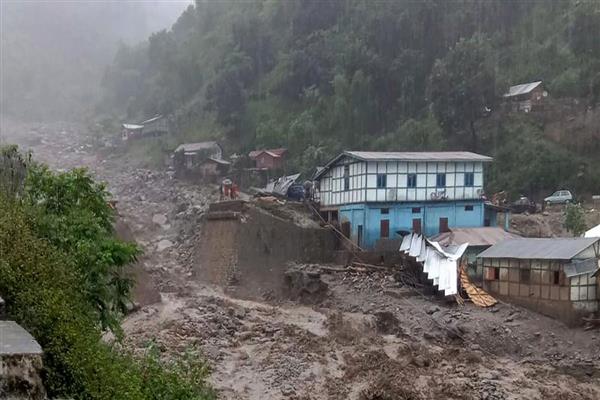
The worst-affected areas were in Doda district’s Bhalessa region, where cloudburst-like incidents struck Kalalgisar and Seru villages following intense afternoon rainfall.
Floodwaters carrying mud, rocks and debris blocked stretches of the Thathri-Kilhotran road, cutting off several villages and leaving commuters stranded as authorities suspended movement through vulnerable stretches.
Officials said restoration work would begin once weather conditions improved, while damage assessment teams had been deployed to evaluate losses to roads and public infrastructure.
The district administration advised residents to avoid unnecessary travel in landslide-prone areas as continuous rainfall heightened the risk of slope failures and shooting stones.
Local residents said the Bhatiyas area suffered extensive damage after floodwaters inundated a government food storage depot, damaging food grains stored inside the facility. Residents also complained of delays in the deployment of road-clearing machinery and said inadequate drainage infrastructure had aggravated flooding in the area.
Authorities later began efforts to clear debris and restore connectivity.
Heavy rainfall in the upper reaches of the Chenab basin also caused the river’s water level to rise above the danger mark in Doda district, prompting the administration to issue a high alert and advise people living along the riverbanks to remain vigilant and stay away from the river.
In south Kashmir, flash floods inundated Mir Mohalla in Guridraman village of Anantnag district’s Larnoo area, where a government primary school was flooded while classes were in progress.
Residents evacuated students before water entered the building, while police, State Disaster Response Force (SDRF) personnel and civil administration teams rushed to the scene. Officials said no injuries were reported and were assessing the extent of damage to the school building.
Heavy showers also flooded parts of Aishmuqam market and the shrine of Hazrat Zainuddin Wali, while rain lashed the tourist resort of Pahalgam and higher reaches of Kulgam, Pulwama and Shopian districts.
Intermittent rainfall accompanied by gusty winds was also reported from Budgam, Ganderbal and parts of north Kashmir, while much of the Valley remained overcast through the day.
The rainfall brought significant relief from the intense heat that had gripped Kashmir during the previous five days.
Srinagar recorded a maximum temperature of 31.5 degrees Celsius on Wednesday after temperatures had climbed above 35 degrees on the preceding two days, among the highest recorded in recent years.
Temperatures also moderated across other parts of the Valley, with Pahalgam recording 25.6 degrees Celsius and Gulmarg 23.6 degrees, while Jammu city registered a maximum of 31.8 degrees Celsius following widespread rainfall across the Jammu region.
According to the Meteorological Department, Samba recorded the highest rainfall in the past 24 hours at 62.5 mm, followed by Jammu city with 35.8 mm, Kathua with 23.8 mm, Rajouri with 19.6 mm and Katra with 12 mm.
Meteorological Centre Srinagar Director Mukhtar Ahmad said the prevailing weather system was likely to keep conditions unstable across Jammu and Kashmir until July 5.
He said widespread light to moderate rainfall accompanied by thunderstorms was expected across the Union Territory, with isolated locations likely to witness intense showers, gusty winds, lightning and hailstorms.
The department warned that heavy rainfall could trigger localised flash floods, waterlogging, landslides and shooting stones along vulnerable highways and hill roads, while strong winds and lightning could disrupt transport services and outdoor activities.
Ahmad said the weather system was expected to weaken gradually after July 5, although isolated spells of rain and thundershowers could continue until July 8, after which hot and humid conditions were likely to return across the region.
The fresh spell of adverse weather comes at a crucial time as authorities complete preparations for the annual Amarnath Yatra beginning July 3, with disaster response agencies and district administrations remaining on alert for weather-related emergencies along the yatra routes and major highways.