
Srinagar, May 12
Lieutenant Governor Manoj Sinha said on Tuesday that border villages in the region had been connected to the mainstream of development under federal government initiatives, while also announcing a community-based anti-drug campaign involving religious leaders and social groups.
Addressing a public gathering in Uran Bowa village in Baramulla district under the Centre’s Vibrant Villages Programme, Sinha said the distance between border villages and New Delhi had “reduced” under Prime Minister Narendra Modi’s leadership.
“They are connected to the mainstream of development and it is the commitment of the Government of India to ensure that border villages become a symbol of inclusive development,” Sinha said while reviewing ongoing schemes in the area.
The programme focuses on infrastructure development in border regions, including all-weather road access, electrification, telecom services and television connectivity.
Sinha said all 18 villages covered under the programme in the region had been linked by all-weather roads, while efforts to connect all 83 border villages in Baramulla district had been accelerated.
“Very soon every border village of Jammu and Kashmir will be integrated into the economic mainstream and linked to other key cities of the country,” he said.
According to Sinha, telecom and digital coverage in the 18 villages had risen from below 40% before 2019 to full 4G and 5G coverage.
He said the administration was also focusing on literacy, economic growth and employment generation in border areas, particularly for women and youth, through vocational training, tourism and agricultural initiatives.
During the visit, Sinha inaugurated and laid foundation stones for development projects worth 9.4 billion rupees ($110 million) across 83 villages under the second phase of the Vibrant Villages Programme.
He also distributed appointment orders to special police officers, tablets to students and sanction letters to beneficiaries under various government schemes.
Separately, Sinha launched two new initiatives under Jammu and Kashmir’s anti-drug campaign, including what he described as a “community immunisation programme against drugs” and a “family fortress initiative”.
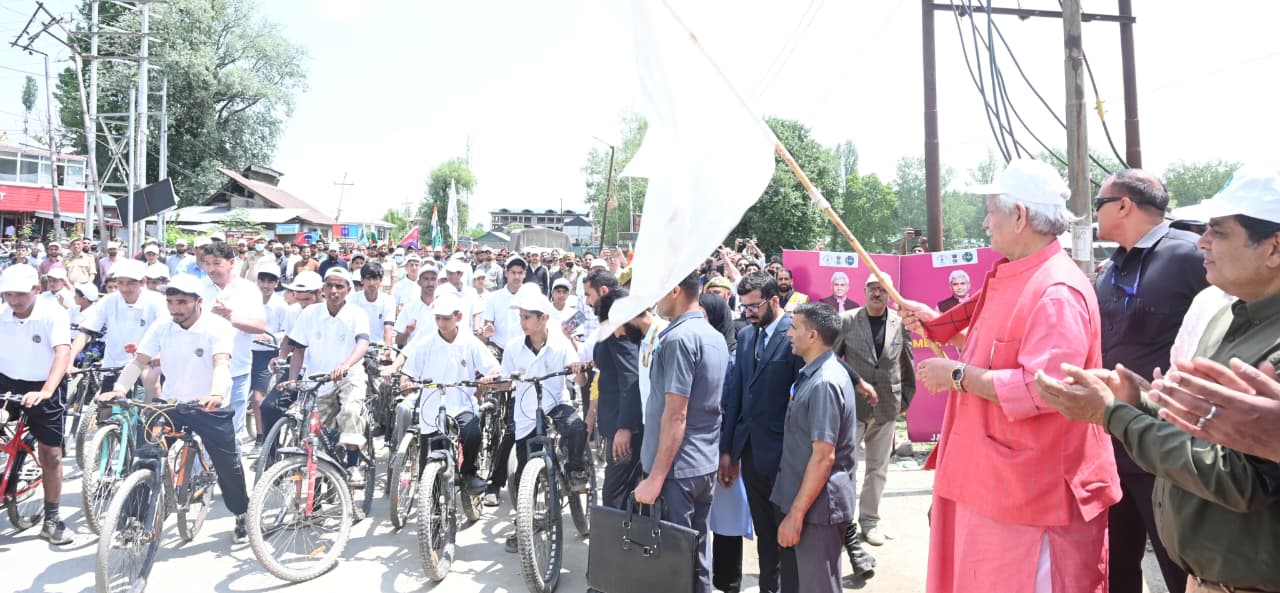
Participating in a public march in Baramulla, he said the administration would work with religious leaders, schools, non-governmental organisations and social groups to strengthen awareness and prevention efforts in high-risk areas.
“Just as we have taught communities to vaccinate against bacteria or viruses, we will partner with religious leaders and social groups to create a community immunisation initiative against drugs,” Sinha said.
He urged schools, mosques, temples, gurdwaras and NGOs to dedicate one hour every week to anti-drug awareness activities over the next 69 days.
Sinha said more than 235,000 awareness and outreach events had been held across Jammu and Kashmir in the past month, while over 44,000 outpatients had received treatment related to substance abuse.
Nearly 700 alleged drug smugglers and peddlers had been arrested during the period, he said, adding that authorities had also moved against assets linked to narcotics trafficking.
According to Sinha, more than 3,300 drug stores had been inspected and 150 licences suspended for violations. Authorities had also recommended cancellation of around 300 driving licences and over 400 vehicle registrations allegedly linked to drug traffickers.
“We will chase every rupee, every asset and shell company of drug traffickers, ensuring the harshest punishment for those who are destroying our youth’s future,” he said.