
Kashmir Impulse Desk
Kolkata, July 6
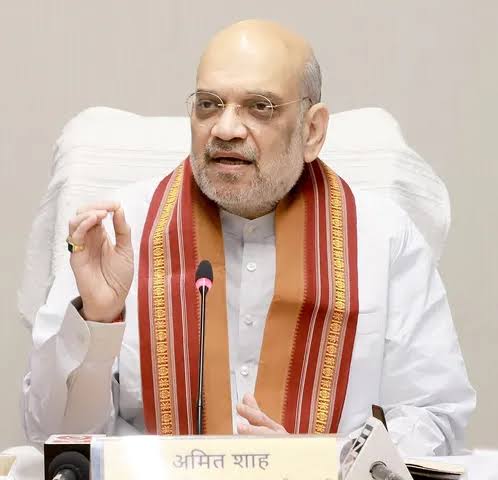
Union Home Minister Amit Shah on Monday said the abrogation of Article 370 had fulfilled Bharatiya Jana Sangh founder Syama Prasad Mookerjee’s vision of the complete integration of Jammu and Kashmir with the rest of India, describing the constitutional change as the realisation of a cause for which Mookerjee had laid down his life.
Addressing a commemorative programme in Kolkata to mark Mookerjee’s 125th birth anniversary, Shah said Prime Minister Narendra Modi had translated the Jana Sangh founder’s call for “One Nation, One Constitution” into reality by revoking the special constitutional status of the erstwhile state of Jammu and Kashmir.
“Mookerjee gave the slogan that one country cannot have two constitutions, two heads and two symbols. He died under suspicious circumstances in a Kashmir jail while pursuing that cause, and the then government did not investigate his death. Prime Minister Modi fulfilled his resolve by removing Article 370. Today, Jammu and Kashmir is an integral part of India,” Shah said.
Prime Minister Narendra Modi addressed the gathering through a video message, while the event was attended by senior Bharatiya Janata Party leaders, including Union Minister Gajendra Singh Shekhawat and Leader of the Opposition in the West Bengal Assembly Suvendu Adhikari.
Shah also announced that the foundation stone had been laid for a 125-foot statue of Mookerjee in Kolkata, saying the memorial would symbolise the beginning of a broader effort to realise the vision of “Sonar Bangla.”
He said the memorial complex, to be developed on the banks of the city’s largest man-made lake, would also house the Shyama Prasad Mookerjee Institute, a research centre dedicated to national security and strategic studies.
“This is not merely the foundation-laying ceremony for a statue, but the beginning of the resolve to build Sonar Bangla,” Shah said.
Congratulating the West Bengal government for declaring Mookerjee’s birth anniversary a public holiday, Shah said the decision was a tribute to one of Bengal’s foremost nationalist leaders and expressed hope that the state would also advance Mookerjee’s vision for promoting Indian languages.
Recalling Mookerjee’s political career, Shah said he had resigned from the first Union Cabinet headed by Jawaharlal Nehru in protest against the Nehru-Liaquat Pact, arguing that the agreement had failed to adequately safeguard the interests of Hindus who had remained in Pakistan and East Pakistan after Partition.
“He believed the agreement was one-sided, and therefore resigned from the Cabinet,” Shah said.
The home minister said the BJP-led government had subsequently enacted the Citizenship (Amendment) Act (CAA) to grant Indian citizenship to persecuted religious minorities from neighbouring countries and reiterated the Centre’s resolve to identify and deport illegal infiltrators.
“We have abolished Article 370, granted citizenship to refugee Hindus, and will identify and remove every infiltrator to make India completely secure,” he said.
Describing Mookerjee as a leader whose ideas transcended generations, Shah said he had founded the Bharatiya Jana Sangh to unite nationalist forces under the principles of cultural nationalism and national unity.
“The seed sown by Mookerjee has today grown into the banyan tree called the Bharatiya Janata Party,” Shah said, adding that the party now governed a substantial portion of the country’s territory and population.
He said Mookerjee believed that independent India’s policies should reflect the country’s civilisational values rather than emulate Western models, and credited the Modi government with pursuing development while preserving India’s cultural heritage.
According to Shah, Mookerjee’s philosophy continued to influence the government’s approach to governance, balancing economic development with the protection of India’s cultural identity as the country worked towards becoming a developed nation by 2047.
Referring to Bengal’s intellectual and cultural legacy, Shah said the rebuilding of the state envisioned by figures such as Rabindranath Tagore, Ramakrishna Paramahansa, Swami Vivekananda, Sri Aurobindo, Netaji Subhas Chandra Bose and Raja Rammohan Roy had begun under the present dispensation.
He said the coincidence of the 150th anniversary of “Vande Mataram” and Mookerjee’s 125th birth anniversary in the same year carried symbolic significance, adding that efforts were being made to encourage younger generations to embrace the national song in its entirety.
Listing initiatives undertaken by the newly elected government in West Bengal, Shah cited the rollout of the Annapurna Yojana, Ujjwala 3.0, free bus travel for women and girl students, the Lakhpati Didi Mission and the implementation of Ayushman Bharat, which provides health insurance cover of up to Rs 5 lakh to eligible families.
He said construction of a cancer hospital in north Bengal had commenced, land had been handed over to the Border Security Force for border fencing and judicial committees had been constituted to investigate corruption and crimes against women.
Shah said the government had also initiated the process of identifying illegal infiltrators, constituted a “Durga Suraksha Squad” to strengthen women’s safety and set up a committee to examine implementation of the Uniform Civil Code in the state.
Accusing previous Left Front and Trinamool Congress governments of holding back Bengal’s development, Shah expressed confidence that the present government would fulfil its electoral commitments and lay a strong foundation for a “Sonar Bangla.”
He said Mookerjee, whom he credited with safeguarding the interests of Bengal, Kashmir and Assam during critical periods in India’s history, had not received a memorial befitting his legacy, and expressed hope that the proposed monument in Kolkata would inspire future generations.