
Amir Yaseen
Srinagar, June 23
The records have long since blurred together for Lionel Messi.
Most appearances. Most matches as captain. A World Cup winner. A footballing icon whose career has been measured not in seasons, but in milestones.
Now, at age 38 and days away from his 39th birthday, Messi has climbed yet another summit – one that many believed would stand for generations.
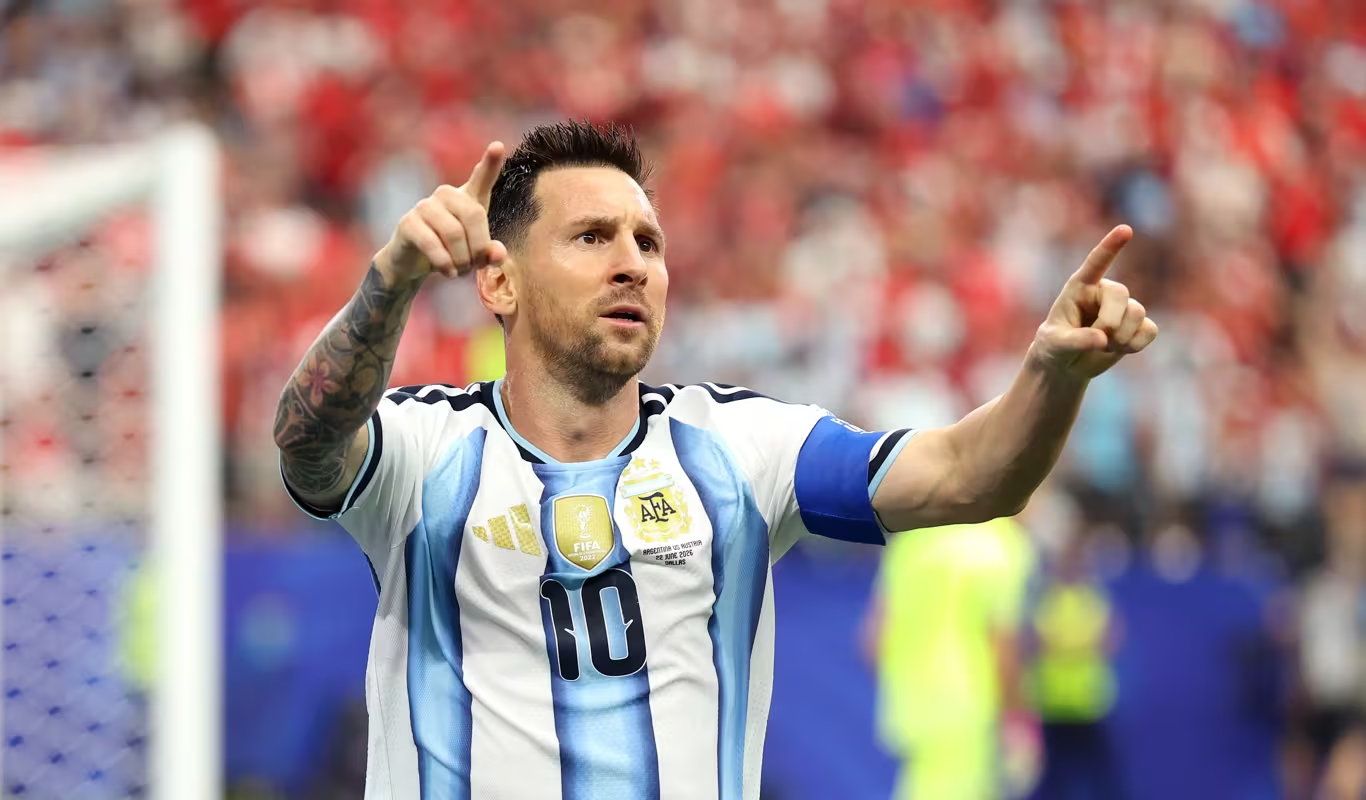
On Monday afternoon at Dallas Stadium, the Argentina captain became the FIFA World Cup’s all-time leading scorer, surpassing German legend Miroslav Klose with his 17th career goal in the tournament before adding an 18th for good measure in a 2-0 victory over Austria.
The moment arrived late in the first half. Having already seen an earlier penalty saved, Messi found himself in familiar territory inside the Austrian penalty area. A first-time left-footed finish beyond goalkeeper Alexander Schlager settled not only the match but also a piece of football history.
For the first time since Klose’s record-setting run ended in 2014, the World Cup had a new king of goals.
And Messi wasn’t finished.
Deep into stoppage time, the Argentine superstar followed up a shot from Julian Alvarez to score again, pushing his World Cup tally to 18 and providing a fitting flourish to another chapter in a career that increasingly defies comparison.
The significance of the achievement extends beyond a single afternoon in Texas.
Klose’s mark of 16 goals had survived for 12 years. The German striker scored across four World Cups between 2002 and 2014, establishing a benchmark that appeared untouchable in an era when international careers rarely stretched long enough to challenge it.
Messi, however, has rewritten the rules of longevity.
The 2026 tournament marks his sixth World Cup appearance, tying the competition record for editions played. Remarkably, he has scored in five different World Cups, beginning with his first strike against Serbia and Montenegro as a teenage prodigy in Germany in 2006.
Twenty years later, he remains the defining figure on football’s biggest stage.
His latest goals also strengthened his grip on the scoring lead at the 2026 tournament. After opening the competition with a hat trick against Algeria, Messi now has five goals through Argentina’s first two matches as the defending champions pursue another title.
Perhaps fittingly, one of the first people to acknowledge the inevitability of the record was the man Messi surpassed.
Before the tournament, Klose spoke warmly about the Argentine legend while reflecting on the possibility that his record would fall.
“Messi is simply Messi,” Klose told FIFA. “I’ve always admired the way he solved problems and the way he carried himself as a person, even on the pitch.”
Klose continued his praise by highlighting Messi’s transformative impact on the game, adding that he had long been a fan of the Argentine captain’s brilliance and humility.
It was a passing of the torch without bitterness—a salute from one World Cup great to another.
For Messi, though, the emotions of the moment were mixed with exhaustion.
After the final whistle, he struggled to identify a favorite among his 18 World Cup goals.
“I don’t know, to be honest, I can’t remember right now,” Messi told Telemundo. “I’m tired, I’m running low on energy, and I’m finding it hard to think, so anyway, I’m just going to enjoy this moment, and I’m looking forward to celebrating with my team-mates.”
That response may be the most revealing detail of all.
For two decades, football has chronicled Messi’s goals, trophies and records with meticulous precision. Yet for the player himself, history appears secondary to the journey still unfolding.
Argentina arrived in the United States seeking to defend its world title. Two matches into the tournament, the Albiceleste remain perfect, Messi leads the Golden Boot race, and another record has been crossed off the list.
The numbers are staggering: six World Cups, five tournaments with goals, 18 World Cup strikes and counting.
But as Argentina’s captain walked off the field in Arlington, history felt less like a final destination and more like another stop along a career that continues to redefine what is possible in football.
Match information, quotes, and photos courtesy of FIFA.com