
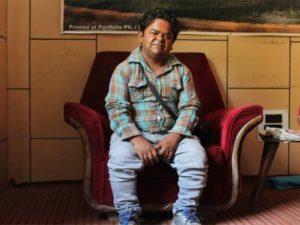
For Kashmiris with dwarfism, every day is a climb through stigma, exclusion, and extraordinary resilience. Tabish Khan reports.
Parvaiz Ahmad, 27, was bullied at school for being short.
At 4.5 feet tall, he was always the last to be picked for cricket and football teams.
Even today, a sense of discomfort and inferiority lingers within him.
A resident of Kupwara in north Kashmir, Ahmad believes that being a person with dwarfism is akin to living with a disability.
“The worst thing about being short is that there is nothing we can do about it. Overweight people can follow diets and exercise, and skinny people can eat more and lift weights,” Ahmad says as we chat inside a café on the banks of the River Jhelum near his office in Srinagar, the summer capital of Jammu and Kashmir.
Ahmad lives with his three sisters and three brothers, all of whom are of average height. During childhood, they too would often make fun of him.
“It was one of the most difficult phases of my life. I often wished to die,” he recalls with a sigh, adding that family support is extremely important for little people.
According to Ahmad, people with dwarfism are treated like children in workplaces and are rarely taken seriously.
During his early academic years, television fascinated him.
He wanted to join the entertainment industry both to earn money and to prove wrong those who believed he was incapable.
“After passing Grade 10, I managed to enter the industry, but because of my height, I ended up editing videotapes,” he says, lamenting that little people are rarely judged on the basis of their skills and talent.
Finding a life partner is also difficult, Ahmad says, because many women dream of tall and handsome men.
“Friends, relatives, and acquaintances usually come forward to help others find suitable life partners, but in our case, they remain silent spectators. With no matchmakers willing to help us, we have to find someone on our own,” Ahmad explains.
Those with dwarfism who do manage to find partners often become internet celebrities for the wrong reasons.
“Our pictures are shared on social media, and you know what happens afterward,” he says.
In the summer of 2013, Ahmad married Hafiza Begum, who lived in his neighbourhood.
His sister acted as the matchmaker.
A few years later, the couple welcomed a baby boy, Adnan.
Since then, Ahmad says he has dedicated himself to proving that he is a good father.
“I want to be a good parent, and hopefully height will never become a criterion for that,” he says with bitter sarcasm.
However, dwarfism sometimes creates hurdles in his role as a father.
He recalls an incident when Adnan was suffering from pneumonia and neither patients nor doctors at a government hospital were willing to help him.
“Instead of helping a disabled person, people at the hospital rebuked and insulted us for trying to enter the doctor’s chamber before our turn. I too have emotions, I too get angry, but I am helpless. I can never properly stand up for my family because of my height,” Ahmad says.
Double Whammy
Less than 4 km from Lal Chowk lives Abdul Hameed Sheikh, a 4.1-foot-tall man now in his fifties.
Sheikh has worked as a peon at a government school for more than 30 years.
Before this, he worked with a local tailor to learn tailoring skills.
However, a wrongly stitched pair of trousers landed him in trouble with his employer.
“My teacher hit me on the back of my neck with a ruler. I collapsed and fell into a drain,” Sheikh recalls.
He was rescued by Jalali Sahab, then principal of the government school where he now works, who took him inside the school building.
“Once I regained consciousness, I couldn’t stand properly, and Jalali Sahab took care of me like a child. After the incident, I became both a person with dwarfism and a person with a physical disability. Taking pity on my condition, Jalali Sahab offered me a job,” he says while sitting on an old wooden chair near the school gate.
Unlike Ahmad, Sheikh was fortunate to have supportive siblings.
After the death of their parents, his five brothers took care of him.
Two years ago, when Sheikh underwent surgeries for urinary bladder suspension and gallstone removal, his brothers stayed beside him throughout his hospital stay.
Sheikh’s sister-in-law says her husband maintains a carefully organised record of Sheikh’s medical reports and never tolerates disrespect toward him.
“Once I called Sheikh by a funny nickname, and my husband did not speak to me for three days,” she shares.
For Sheikh, kindness is not limited to family.
Two years ago, when his specially modified red bicycle stopped working, a group of teenagers would push it like a cart wherever he needed to go.
“I bought the second-hand vehicle for US 170 dollars using my savings from another person with disabilities and dwarfism. I approached the Social Welfare Department for assistance, but to no avail. I chose not to visit them again and continue using the defective one,” Sheikh says.
As if real-life mockery was not enough, Sheikh believes the media has also failed little people.
“I believe they are making fun of us, aren’t they?” he asks innocently.
“I understand that what we see on screen is fiction, but producers and directors often portray people with dwarfism as clowns. We are not clowns; we are people with different abilities and needs. Whenever I watch such shows, my heart aches,” he says.
A Lifetime of Misery
While little people struggle through life, their loved ones also share their pain and suffering. Haleema, the mother of two daughters with dwarfism, finds it difficult to describe what her family has endured.
“From relatives and friends to neighbours, no one misses a chance to ridicule us,” she says as we sit in her drawing room.
“My daughters, Simran and Hoorain, always wanted to attend firesaal and satimsaal – local wedding celebrations – but they were never invited. Once, I sent Hoorain alone, but she was told to leave because our relatives were embarrassed to take her along. She returned home in tears,” Haleema recalls.
She herself is of average height.
When searching for a groom for Hoorain, Haleema says everyone acted as a barrier, with even matchmakers mocking her daughter.
The emotional toll pushed Hoorain into depression, leading her to take medicines to increase her height without consulting a doctor.
“The pills didn’t change her height, but her health deteriorated day by day,” Haleema says.
Now married to a man of average height, Hoorain is finally happy, although the couple faces financial difficulties.
Hoorain’s sister, Simran, joined the conversation only after repeated requests.
“She is a bit short-tempered,” her mother warns.
Simran’s words quickly confirm this.
“Why do you want to talk to me? Sorry, I don’t want to talk. I don’t face any hardship; can’t you see I am happy? You can leave if you have some self-respect,” Simran blurts out before walking away, leaving Haleema embarrassed.
Her close friend, Iqra Bhatt, attributes Simran’s anger to the hardships she faced during school and college.
“We had to place our belongings on high shelves, and since Simran couldn’t reach them, she often felt sad. She isolated herself and gradually lost her temper. The result is in front of you,” Bhatt explains.
Simran also experienced heartbreak that left a lasting impact on her life. According to Bhatt, she fell in love with a boy named Shahzad through Facebook chats.
“She avoided meeting him because she didn’t want him to know about her height, though she once showed him her face through a window. When they finally met, Shahzad ended the relationship because of her dwarfism. Simran’s first love turned out to be her last,” Bhatt says.
About the Author
Tabish Khan is a multi-media journalist whose work moves fluidly across text, video, and the fast-evolving grammar of social media. With postgraduate degree in Convergent Journalism, her storytelling often bridges traditional field journalism with platform-driven formats – short-form video, visual explainers, and audience-first storytelling.