
Kashmir Impulse Desk
Srinagar, June 16
Union Minister Jitendra Singh on Tuesday said pension reforms introduced during Prime Minister Narendra Modi’s tenure are increasingly benefiting government employees and retirees in Jammu and Kashmir, with digitisation and administrative restructuring helping extend central government welfare measures across the Union Territory.
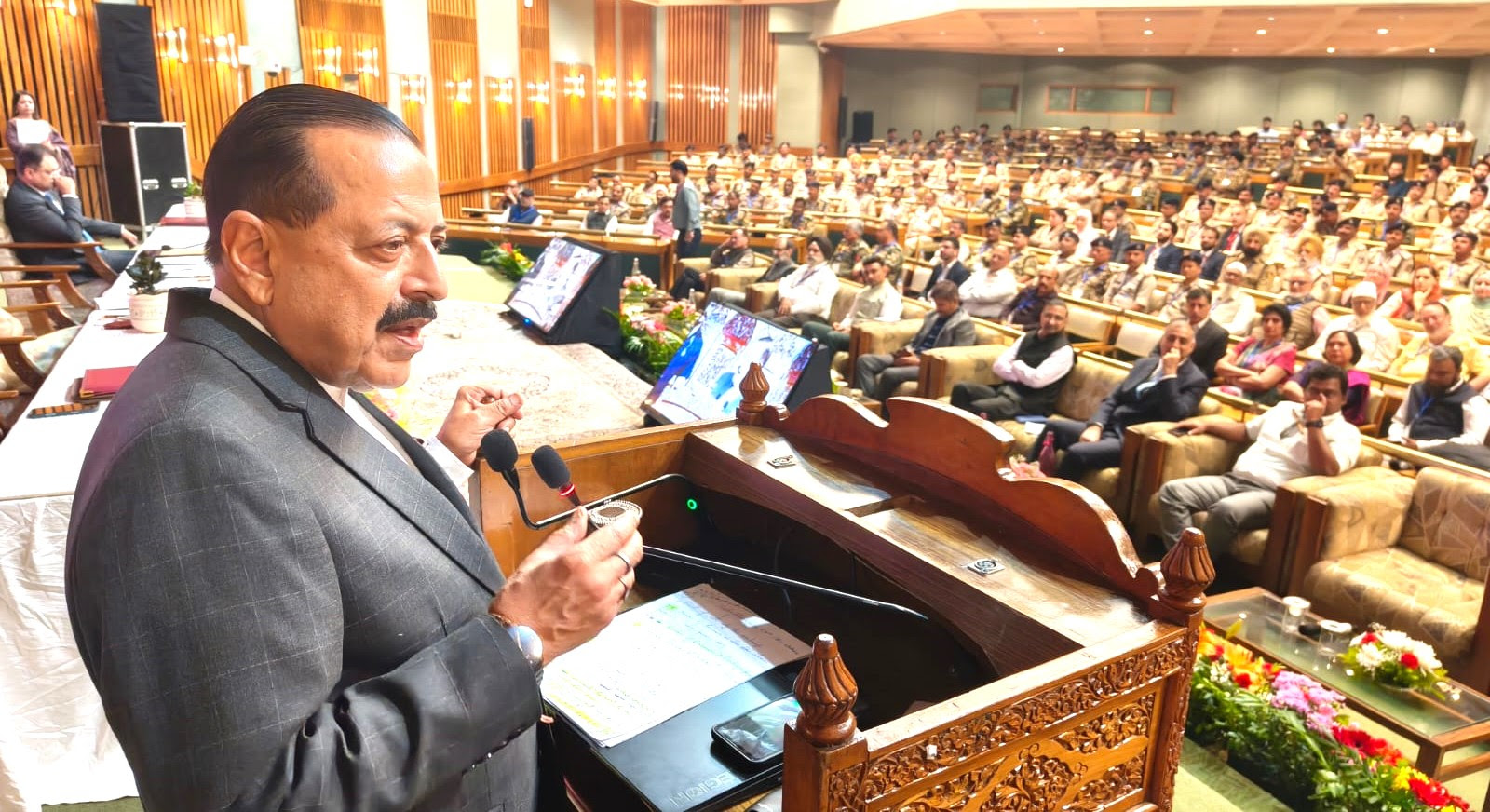
Speaking at the 59th Pre-Retirement Counselling Workshop and the 13th Bankers’ Awareness Programme organised by the Department of Pension and Pensioners’ Welfare (DoPPW) at Srinagar’s Sher-e-Kashmir International Conference Centre, Singh said the government’s approach towards pensioners had undergone a fundamental shift over the last decade.
Rather than viewing pension administration merely as a mechanism for processing retirement benefits, the government now treats pensioners’ welfare, dignity and ease of living as central policy objectives, he said.
“The focus today is not only on issuing pension payment orders but on ensuring dignity, convenience, social security and quality of life for pensioners and senior citizens,” Singh said.
The minister said Jammu and Kashmir’s transition from a state to a Union Territory resulted in a significant expansion in the number of central government employees and pensioners within the region.
While the transition initially created administrative challenges and increased workloads for service-delivery institutions, those difficulties were gradually resolved through coordination between government departments, banks and pensioners’ organisations, he said.
Singh particularly praised the role played by Jammu and Kashmir’s pensioners’ associations, saying they had helped identify implementation challenges and offered practical solutions during the transition period.
“Their engagement has helped ensure that pension reforms are effectively reaching employees and pensioners across Jammu and Kashmir,” he said.
The workshop was attended by Department of Pension and Pensioners’ Welfare Secretary Nivedita Shukla Verma, Chief Secretary Atal Dulloo, J&K Bank Managing Director and Chief Executive Officer Amitava Chatterjee, Joint Secretary (Pension) Dhrubajyoti Sengupta and senior officials from government departments and banking institutions.
During the event, DoPPW and J&K Bank launched a collaborative initiative aimed at expanding pension-related services and improving accessibility for retirees throughout Jammu and Kashmir.
Officials said the partnership is expected to strengthen service delivery systems and improve outreach in remote areas.
Singh highlighted the government’s digital transformation agenda as a major factor behind improvements in pension administration.
He cited the Bhavishya platform as a key reform that has enabled end-to-end digitisation of pension processing and reduced dependence on paperwork.
The integration of Pension Payment Orders with DigiLocker has further improved accessibility by allowing retirees to securely access pension documents online, he said.
Among the most significant reforms, Singh highlighted the introduction of Digital Life Certificates using facial authentication technology.
The initiative allows pensioners to submit life certificates from their homes using mobile phones, eliminating the need for physical visits to banks and government offices.
According to the minister, the nationwide Digital Life Certificate campaign conducted in November 2025 recorded unprecedented participation.
More than 1.91 crore digital life certificates were generated during the campaign, including over 1.16 crore through face-authentication technology, he said.
The figures reflect increasing acceptance of digital governance among senior citizens and demonstrate the growing reach of technology-enabled public services, Singh added.
He also cited improvements in grievance redressal systems through CPENGRAMS, National Pension Adalats and thematic review mechanisms designed to resolve pension-related complaints more efficiently.
Reforms involving family pensions, additional pension benefits and provisions for families of missing employees have strengthened the social security framework available to retirees and their dependents, he said.
Singh further highlighted the government’s efforts to preserve institutional knowledge through the Anubhav platform, which encourages retiring employees to document experiences, innovations and best practices accumulated during their careers.
The repository serves as a knowledge base for future generations of public servants while recognising the continued contribution of retirees, he said.
The minister welcomed the launch of the Anubhav Scheme 2026, aimed at recognising outstanding contributions by retiring government employees.
He said increasing life expectancy and improvements in quality of life have resulted in a growing pensioner population, making it important to view retirement not as the end of public service but as a transition into another phase of contribution to society.
“Retiring employees possess enormous experience, expertise and institutional knowledge. Their role remains important even after retirement,” Singh said.
He said pre-retirement counselling programmes are intended not only to familiarise employees with pension procedures and retirement benefits but also to prepare them for meaningful and productive post-retirement lives.
Calling upon retirees to remain engaged in nation-building, Singh said senior citizens have an important role to play in India’s ambition of becoming a developed nation by 2047.
“Every citizen has a role in the making of Viksit Bharat. Pensioners and senior citizens, with their wisdom and experience, remain important partners in that journey,” he said.