
Kashmir Impulse Desk
Srinagar, Nov 5
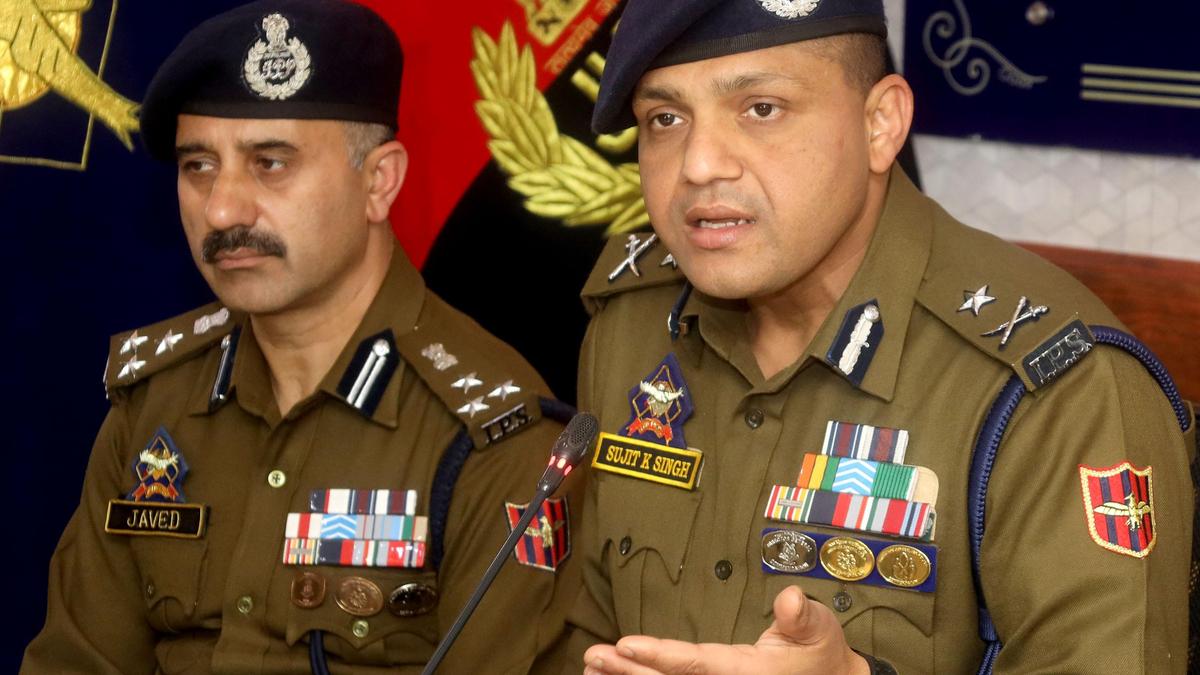
Only one local militant is currently active in Kashmir, supported by a small number of foreign militants, Inspector General of Police (IGP), Kashmir Zone, Sujit Kumar said on Thursday, warning that Srinagar continues to receive security threat inputs.
Kumar identified the local terrorist as Muhammad Lateef Bhat, a resident of Kulgam, who police allege was involved in two attacks earlier this year — one in Anantnag in which a police official was killed and another in Kulgam that left two migrant workers from Chhattisgarh dead.
“There is certainly one local terrorist, supported by a few foreign terrorists. We have some footprints, but giving a fixed number of active terrorists would be an exaggeration because they are constantly moving from one place to another,” Kumar told reporters.
He said there was no official data available on infiltration during the current year, adding that security forces were tracking the group on the basis of intelligence inputs.
Referring to recent encounters in Budgam district, the IGP said the militants killed in two separate operations were operating in upper reaches.
The terrain connects with the Pir Panjal range and Kishtwar and has remained a focus of joint operations involving the Army, Jammu and Kashmir Police and Central Armed Police Forces.
Kumar said sustained domination of high-altitude areas had helped security forces conduct successful operations.
On the technological capabilities of militants, he said security agencies were monitoring the devices and equipment being used by them but declined to disclose operational details.
“Whatever technology they are using is on our radar. We have devised a mechanism and will not allow their nefarious designs to succeed,” he said.
The IGP also reviewed security arrangements along the National Highway, saying a mechanism had been put in place following a terror attack and that further adjustments would be discussed with other agencies.
“In Srinagar we get inputs, which is why extra measures have been put in place. Still, we recover IEDs around the National Highway — threats are there,” he said.
He said any decision on restrictions would require consultations with other agencies.
The remarks come amid the implementation of the winter security strategy. Earlier this week, Kumar reviewed the Srinagar city security grid and arrangements along the Jhelum corridor, directing officers to improve coordination and operational preparedness.
Police officials said the security framework remained focused on intelligence-based operations, area domination and coordination among agencies to counter threats and protect public spaces and important routes.
Kumar also said police had registered more than 1500 cases under the Narcotic Drugs and Psychotropic Substances (NDPS) Act in Kashmir this year, arrested 1941 people and attached properties worth Rs 154 crore as part of an intensified crackdown on drug trafficking.
Addressing a separate part of the news conference at the Police Control Room in Srinagar, he said authorities had seized 1711 kg of contraband, recovered more than Rs 10 lakh in cash and frozen 567 bank accounts linked to narcotics-related activities.
Illicit cultivation spread over 2116 kanals had also been destroyed during enforcement operations, he said.
Kumar identified drug trafficking, cyber fraud and dangerous driving as major challenges affecting young people in the Valley.
He said the crackdown was intended not only to disrupt trafficking networks but also to prevent young people from becoming involved in criminal activities.
“The purpose of sharing these figures is to show that our teams are working on the ground. But enforcement alone is not enough. We want our youth to play a constructive role in society, and the entire Kashmir Police team stands ready to help them,” he said.
The IGP urged people struggling with drug addiction to approach police stations for assistance, assuring them that their identities would be protected.
“Those who are fighting drug addiction and want to come out of it can approach any police station. We will protect their identity and help them in their recovery,” he said.
He said the Police Drug Rehabilitation Centre was providing treatment at minimal cost, with patients required to bear only expenses relating to food and medicines, where applicable.
Kumar also alleged that proceeds from narcotics trafficking were being channelled into militant networks, including their overground workers.
“The kingpins, whether operating here or across the border, distribute earnings from narcotics to their overground workers. This is true, although it is difficult to specify the exact volume of money involved,” he said.
He said drugs entering Kashmir originated both from across the border and other states, with investigations identifying multiple supply routes.
Referring to a major drug network recently uncovered in downtown Srinagar, Kumar said investigators were tracing its wider connections, including links outside Jammu and Kashmir.
Police teams had been sent to Chandigarh and other states to identify those involved in the network, which had reportedly resulted in recoveries worth around Rs 7 crore and several arrests.
“The SSP has sent teams not only to Chandigarh but also to other states where the racket has links. The investigation is being pursued at a larger level, and the entire forward and backward network will come to light,” he said.
Kumar also expressed concern over the involvement of local youth in cybercrime, saying investigations had exposed cases in which people based in Kashmir were operating fraudulent networks targeting victims both within and outside the region.
Citing a case detected in Ganderbal, he said investigators had uncovered a cyber fraud operation with alleged Chinese links that was being run by a Srinagar-based youth.
“Some of our own young people are sitting here and cheating their own people. This is wrong, and they must stay away from such activities,” he said.
Police had received 12,385 cybercrime complaints involving more than Rs 54 crore during the current year, Kumar said.
Of the amount involved, Rs 7.48 crore had been recovered, while additional funds had been frozen or placed under lien in bank accounts pending legal procedures.
“We have recovered around 13 to 14 per cent of the amount involved. A substantial portion of the remaining money is under lien or frozen, while some could not be traced or blocked,” he said.
A total of 93 FIRs had been registered in connection with cyber fraud complaints, including seven cases involving mule accounts used to facilitate fraudulent financial transactions.
Kumar urged people to report cyber fraud immediately through the national cybercrime helpline 1930, saying prompt reporting could help authorities freeze suspicious transactions and improve the chances of recovering money.